Get Full Government Meeting Transcripts, Videos, & Alerts Forever!
Get email alerts on the Tenant Rights topic
No spam. Unsubscribe anytime.
House hearing pits tenants’ transparency push against landlords’ concerns over costs and timing
Summary
HB 304 would extend the time tenants have to correct move‑out deficiencies to 48 hours, bar reinspection fees and require landlords to provide an estimated deduction if a tenant declines to correct defects. Student groups and tenant advocates backed the bill; landlord groups warned estimates are infeasible and the change would delay turnovers and impose costs. Committee recorded broad questioning and rebuttals; no committee vote on the bill is recorded in this session.
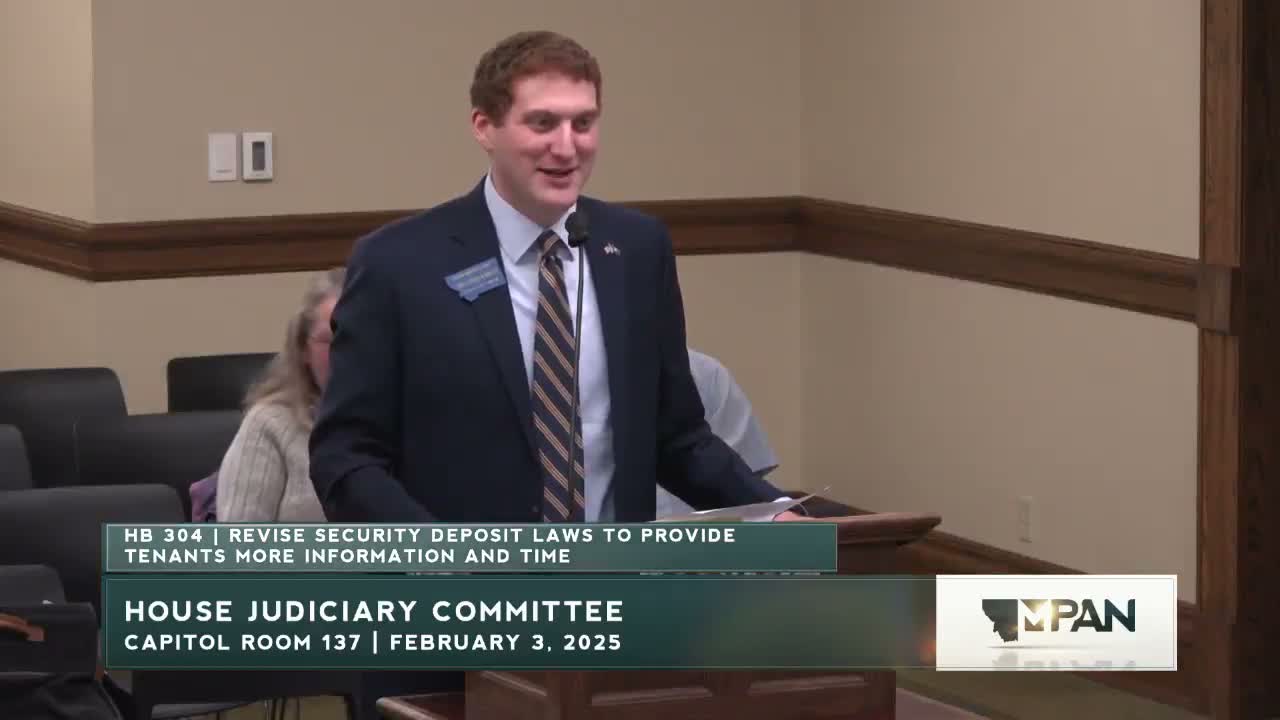
Representative Jonathan Karlen opened the House Judiciary hearing on House Bill 304 saying the bill aims to give renters more transparent information about potential security‑deposit deductions and more time to correct minor defects after a move‑out inspection.
Karlen showed committee materials he said illustrated property managers producing extremely detailed move‑out checklists (an example described in testimony was 44 pages). The sponsor summarized three changes in the bill: extend the tenant correction period from 24 to 48 hours, prohibit reinspection fees for tenants who exercise their right to correct, and require landlords to provide a reasonable estimate of the cost the landlord would charge if the tenant declines to remedy the identified issues.
Proponents — including student government representatives, the Montana Public Interest Research Group and other tenant advocates — argued the changes would protect students and low‑income renters from unexpected deductions and give tenants a realistic choice about whether to pay for cleaning, hire help, or accept deductions.
Opponents, including the Montana Landlord Association and many individual landlords and property managers, argued the bill is unnecessary and would impose administrative burdens and financial losses. Witnesses said tenants already receive multiple notices (including a 30‑day move‑out inspection) and that producing quick cost estimates for repair or cleaning within 24–48 hours would often be impossible. Some small landlords said a 48‑hour delay could block scheduled move‑ins and cost rent.
Committee members asked detailed operational questions: whether estimates are feasible for significant damage, how corporate managers differ from mom‑and‑pop landlords, and whether the bill should target large property managers rather than apply broadly. The sponsor said the bill is a transparency measure that leaves ultimate recovery amounts unchanged and that estimates need not be exact, only a reasonable approximation to help tenants make decisions.
The hearing record closes with the committee moving into executive action but contains extended questioning and rebuttal and no committee vote on HB 304 recorded in this session.
What comes next: The hearing closed and the committee recessed for executive action. Any formal motion or amendment would be recorded at the executive action stage.