Get Full Government Meeting Transcripts, Videos, & Alerts Forever!
Get email alerts on the Immigration Enforcement topic
No spam. Unsubscribe anytime.
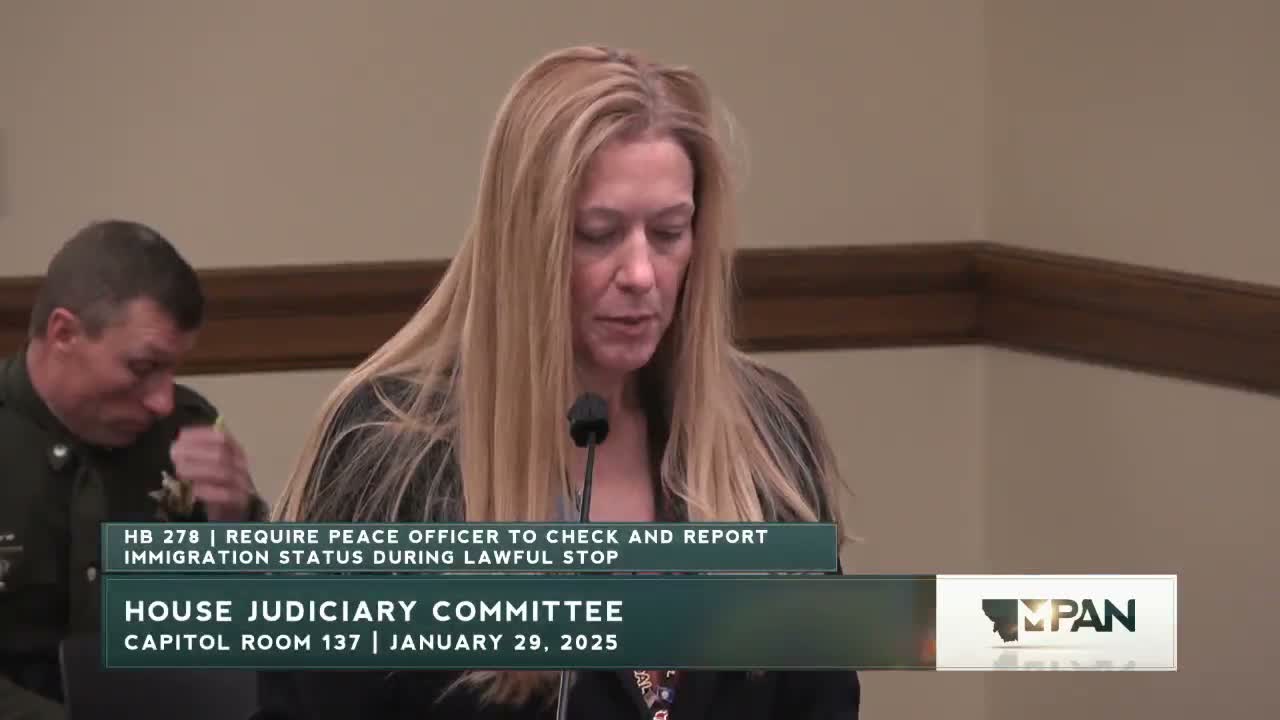
Heated hearing on bill that would require peace officers to check and report immigration status
Summary
Supporters, including the highway patrol, said HB 278 would help find trafficking victims and protect officers; tribal leaders, police associations and civil-rights witnesses warned the 'shall' language risks profiling, Fourth Amendment conflicts and operational burdens — many urged changing 'shall' to 'may'.
Representative Nickel opened House Bill 278 by describing a ride-along with the highway patrol and by saying the bill would let peace officers make a reasonable attempt, when practicable, to determine a stopped person’s immigration status and report that information to a federal immigration agency. He framed the bill as a tool to address human trafficking, cartel activity and officer safety.
Lieutenant Colonel Kyle Hayter of the Montana Highway Patrol testified in support, saying MHP wants clarity so troopers are not ‘‘tied by litigation’’ when pursuing suspected cross-border criminal activity. Anna Schlemelinen, a private witness, said the bill targets lawful driver stops and verification tasks rather than encouraging stops based on appearance.
Opponents included Patrick Kawaki, who spoke for several tribes and warned HB 278 risks wrongful detention and trauma for American Indian communities; he said recent federal immigration activity in some tribal areas raised concerns. The Montana League of Cities and Towns, Association of Montana Troopers, Montana Police Protective Association and the Montana Sheriffs and Peace Officers Association all testified in opposition, stressing constitutional concerns, practical burdens, and the impact of the bill’s “shall” requirement.
Legal and operational objections focused on two linked points: (1) the bill’s use of ‘‘shall’’ to require officers to make a reasonable attempt when practicable could create liability and operational pressure to perform immigration checks in every stop; and (2) officers currently may pursue immigration questions when they have reasonable suspicion, but courts and settlement agreements (the transcript referenced Reyes Royas Diaz v. Butler) and departmental policies complicate how those checks are handled. Witnesses argued changing the first ‘‘shall’’ to ‘‘may’’ would preserve discretion, reduce litigation risk and allow local agencies to adopt policies and trainings to implement checks responsibly.
Witnesses described implementation limits: Highway Patrol witnesses said there is no single master database officers can reliably query in seconds; checks often require contacting federal partners or dispatch and can take minutes to hours depending on circumstances and connectivity. Witnesses gave operational estimates (one example: up to 30–45 minutes in some follow-ups) and warned that mandatory documentation of ‘‘reasonable attempts’’ on every stop would create burdens and risk discriminatory implementation absent clear standards and training.
Committee members repeatedly asked whether the bill would permit detaining someone solely for an immigration query; witnesses said detention beyond what is justified by the original stop would raise Fourth Amendment concerns and that reporting requirements do not, by themselves, create a new statutory arrest authority. Law-enforcement witnesses and associations urged amendments (particularly replacing ‘‘shall’’ with ‘‘may’’) and additional clarifying language such as tying any permissive check to ‘‘reasonable suspicion.’’ The sponsor said he would talk with stakeholders about amendments.
What happens next: the committee closed the hearing; members indicated a likely path of amendments and further negotiation, notably on the ‘‘shall’’ v. ‘‘may’’ language and on clarifying reasonable-suspicion standards and documentation requirements. The committee did not record executive action on HB 278 in this session.