Get Full Government Meeting Transcripts, Videos, & Alerts Forever!
Get email alerts on the Jury Selection topic
No spam. Unsubscribe anytime.
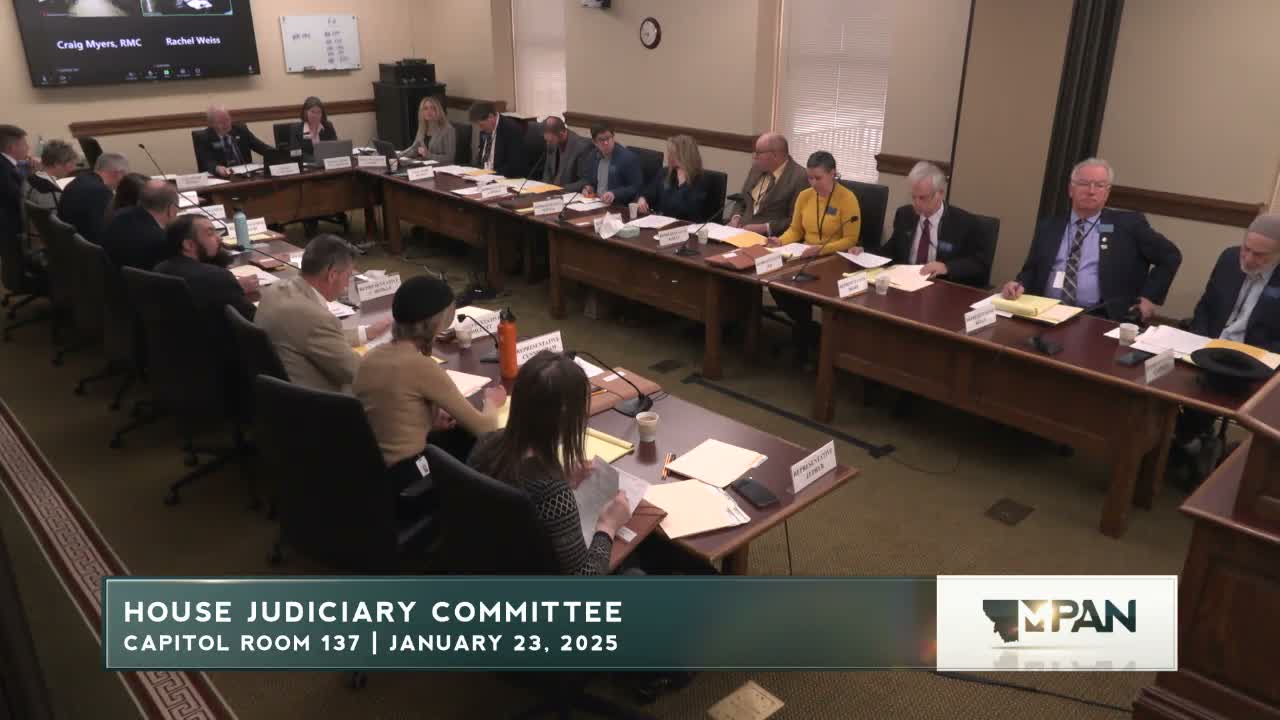
House Judiciary hears bill to modernize Montana jury notice and summons process
Summary
Proponents including clerks, sheriffs and the attorney general told the House Judiciary Committee that House Bill 194 would modernize jury notices and reduce burdens on sheriffs and clerks; the public defender raised concerns the language could eliminate remedies when statutes are not substantially complied with.
Representative Amy Regier, sponsor of House Bill 194, opened the House Judiciary hearing by saying the bill would "modernize Montana's jury notification and summons process, reduce unnecessary burdens on Montana's justice system, and promote efficiency in government." Proponents from county clerks, sheriff's offices and the attorney general's office described long-standing operational difficulties under the existing statutes.
Amy McGhee, Clerk of District Court in Missoula, told the committee Missoula draws about 16,500 names for its annual jury pool and runs roughly 90 panels a year, with "an average of 150 people per panel," and said current law is confusing on when questionnaires must be returned. She described the bill's core change as allowing clerks flexibility to send the qualification questionnaire either with the initial notice or with the later summons so that people only must respond when they are actually summoned.
Cynthia Neste, a clerk from Sanders County, and Undersheriff Scott Van Dyken of Cascade County said the present process imposes heavy burdens on smaller counties and on sheriff's offices. Van Dyken said deputies and school resource officers are being pulled from patrol and schools to serve thousands of notices — "we're pulling them off the streets" — and that the bill would reduce that operational strain.
Mardell Ployhar of the Attorney General's Appellate Services Bureau said the statutory scheme, as currently written and applied, has led to procedural technicalities that can be used to seek new trials long after convictions, imposing burdens on the court system and risk to the finality of convictions. Ployhar said the bill broadens the pretrial window for raising notification-related challenges and adds language requiring a defendant to demonstrate a "material departure from the statutory requirements" before a jury panel is vacated.
Claire Leto, a managing attorney at the Office of the Public Defender, said she "generally support[s] the bill" but opposed it as drafted because subsections that would bar invalidation of a jury pool for failure to "strictly adhere" to the statute risked removing a remedy when there has not been "substantial compliance," a standard from State v. Lemire (2000) she said must be preserved to protect defendants' rights. She asked the committee to amend or strike the relevant lines to preserve remedies for statutory violations that affect fairness.
Committee members pressed proponents on specifics: how many weeks before trial notices and summonses would be sent, what constitutes "reasonable efforts" by clerks or sheriffs, how public defenders with limited resources could investigate pretrial challenges within five days, and whether social media postings and phone calls should count as attempts. Proponents and AG counsel responded that counties already use mixed methods (mail, phone, postings) and that the bill is meant to reduce technical reversals while preserving constitutional claims.
The hearing closed without a committee vote on HB 194; the sponsor asked for a "do pass" recommendation and the committee proceeded to executive action on other bills later in the session.