Get Full Government Meeting Transcripts, Videos, & Alerts Forever!
Get email alerts on the Remote Appearances topic
No spam. Unsubscribe anytime.
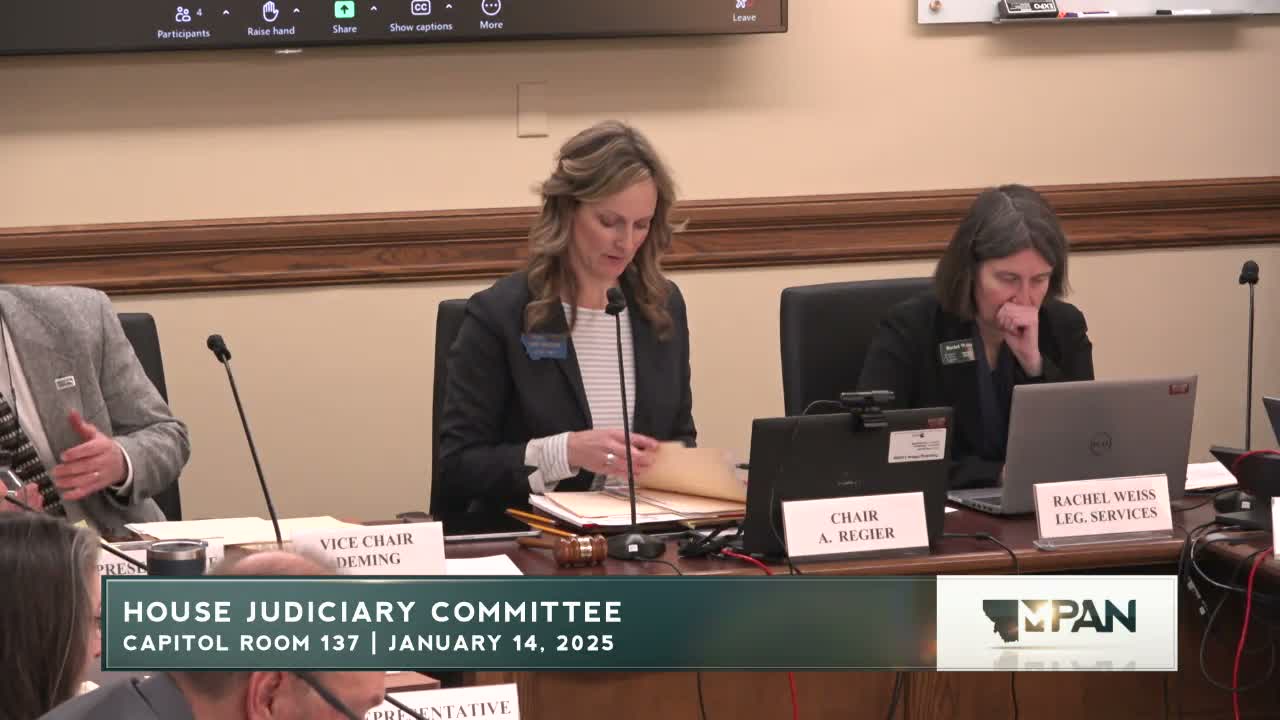
Panel debates allowing remote appearances for public defenders; magistrates warn of client contact and privacy risks
Summary
House Bill 116 would let public defenders appear remotely for routine, non‑substantive hearings to reduce travel and free attorney time. The Office of Public Defender and some advocacy groups supported the bill as an efficiency measure; the Montana Magistrates Association opposed it, citing risks to attorney‑client contact and worries about handling bond hearings remotely.
Representative Valerie Moore opened the hearing on House Bill 116, describing it as her first bill and as an effort to reduce unnecessary travel by public defenders for routine, non‑substantive hearings. Moore cited an OPD estimate that public defenders logged roughly 16,000 hours of travel in fiscal 2024 and said the fiscal note estimates savings of about $164,000 if more routine hearings were conducted remotely.
Brett Schandelson, director of the Office of State Public Defender, testified in support. He said remote appearances would let OPD use limited appropriated resources more efficiently, reduce travel costs paid to private attorneys, and free staff time for substantive legal work. Schandelson said the policy change would not replace in‑person appearances for hearings that are substantive or where the court finds good cause to require personal appearance. He described the operational savings as potentially reducing workload by roughly 1.4 FTEs-worth of work in OPD’s accounting.
Don Cape, testifying for the Coalition for Safety and Justice, supported the bill but warned that judges and some courts might be reluctant to accept remote appearances and that practical pitfalls (technology differences across courts, ensuring confidential attorney‑client meetings) must be addressed.
Rebecca Myers of the Montana Magistrates Association opposed the bill, arguing that judges already have discretion to permit remote appearances and that expanding remote defaults risks defendants not having necessary one‑on‑one time with counsel. Myers also said lower courts often lack the technical and physical infrastructure (private rooms, secure conferencing) to guarantee confidential consultations and flagged concerns about whether certain hearings—especially bond and bail settings—are truly non‑substantive.
Committee members asked a series of follow‑up questions about confidential attorney‑client conferencing during virtual hearings, platform security, logistical burdens on small municipal courts, and whether the bill would shift costs to counties for courtroom technologies. Schandelson said the judicial branch has broadly adopted Zoom and that Zoom offers private meeting (breakout) functionality; he also said the bill includes a good‑cause definition that would allow courts lacking technology to require in‑person appearances.
Members debated possible amendments, including restricting remote defaults for bond and bail hearings to uncontested matters; proponents said they would review amendment language with practitioners because operational realities sometimes make pre‑certifying cases as uncontested difficult.
Schandelson reiterated OPD’s staffing shortfall metric—44 FTEs of unmet workload in FY24—and said modest procedural changes such as allowing remote appearances for routine hearings can help make existing resources go further while the agency continues to request additional funding and FTEs in the budget process.
Sponsor Valerie Moore closed the HB 116 hearing recommending a do‑pass; the committee closed the hearing with no immediate vote and discussed scheduling executive action for a future meeting.