Get Full Government Meeting Transcripts, Videos, & Alerts Forever!
Get email alerts on the Juvenile Justice topic
No spam. Unsubscribe anytime.
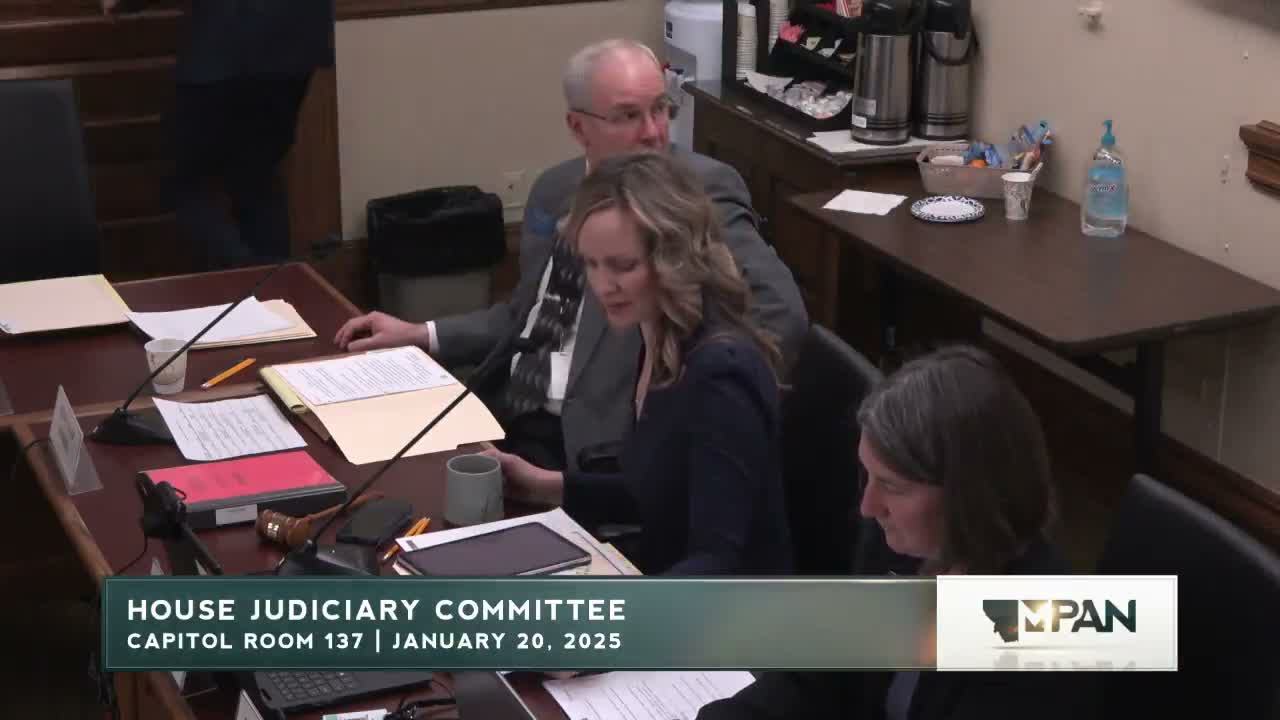
Committee hears competing views on HB 173 to restore business restitution in youth court
Summary
Supporters say HB 173 restores a 1974-era youth-court definition so businesses and governments can be restitution recipients; opponents (ACLU, policy groups) argue the change would increase burdens on low-income youth and hamper rehabilitation.
Representative Neil Durham, the sponsor of House Bill 173, told the House Judiciary Committee the bill strikes the word "natural" from the Youth Courts Act victim definition to allow businesses, governments and corporations — as well as individuals — to be listed victims entitled to restitution. "We can call the cops, we can get him caught and identified," Durham said, describing vandalism of community baseball fields he said youth court could not remedy after the change last session.
The bill drew unified opposition from civil-rights and policy groups. Henry Seaton of the ACLU of Montana said HB 173 "is duplicative of existing law and has the possibility of increasing restitution burdens for youth within our criminal legal system," arguing financial penalties harm a young person’s prospects for rehabilitation and disproportionately affect youth from reservation and low-income families. Heather O'Loughlin of the Montana Budget and Policy Center urged the committee to invest in diversion and community-based programs rather than expanding restitution authority.
Nicole Gomez, Justice Initiative Director at Catalyst Montana, cited the Judicial Branch’s Youth Court report and told members restitution frequently falls to families because juveniles lack income. "Requiring families to make restitution payments for harms done to businesses further traps these families in cycles of debt and poverty," she testified.
Tom Billetein of the Office of Court Administrator, Youth Court Services Bureau, answered committee questions about how youth courts calculate restitution and enforcement options. Billetein described existing guidance that courts consider a youth’s age, ability to pay, parental contribution, the amount of damage and other remedial options when setting restitution. He also described local "sweat equity" programs that allow youth to perform community service credited toward restitution.
Committee members pressed the sponsor and Billetein on whether removing the word "natural" would permit businesses and government entities to seek restitution and whether insurance subrogation limits restitution awards; Billetein said courts already weigh multiple factors and that a separate civil remedy can exist for property owners. The transcript records a number of statutory references cited in committee questioning; the exact MCA cross-references were spoken aloud during testimony and were not consistently transcribed, so the record does not contain a single unambiguous citation to reproduce here.
The hearing closed without a committee vote recorded in the transcript. Members signaled follow-up interest and questions about how often youth would be sanctioned for restitution-only violations and how the change would operate in practice.