Get Full Government Meeting Transcripts, Videos, & Alerts Forever!
Get email alerts on the Justice Data Warehouse topic
No spam. Unsubscribe anytime.
Committee hears continuation of justice data warehouse bill, proponents stress privacy controls and multiyear timeline
Summary
House Judiciary heard testimony on House Bill 117, which continues Senate Bill 11's effort to scale an integrated justice data warehouse. Supporters said it will break down data silos and inform policy; witnesses detailed privacy safeguards, a multi‑year rollout and a fiscal request for software, staffing and court integration.
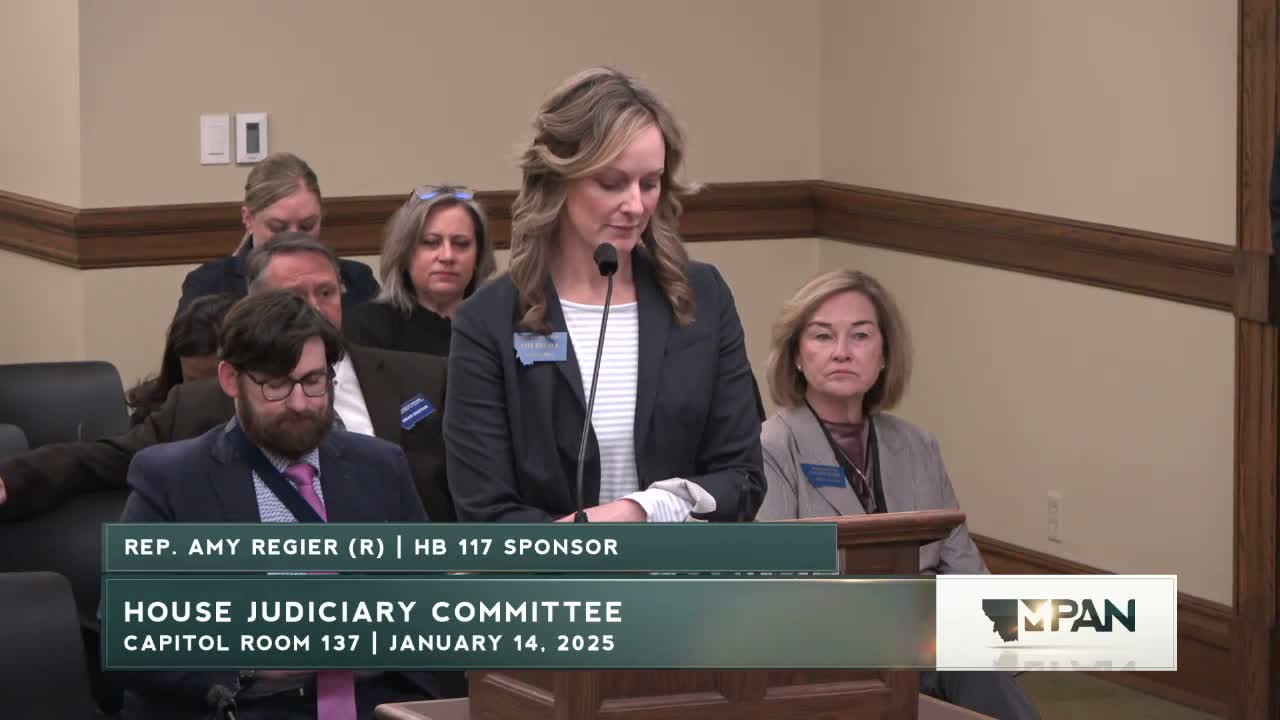
Representative Amy Regier, sponsor of House Bill 117, opened the Judiciary Committee hearing by saying the bill continues work begun in 2023’s Senate Bill 11 to create an integrated justice data warehouse overseen by the Board of Crime Control and advised by the Criminal Justice Oversight Council. She said HB 117 sets criminal justice data priorities for the 2025–26 interim and urged legislative investment to continue the effort.
Brett Schandelson, director of the Office of State Public Defender and a member of the Criminal Justice Oversight Council, told the committee SB 11 began as a pilot and that a statewide, scalable structure will likely take four to six years and sustained funding. “This is not a one‑session or even one biennium kind of project,” Schandelson said, urging a do‑pass recommendation.
Brian Gookin, director of the Department of Corrections and chair of the data warehouse working group, supported the bill and said the warehouse will reduce siloing across law enforcement, detention centers and state stakeholders and improve both policymaking and operational effectiveness.
Information witnesses from the Board of Crime Control and partner agencies described how the system will operate and the safeguards under development. Natalia Bowser, director of the Board of Crime Control, outlined the bill’s fiscal request: $480,000 in general fund for software (a data catalog and master data management tools), $504,243 for additional FTEs to handle incoming data and analysis, and roughly $500,000 for court integration effort to allow court data to be mapped into the warehouse. Bowser said some of the figures are estimates and that the project team has sought grant funding to offset costs.
Adam Carpenter, the state chief data officer, and Janice Friess, the state statistical analysis center director, explained technical and access controls. Carpenter said the warehouse will extract data only from existing justice systems and will reflect additions and deletions in those source systems (for example, expungements). He described a layered approach in which raw data is accessible to very few staff for matching and master data management; once records are matched they are anonymized and published in aggregated datasets for policy queries. “Legislators and policy analysts will not get John Smith did this,” Carpenter said; they will receive aggregated outcomes and percentages.
Committee members pressed witnesses on privacy, the possibility that ordinary citizens could be included, and who can access raw records. Witnesses said the system is limited to records created by justice system interactions and that traffic citations generally are excluded; access will be governed by MOUs and legal authorities, and only authorized stakeholders will have access to non‑anonymized data. Janice Friess said, at present, only two people would have access to raw, unanonymized data in the system: herself and the data warehouse architect, and both have criminal justice information system training.
Representative questions also covered tribal participation and pilot scope. Bowser said initial SB11 pilots did not include tribal courts or tribal law enforcement, and that separate engagement and agreements are needed to include tribal data. Witnesses said the current biennium funding focuses on four pilot counties and state stakeholders, with the intent to build a model that can scale.
Witnesses acknowledged the technical complexity of integrating dozens of disparate local systems and vendors. Bowser said a significant share of local law enforcement agencies use a small number of vendors, which informed vendor choices for early extraction work; the approach emphasizes extracting and mapping existing operational data rather than forcing new local systems.
Sponsor Regier closed the HB 117 hearing by urging committee support for continued work to break down data silos and provide policymakers with better empirical evidence.
The committee took no final action on HB 117 at the hearing.