Get Full Government Meeting Transcripts, Videos, & Alerts Forever!
Get email alerts on the Judicial Standards Commission topic
No spam. Unsubscribe anytime.
Sponsor seeks to move Judicial Standards Commission to Department of Justice to reduce perceived conflicts
Summary
House Bill 35 would administratively attach the Judicial Standards Commission to the Department of Justice while preserving the commission—s independent investigatory role; sponsor and the court administrator discussed staffing (0.25 FTE) and a small investigative budget (about $50,000).
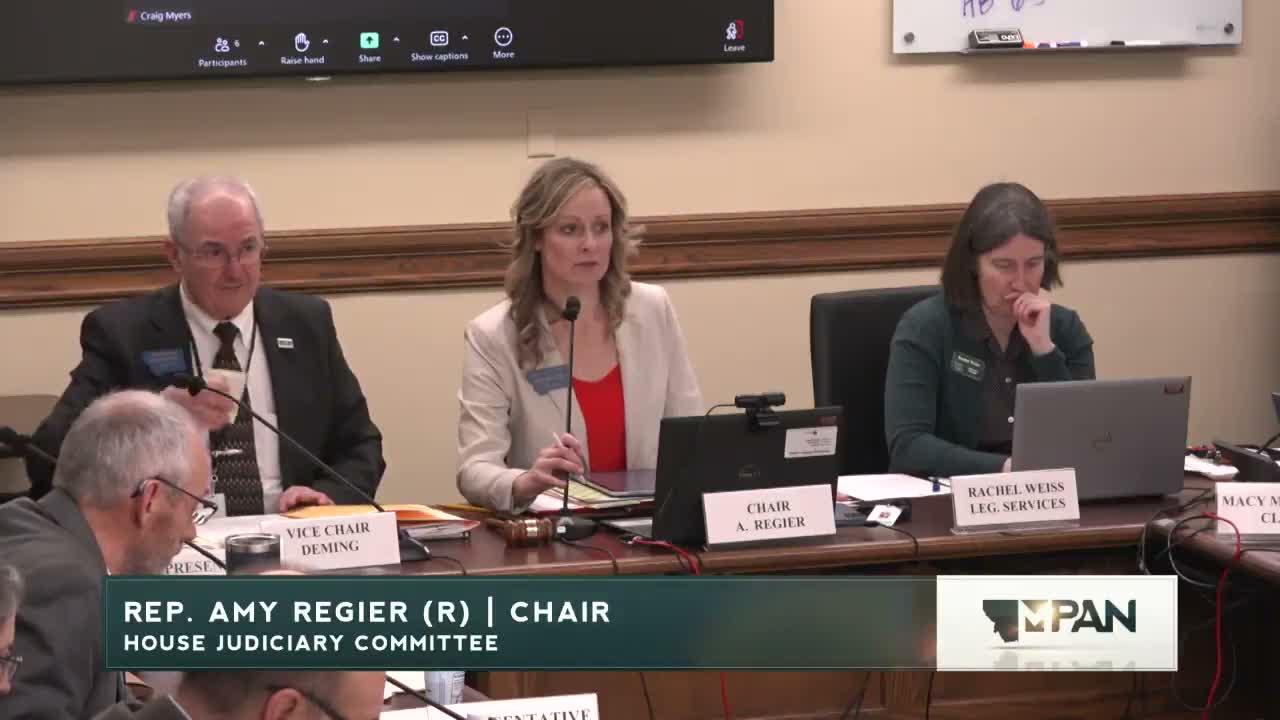
House Bill 35 was introduced to the House Judiciary Committee as a measure to administratively move the Judicial Standards Commission (JSC) out of the Judicial Branch and place it under the Department of Justice. The sponsor told the committee the change is intended to reduce the appearance that judges or lawyers serving on the commission are supervised by the Supreme Court or the state bar.
The sponsor summarized the commission—s purpose: to investigate complaints of judicial misconduct, preserve public confidence in the judiciary and recommend discipline to the Montana Supreme Court. "It moves the Judicial Standards Commission away from the Judicial Branch and administratively attaches it to the Department of Justice," the sponsor said in opening remarks. The sponsor argued the bill would not increase Department of Justice burdens and would keep the commission—s investigatory functions intact.
Dave McAlpin, court administrator for the Judicial Branch, provided informational testimony about how the JSC operates today. McAlpin said the commission is supported by roughly 0.25 full-time-equivalent staff who handle intake and agendas and that the commission maintains a small budget to hire outside investigators when necessary. He said the JSC issues reports to the Clerk of the House and that investigation results and basic case information are available on the branch—s website.
Committee members pressed the sponsor and McAlpin on concrete examples of "judicial interference," whether the 0.25 FTE administrator could have contact with justices and whether moving the commission to the attorney general or to the Department of Administration would avoid perceived conflicts. The sponsor said alternatives had been considered and that the bill intentionally preserves an independence requirement: the JSC "shall exercise its functions independently of the Department of Justice and without approval or control of the department." The sponsor also said a roughly $50,000 budget item would move with the commission to cover investigative contracting if needed and that the commission could hire its own personnel at its discretion.
Committee members asked about statutory and procedural protections for hearings the JSC holds. McAlpin pointed to JSC rules (Rule 15(c)) and the Montana Rules of Evidence as governing how hearings are conducted, and he described a "Chinese wall" between his office and the secretary who handles complaint intake.
The sponsor closed by urging members to support the bill, saying the goal is to sustain public confidence in the judiciary by minimizing perceptions of undue influence. The hearing was closed without a committee vote recorded in the transcript.