Get Full Government Meeting Transcripts, Videos, & Alerts Forever!
Get email alerts on the Ldsis Appropriations Roundup topic
No spam. Unsubscribe anytime.
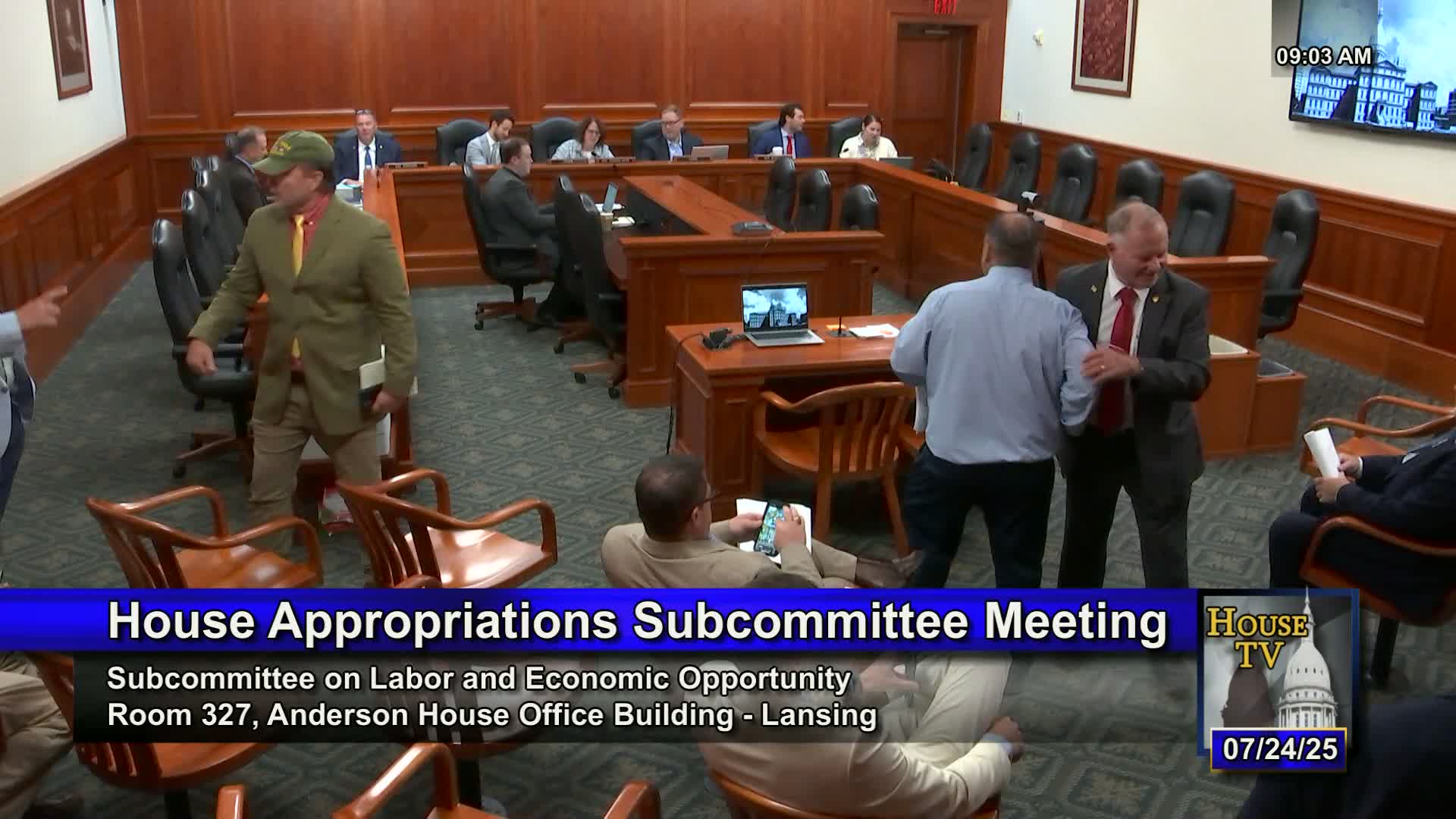
House Appropriations Subcommittee Hears Wide Range of LDSI Requests for Water, Sewer, Flood and Safety Projects
Summary
At a day-long Michigan House Appropriations Subcommittee hearing, local officials pitched dozens of legislatively directed spending requests — including $15 million for Owosso nitrification towers, $9.2 million for Portland wastewater upgrades and $10 million toward rebuilding dams damaged in the 2020 Midland floods. No votes were taken.
LANSING — The House Appropriations Subcommittee on Labor and Economic Opportunity spent a full session taking testimony on dozens of local infrastructure requests tied to legislatively directed spending, with officials from small towns, counties and authorities seeking state help for looming public‑health and safety risks.
The largest single request came from Rep. Begole for the City of Owosso, which is asking for $15 million to replace three nitrification towers at the city’s wastewater treatment facility. “If they fail, it’s gonna put 6,000,000 gallons of sewage into the river,” Rep. Begole told the subcommittee, warning that the system is strained and that local ratepayers face an estimated 108% bill increase without state assistance.
Why it matters: committee members repeatedly framed the hearing around avoiding environmental damage and steep local rate increases. Across the room, presenters tied sewer and water projects to river health, tourism and local economies — arguments that surfaced in requests from Port Huron, Portland, Erie Township and several northern and rural communities.
Other major requests and details
- Portland: City leaders requested $9.2 million to finish shovel‑ready wastewater plant enhancements ($4.1M), install three aging lift stations ($1.5M) and complete sewer‑line work ($3.6M). Andrew Jemczyk, Portland’s city manager, said bids came back “well over expected” and the project is necessary to avoid steep rate spikes and preserve water‑trail and recreation resources.
- Midland / 4 Lakes Task Force: Rep. Schutte described two linked asks totaling $20 million — $10 million to rebuild dams that failed during the May 2020 floods and $10 million for broader flood‑reduction work. He emphasized the 2020 disaster’s damage to homes and infrastructure and urged state help to limit special assessments on flood victims.
- Lake Mitchell Sewer Authority: Rep. Fox sought $5 million to fix failing pumps and other parts of a system serving more than 800 users; testimony showed monthly user fees have risen sharply and that EGLE (Michigan’s environmental agency) has imposed deadlines on improvements.
- Other notable projects: a $6.5 million request from Port Huron to rebuild a Tainter flood gate and armor the Black River Canal; $1.9 million for Carcullen Township storm‑sewer remediation; a $1.7 million completion request for Mancelona’s stalled 2021 water/sewer extension; and requests for park infrastructure, pools and fire‑suppression wells in communities without municipal water.
What presenters said about funding sources and phasing
Local representatives and city officials told the committee many projects have already sought federal, county or grant funding (ARRA/ARPA funds, MEDC grants, USDA loans, Clean Water SRF) but remain short due to higher bids or limited program eligibility. Several speakers said parts of projects were funded earlier and returned to the state for reallocation when a previous fiscal agent could not use the money as intended (for example, the Treetops Resort project previously allocated to the City of Gaylord).
On timelines, presenters generally described near‑term work to address urgent components (pump or tower replacements) followed by phased construction for broader upgrades. Portland officials said some work was designed and shovel‑ready but bids exceeded local capacity; Springfield Township said a program of 10 emergency wells could be finished by 2026 if funded.
Agency and compliance context
Multiple presenters referenced EGLE compliance timelines for failing systems. The committee pressed for clarity on whether requested funds would be used for capital work (construction and equipment) rather than loan repayment or ongoing administrative costs; presenters repeatedly said money would be applied to infrastructure itself, with local governments or authorities covering maintenance and operations.
Quotes that capture the hearing’s tone
“If they fail, it’s gonna put 6,000,000 gallons of sewage into the river,” Rep. Begole said of Owosso’s nitrification towers.
“Bids came back and they were well over expected,” Portland’s Andrew Jemczyk said, explaining the city’s need for supplemental state assistance to complete previously designed work.
“We are under administrative consent order due to high flows,” a Bronson official said, describing the health‑protective role of replacing an aging UV disinfection unit.
Next steps and outcome
The subcommittee heard all testimony but took no formal votes during the session. Committee members asked questions about prior funding, alternative financing (loans and SRF programs) and phasing; no appropriation decisions were made at the hearing and presenters were sent back for further budget consideration. Chair Jenkins adjourned the meeting with the committee’s next steps and any rollups to be decided in the budget process.
Speakers and attributions
Quoted speakers and principal presenters in this article are drawn from subcommittee testimony, including Rep. Begole (Owosso), Andrew Jemczyk (City of Portland), Rep. Schutte (Midland), Rep. Fox (Lake Mitchell), Matt Covey (Springfield Township Fire Chief) and other municipal officials who presented project details to the committee.
Funding requests documented at the hearing are subject to the usual appropriations process; this article reports on testimony and figures provided to the committee during the hearing and does not infer approvals or final allocations.