Get Full Government Meeting Transcripts, Videos, & Alerts Forever!
Get email alerts on the Business Court Jurisdiction topic
No spam. Unsubscribe anytime.
Judges tell committee HB 4840 would clarify business‑court jurisdiction for shareholder and LLC disputes
Summary
Judges and business‑court advocates said House Bill 4840 would ensure shareholder and LLC 'oppression' disputes go to Michigan business courts even when the company is not named, and would keep post‑judgment enforcement in the business court to preserve expertise and consistency.
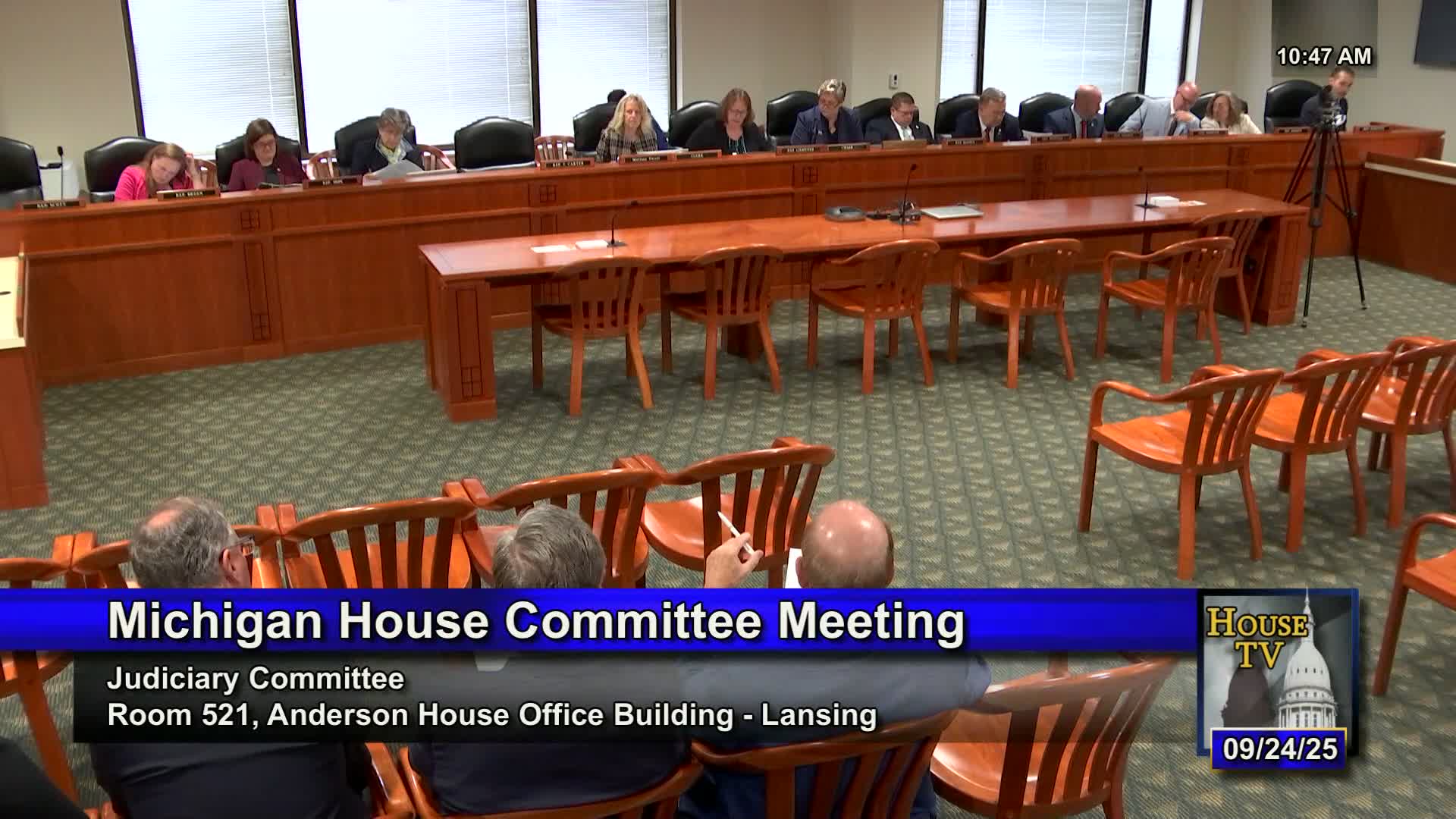
Judges and business‑court practitioners told the House Judiciary Committee that House Bill 4840 would resolve ambiguity in current law about whether internal disputes among owners of privately held corporations and LLCs belong in Michigan business courts when the company itself is not named as a party.
"A shareholder dispute is a business dispute," one judicial witness said during testimony supporting the bill, arguing that the business court system was created to provide consistency and specialized expertise. Witnesses described situations where courts of general jurisdiction have taken cases that business‑court judges believe belong in the business docket, producing inconsistent results across circuits.
Presenters said the proposed amendments would (1) clarify that disputes among members or shareholders should be assigned to business courts regardless of whether the company is named as a party, and (2) confirm that post‑judgment enforcement proceedings should remain in the business court that adjudicated the original matter. One witness referenced the Business Corporation Act and the LLC Act and cited business court statute section 8033 in explaining the statutory framework.
Committee members asked about automatic assignment, opt‑out procedures, venue and travel burdens for litigants. Presenters said the statute already provides chief‑judge review to move cases from the business docket to general jurisdiction in appropriate circumstances, parties can use forum‑selection clauses in contracts, and many circuits that have business dockets also have judges who handle general civil cases to limit travel burdens. Witnesses estimated 16–17 circuits have a designated business docket but emphasized judges often carry both calendars.
Presenters characterized HB 4840 as a "clarifying" and largely non‑controversial fix intended to improve efficiency and ensure expertise in complex commercial disputes; the committee did not take an immediate vote on the bill.