Get Full Government Meeting Transcripts, Videos, & Alerts Forever!
Get email alerts on the Cpl Reciprocity topic
No spam. Unsubscribe anytime.
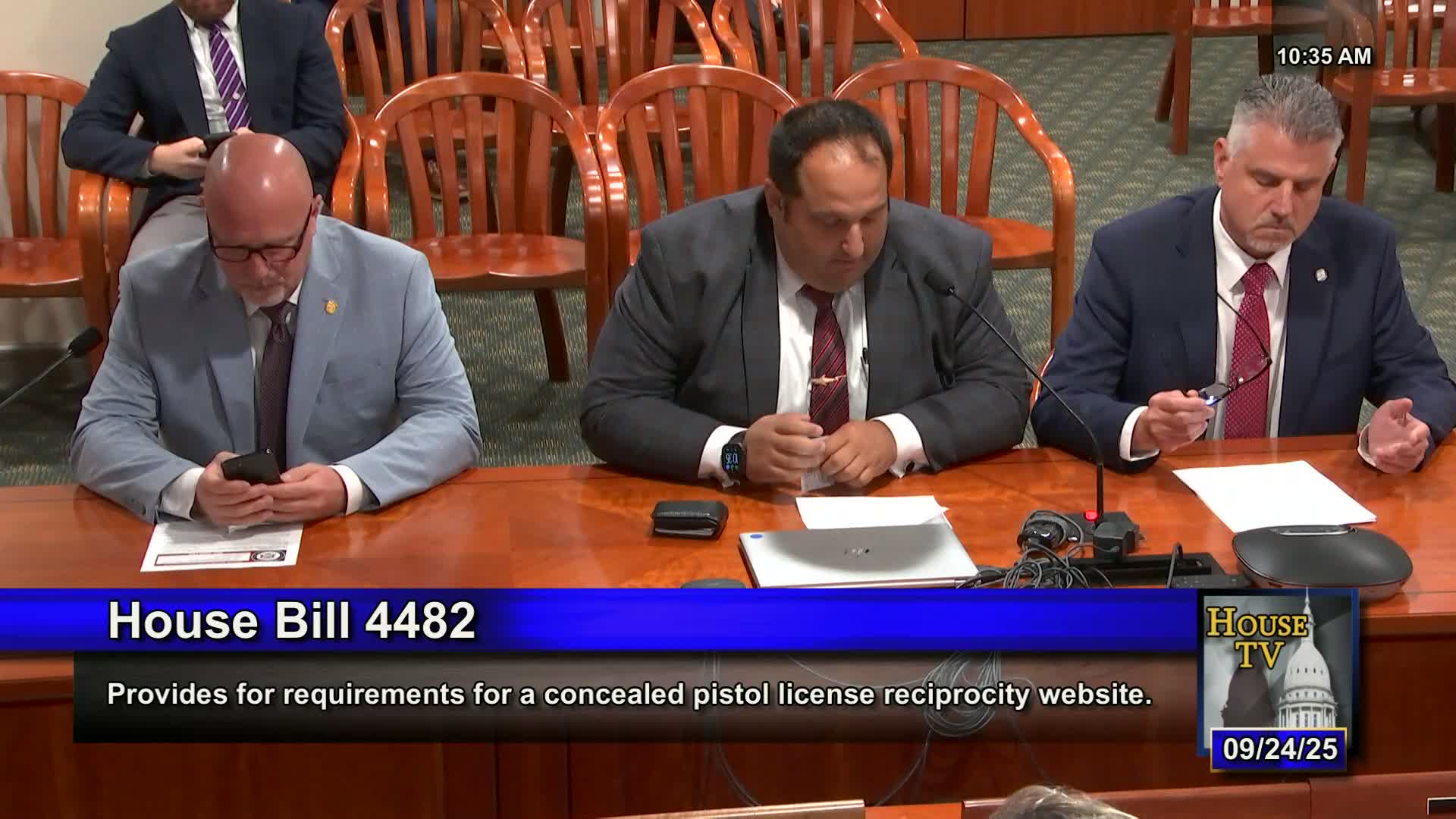
Committee hears bills to create attorney‑general CPL travel website and require QR code on licenses
Summary
Lawmakers and sponsors told the House Judiciary Committee that a package of bills (HB 4481–4483) would establish an attorney‑general maintained website updated every 60 days and add a QR code to concealed pistol licenses to help Michigan CPL holders follow other states' laws when traveling.
Representatives and sponsors told the House Judiciary Committee that a package of bills—House Bill 4481, HB 4482 and HB 4483—aims to help concealed pistol license (CPL) holders avoid unintentional violations when they travel out of state.
"House bill 4481 creates a website that the attorney general will maintain," the sponsor said during the committee presentation. Under the package, HB 4482 would require that website be updated every 60 days; HB 4483 would add a QR code on the CPL that links to the site.
Sponsors framed the bills as practical steps to reduce confusion as CPL holders cross state lines. One sponsor said anecdotal cases illustrate the risk: a traveler whose flight was rerouted was reportedly arrested after landing in a jurisdiction without the reciprocal protections the traveler had anticipated. Another sponsor argued the state has a responsibility to provide accurate legal guidance because it regulates CPLs.
Committee members asked whether the attorney general could simply link to an existing national database rather than build a state site. Sponsors responded that the core concern is update frequency and legal accuracy; as they put it, "we want to make sure this isn't going, you know, 6 months, a year out, and it's not being updated," so assigning responsibility to the attorney general would provide higher confidence in legal interpretation and timeliness. Sponsors also said the QR code would allow travelers to access the information in real time while moving across jurisdictions.
Representative Harris asked about liability if a state changes its law shortly before a traveler is stopped; sponsors said the committee could address protections for the state or clarify the duty of the CPL holder in administrative rule or statutory language, but emphasized the bill is intended primarily as a public‑facing reference tool. During discussion committee members estimated reciprocity in the 'about 39' to '40 plus' states range.
Chair Lightner read into the record one written opposition: Brian Darless, representing Paladin Academy, submitted testimony opposing HB 4481–4483 and did not wish to speak.
The committee did not take a final vote on HB 4481–4483 during this hearing; sponsors said they would continue work to refine details including liability language and update procedures.