Get Full Government Meeting Transcripts, Videos, & Alerts Forever!
Get email alerts on the Tribal Jurisdiction And Benefits topic
No spam. Unsubscribe anytime.
Tribal leaders and legal scholars brief Judiciary Committee on tribal courts and tribal general welfare benefits
Summary
Chairwoman Dory Rios and MSU law professor Winona Single told the committee that statutory clarity is needed to protect tribal general welfare benefits and explained tribal court structures, jurisdictional limits, restorative justice practices and recent expansions of tribal criminal jurisdiction.
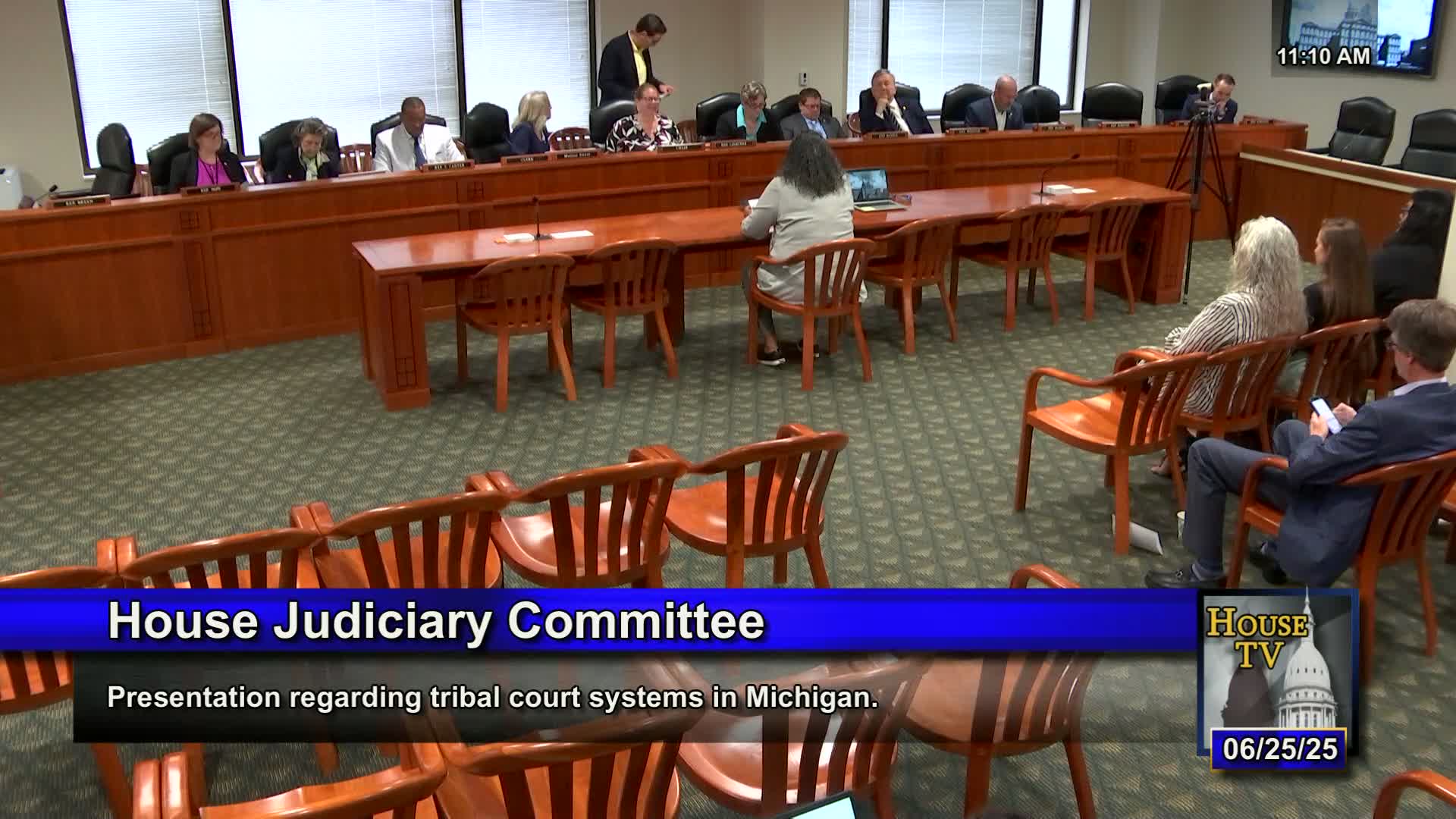
The House Judiciary Committee heard two presentations on tribal governance and justice systems that asked lawmakers to provide statutory clarity for tribal general welfare benefits and highlighted the role of tribal courts in Michigan.
Dory Rios, chairwoman for the Nottawasipihiran Band of Potawatomi, urged the committee to adopt a statute clarifying how the state treats tribal general welfare benefits so tribal members are not forced to choose between tribal support and state assistance. Rios said tribal general welfare programs — such as housing assistance, elder care, educational stipends and cultural preservation programming — "are not income and they are not compensation" but expressions of tribal sovereignty; she cited 26 U.S.C. §139E as federal recognition of the status of such programs.
Winona Single, an associate professor at Michigan State University College of Law and director of the Indigenous Law and Policy Center, outlined Michigan’s 12 federally recognized tribes’ tribal court systems, explained criminal and civil jurisdictional limits (including Supreme Court precedents such as Oliphant v. Suquamish noted in testimony), and described restorative‑justice and specialty courts such as Healing to Wellness courts. Single said four Michigan tribes had met the conditions to exercise expanded criminal jurisdiction as of 2023 and described ongoing tribal‑state judicial collaboration that includes recognition of tribal court judgments under Michigan court rule 2.615.
Committee members asked practical questions about whether tribal courts employ grand juries, who acts as tribal legal officers, and whether tribes operate specialty courts for veterans; presenters replied that structures and titles vary by tribe, many tribes maintain legal teams and tribal prosecutors, and specialty healing courts exist though specific veterans courts were not confirmed.
Presenters asked the committee to continue discussions and collaborate with the governor’s office, DHHS and tribal partners on statutory language to avoid state‑level misclassification of tribal benefits.