Get Full Government Meeting Transcripts, Videos, & Alerts Forever!
Get email alerts on the Criminal Justice topic
No spam. Unsubscribe anytime.
House Judiciary hears law‑enforcement testimony backing tougher penalties for fleeing and eluding
Summary
Lawmakers heard harrowing dash‑cam and body‑cam video and law‑enforcement testimony in support of House Bills 4690 and 4691, which would add tiered mandatory minimums for high‑speed fleeing and eluding; members requested county‑level prosecution and sentencing data before advancing policy.
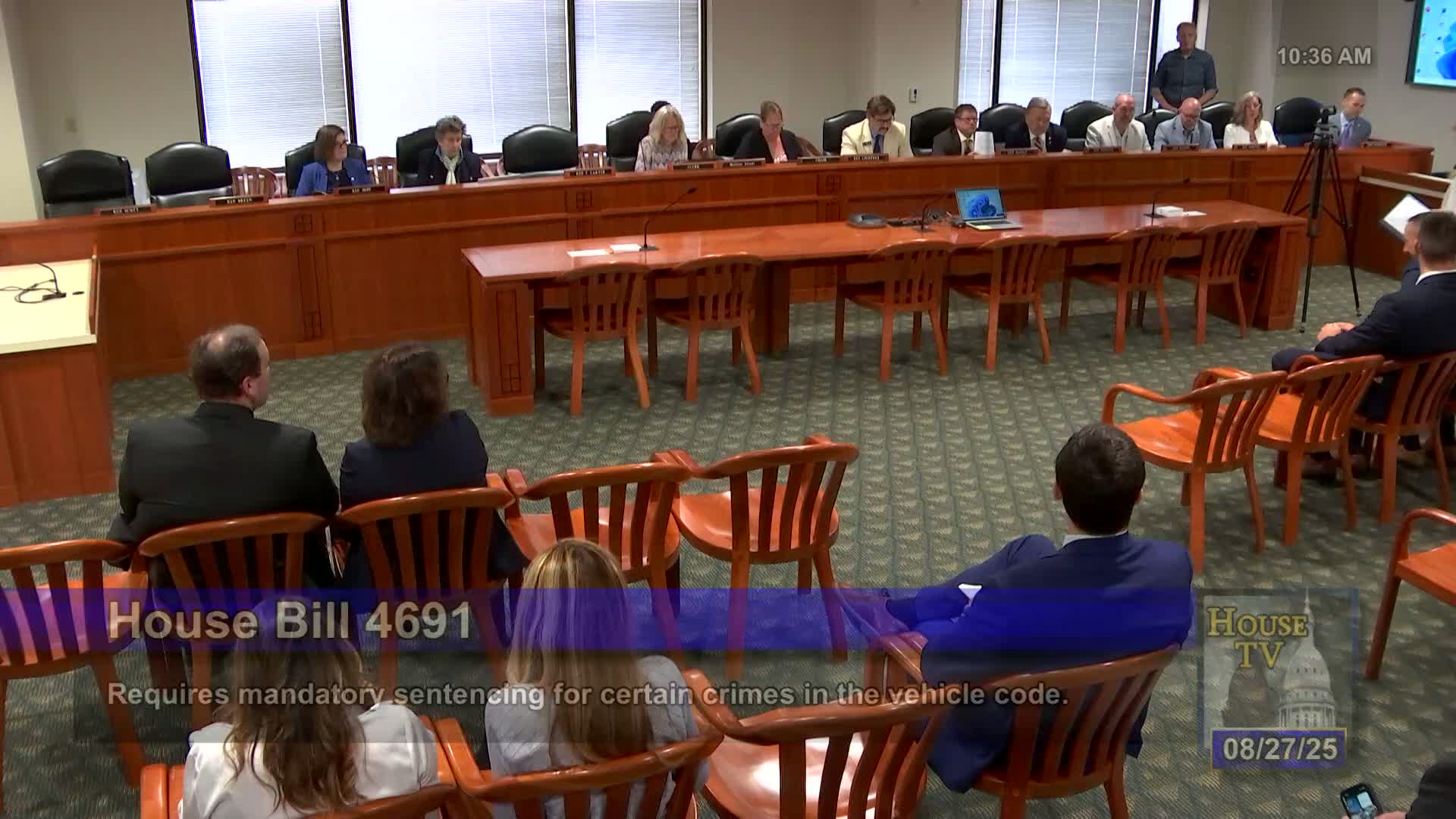
Chair Sherry Leitner convened the House Judiciary Committee to hear testimony on House Bills 4690 and 4691, proposals that would create tiered mandatory minimum sentences for reckless high‑speed attempts to evade law enforcement.
A proponent who identified themselves for the record and several law‑enforcement witnesses played dash‑cam and body‑worn camera videos showing high‑speed pursuits and serious crashes. The testimony described a case in which officers attempted to stop a stolen vehicle and said the suspect died in the crash while an innocent 62‑year‑old motorist was left with lifelong injuries. Witnesses said officers who respond to those scenes suffer lasting trauma.
Deputy Police Chief Archie Hamilton of Wyandotte (identified in the record) and other law‑enforcement supporters told the committee they have observed an increase in pursuits and argued that inconsistent local policies — including some agencies’ restrictive no‑pursuit directives — plus what they described as light sentences for fleeing offenders contribute to repeat behavior. Several members of the committee echoed support for officers and public safety but asked for more evidence before changing sentencing law.
Representative Reen asked for comparative data and questioned a cited statistic that more than 85% of convicted fleeing defendants serve jail time; witnesses countered that published percentages may conflate fleeing with other offenses, and that fleeing alone often does not lead to prison in some counties, particularly Wayne County. Representative Mueller, who described personal experience as an officer, argued that sentencing has been inconsistent across counties and that state minimums can create uniform accountability.
Committee members requested a county‑level breakdown showing how many fleeing cases were charged, adjudicated, and resulted in jail or prison time. Several legislators said they were moved by the videos but were cautious about statutory mandatory minimums because those penalties can reduce judicial discretion. The chair said staff would collect the requested data over the next weeks to inform further discussions.
The hearing included read‑in witness positions both for and against the bills; the record notes support from police organizations and written opposition from several community groups.
Next steps: lawmakers asked staff to compile prosecution and sentencing data across counties and to provide comparisons with other states before considering formal action on the bills.