Get Full Government Meeting Transcripts, Videos, & Alerts Forever!
Get email alerts on the Ai Policy Hb4668 topic
No spam. Unsubscribe anytime.
Experts urge developer‑focused AI safeguards in testimony on HB4668
Summary
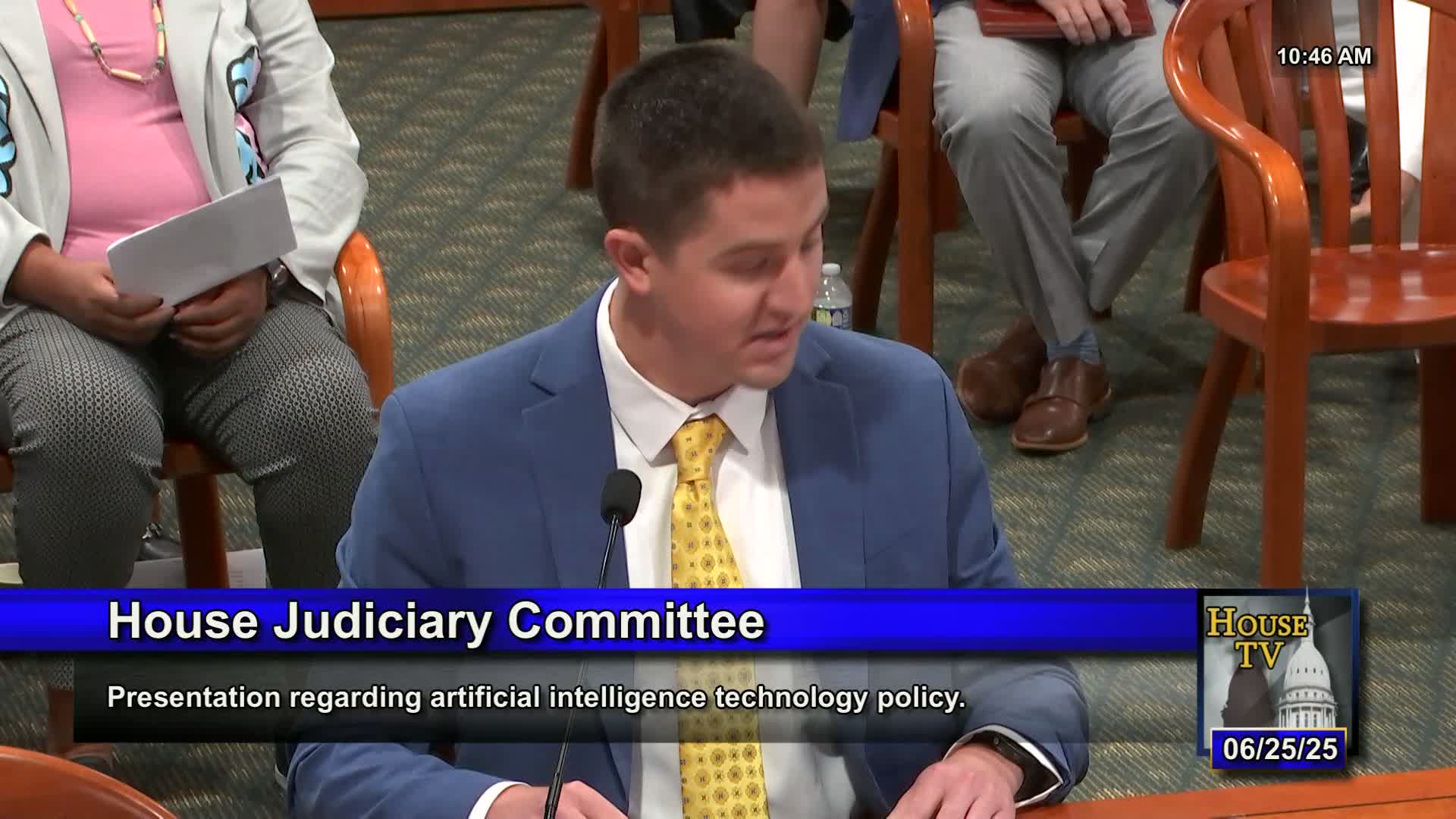
Testifiers told the House Judiciary Committee that HB4668 would require large AI developers to publish and follow safety and security protocols, submit quarterly reports, use independent third‑party audits and provide whistleblower protections; witnesses said the bill targets only the largest developers.
Policy and security experts told the House Judiciary Committee on Feb. 20 that House Bill 4668 would impose a light‑touch, developer‑focused regulatory framework on the largest AI model builders.
Andrew Dorris of the Secure AI Project, testifying in support, summarized the bill as requiring large developers (those spending more than $100 million annually on foundational models and more than $5 million on a single model) to create and publish safety and security protocols, provide quarterly reports about tests and outcomes, and submit to independent third‑party audits to confirm compliance. "We think AI has enormous potential to advance science and education and healthcare," Dorris said, but added the bill aims to guard against "critical harms" that he described as events causing over 100 casualties or more than $1,000,000,000 in economic damages.
Daniel Croth of the Center for AI Risk Management and Alignment (testifying as a researcher and nonresident fellow) outlined categories of AI risk — misuse by bad actors, over‑trust and deployment in consequential settings, and model capabilities that can be unpredictable — and emphasized Michigan’s industrial and agricultural exposure to cyber and biotech risks. Croth said the bill's narrower, developer‑focused approach differs from some state proposals that would define or regulate ‘frontier’ models by technical parameters; instead HB4668 ties obligations to firms’ development spending and published safety commitments.
During committee questioning, members asked how the bill would remain flexible as technology evolves, who would pay auditors, how enforcement would work, and whether federal action could preempt state rules. Witnesses said auditors would be paid by the companies being audited, the attorney general could seek civil fines (discretionary up to $1,000,000 depending on severity), and the bill avoids rigid technical definitions so firms can adapt protocols as risks change.
No vote was taken on HB4668 during the session; the committee concluded presentation and questioning and moved on to other agenda items.