Get Full Government Meeting Transcripts, Videos, & Alerts Forever!
Get email alerts on the Criminal Justice Data Access topic
No spam. Unsubscribe anytime.
Wayne State dean urges law to let researchers link juvenile diversion data
Summary
Supporters told the House Judiciary Committee that House Bill 4396 would let approved researchers access and link currently inaccessible juvenile-diversion and related criminal-justice records under contract or MOU, enabling aggregate analyses of program effectiveness while stripping identifiers for privacy.
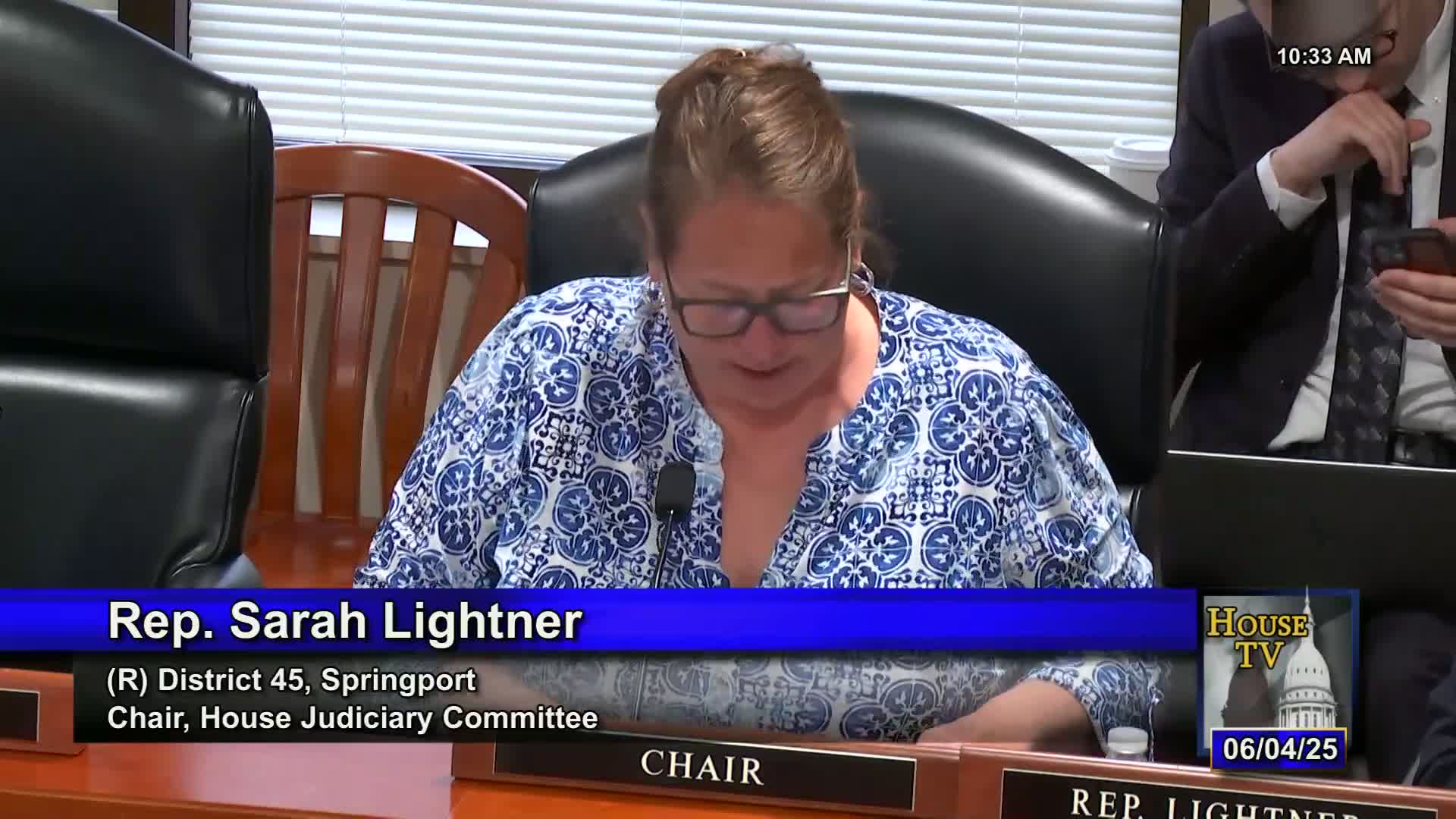
Representative Leitner introduced House Bill 4396 and called Dr. Kubiak, dean of the School of Social Work at Wayne State University, to testify in support. Dr. Kubiak told the committee that data needed to evaluate juvenile diversion and other criminal-justice interventions are currently "legally inaccessible." She said the bill would enable data sharing under contract or a memorandum of understanding so researchers can link records across systems and then remove identifiers to analyze outcomes in the aggregate.
"The data on what youth have been diverted from the system is inaccessible," Dr. Kubiak said, adding that linking records sometimes requires limited personal identifiers so analysts can determine whether records across court, child welfare and program data refer to the same person. She said once records are linked, identifiers would be stripped and researchers would analyze group- or county-level outcomes such as recidivism and program effectiveness.
Leitner told the committee the lack of accessible data has long hindered lawmakers' ability to measure whether policy changes reduce recidivism or improve community safety and that she expects to take the bill up for a vote next week. Support for the proposal was recorded from the State Bar (Nathan Triplett), the Michigan League for Public Policy and the Michigan Center for Youth Justice; those organizations were read into the record and did not testify.
The bill's proponents framed the measure as narrow and procedural: it would create a legal pathway for qualified researchers to receive identifiable data for the limited purpose of linking records, subject to contractual protections, and then to produce de-identified, aggregate analyses for policymakers. Speakers emphasized safeguards: the measure does not change broad privacy laws and proponents said identifiers would be removed before public reporting.
The committee did not take questions from members after Dr. Kubiak's testimony. Representative Leitner said members should anticipate further action next week.
The hearing record does not include text of a final drafting or specific MOU requirements; those implementation details would be decided in subsequent work on the bill.