Get Full Government Meeting Transcripts, Videos, & Alerts Forever!
Get email alerts on the Law Enforcement Funding Staffing topic
No spam. Unsubscribe anytime.
Michigan Sheriffs Association urges more training, jail reimbursements and mental‑health capacity
Summary
The Michigan Sheriffs Association told the House Judiciary Committee it needs help with recruitment, higher jail reimbursements, more state mental‑health beds and updated training standards; deputies and sheriffs detailed programs that reduce recidivism and help victims.
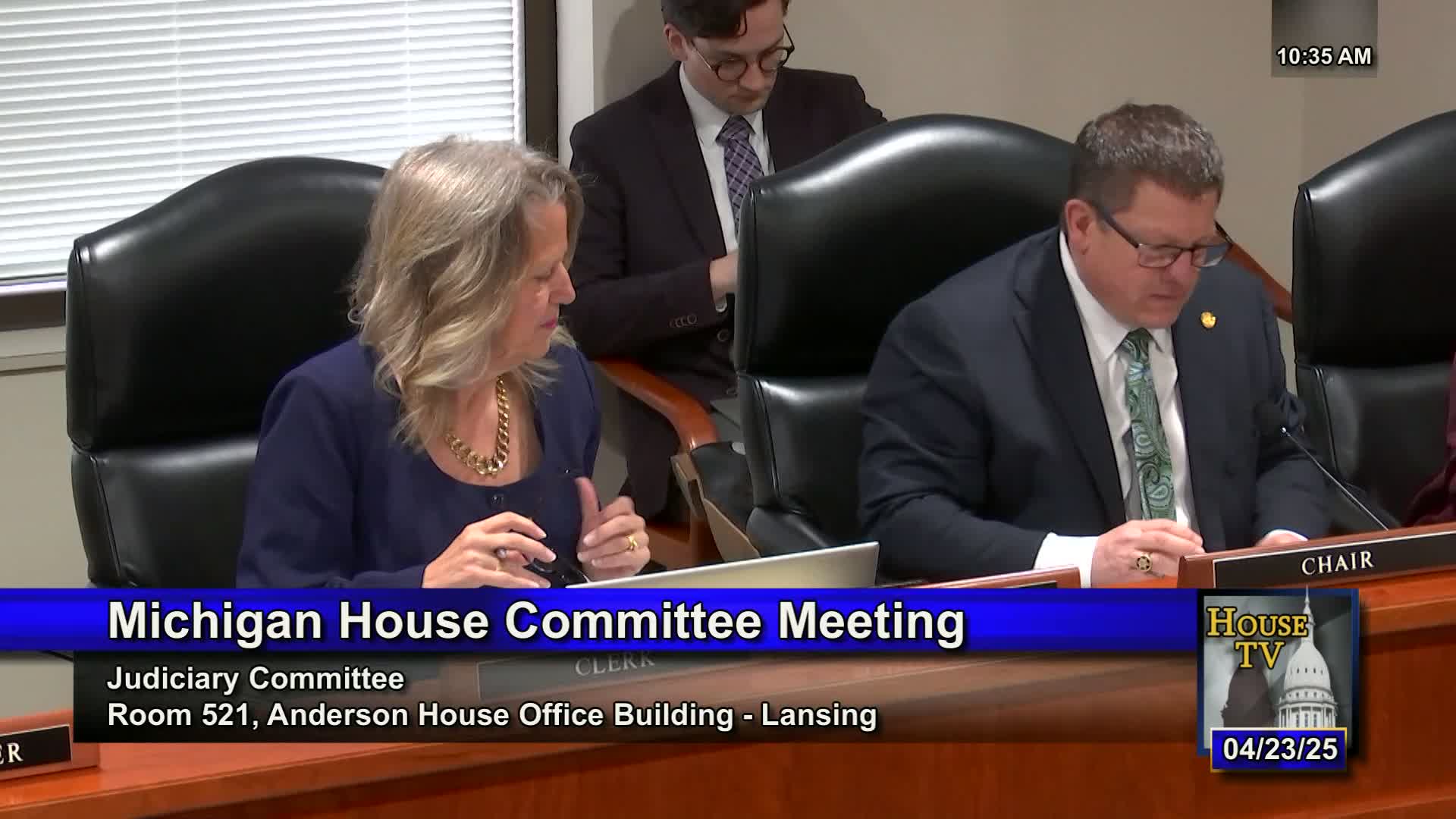
The House Judiciary Committee heard an informational presentation from the Michigan Sheriffs Association on funding, staffing and policy priorities intended to strengthen county law‑enforcement operations.
Matt Saxton, executive director of the Michigan Sheriffs Association, told the committee the association represents Michigan’s 83 elected sheriffs and “approximately 10,000 public safety professionals” who deliver services ranging from patrol and jails to court security and dispatch. Saxton described MSA as a 501(c)(3) organization that provides specialized training, victim‑services volunteer support funded in part by a DHHS grant and technical assistance to sheriffs.
Saxton said MSA’s victim‑services unit is largely volunteer based and receives an $85,000 annual grant from the Michigan Department of Health and Human Services to support volunteer training. “We are such a strong believer of that program; with or without the grant, we will continue to provide needed training,” Saxton said.
Sheriff Michael Poulan of Muskegon County, identified in the transcript as MSA president, described recruitment and retention as the association’s top operational challenge and highlighted tuition‑reimbursement support tied to MCOLES continuing professional education credits as a key recruitment tool. “Every one of us knows that the most important issue in law enforcement right now… is recruitment and retention,” said Dan Fonas, deputy director of MSA.
Fonas outlined eight legislative priorities the association will pursue this year. They include a retiree‑reemployment fix to remove a 1,000‑hour limit that prevents some retired law‑enforcement personnel from returning to work; a proposed experience/licensure requirement for candidates for sheriff; full reimbursement when the Michigan Department of Corrections delays accepting sentenced inmates; and increased per‑diem reimbursement to counties that house MDOC parole violators (the current $35‑per‑day reimbursement was set in 1988, while Fonas said it costs some counties about $165 a day to house an inmate).
“We are seeking an additional $5” to increase existing local reimbursement tiers—currently described in the presentation as $45, $60 and $70 per day—Fonas said, acknowledging a typo on the slide. He also urged a statutory fix to allow officers to transport an adult and a juvenile arrested together in the same vehicle for processing (with required sight‑and‑sound separation after booking) and requested an extension of the period for transferring first‑degree murder convicts to MDOC from 45 to 90 days in cases where MDOC processing delays prolong county custody.
Sheriff Troy Goodnough of Monroe County described local corrections programs—medication‑assisted treatment, peer support, GED classes, clinician coverage and an upcoming family services unit—and said the county has seen a measurable drop in recidivism tied to those investments. “Individuals suffering from serious mental‑health illness, we’ve had a 37 percent reduction in recidivism rate,” Goodnough said.
Committee members asked whether the DHHS victim‑services grant is at risk from pending DHHS budget cuts and for feedback on recent firearm laws and extreme‑risk protection orders (ERPOs). Saxton said he does not believe the victim‑services grant would be affected by proposed cuts but noted that administering the $85,000 grant can be resource‑intensive. On ERPOs, Saxton said law enforcement has used the tool frequently and that “about 81.5% of the time that an ERPO has been issued, it has been requested by law enforcement,” adding the association has not seen systematic abuse to date.
Representative discussion also focused on mental‑health capacity. Saxton and the sheriffs linked increased jail populations to the closure of state mental‑health beds and urged more state or diversion capacity to avoid holding individuals in jails who need treatment rather than incarceration. Sheriff Poulan described local crisis‑intervention teams and embedded mental‑health workers as partial mitigations but said the state needs more dedicated beds to move people out of jails and into treatment.
The committee offered thanks to the presenters; Representative Wozniak moved to excuse absent members and the chair closed the meeting. The transcript records the motion but does not include a recorded roll‑call vote on that specific motion.
The presentation put staffing and reimbursement at the center of MSA’s near‑term legislative agenda and highlighted county‑level programs aimed at reducing recidivism and improving victim services. The association asked the legislature for statutory changes and funding adjustments that it says are needed to sustain county law‑enforcement operations and improve community outcomes.