Get Full Government Meeting Transcripts, Videos, & Alerts Forever!
Get email alerts on the Juvenile Indigent Defense topic
No spam. Unsubscribe anytime.
House Judiciary Committee reports bill to extend indigent-defense standards to juvenile courts
Summary
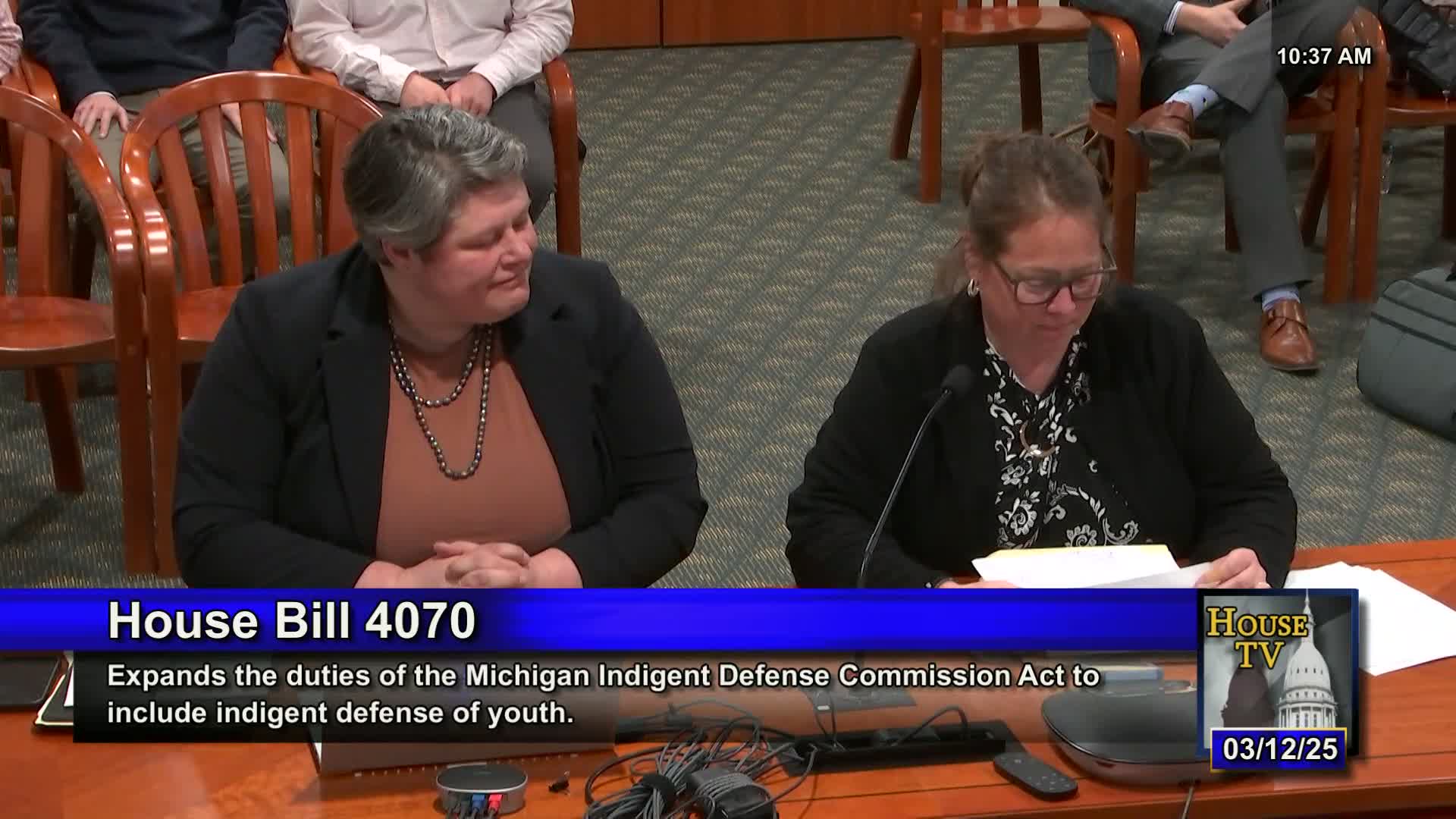
The House Judiciary Committee voted 11-0 to report House Bill 4070, a reintroduction that would extend Michigan's indigent-defense standards and resources to juvenile court practice; witnesses from the Michigan Indigent Defense Commission and the State Appellate Defender Office described standards, data and budget priorities to support the expansion.
The House Judiciary Committee on [date not specified] voted 11-0 to report House Bill 4,070, a measure that would extend statutory standards, training and funding used in adult public defense to juvenile court representation.
Sponsor Chair Lightner described the bill as "a reintroduction from last term" that would "bring parity to the system with a juvenile system and the adult system for indigent defense" and would add a juvenile expert to the Michigan Indigent Defense Commission (MIDC).
Kristin Staley, executive director of the Michigan Indigent Defense Commission, told the committee MIDC was created by the Michigan Indigent Defense Commission Act and now oversees nine adopted standards based on American Bar Association recommendations. "We have a standard that requires attorneys to be part of all critical stages, including first appearance in court," Staley said, and described new rules to cap attorney workloads and require case-appropriate qualifications.
Staley said MIDC funds local systems through state grants, a statutorily defined local share that she described as "hover[ing] around $338,000,000 or so dollars each year," and some attorney-fee reimbursements. She said MIDC's grants have funded new positions such as investigators, mitigation specialists and social workers and that data collection shows improved outcomes: MIDC reported roughly 295,000 people were represented by counsel at first appearance last year (about 86% of arraignments) and cited national research that being represented at first appearance doubles the chance of release without bail and reduces pretrial detention.
"Training is really the best bang for your buck," Staley told the committee, describing federally funded trial-skill programs, partnerships with law schools and a youth-defense federal grant that supports the MIDC's proposed expansion into juvenile work.
Madeline ("Mari") David, Acting Director of the State Appellate Defender Office (SADO), described SADO's appellate role and juvenile-lifer and reentry units. SADO said it represented about 3,200 people annually on appeal and that its work saved the state an estimated $19,000,000 in corrections costs in 2024 by correcting sentencing errors. On juvenile-lifer work, SADO reported reducing approximately 2,473 years in prison and estimated about $94,000,000 in corrections savings since its unit launched.
David outlined four budget priorities tied to appellate and youth-defense work: implementing SADO workload standards, seeking a current-service baseline for salary parity, converting two grant-funded mitigation positions to general-fund positions, and funding paid internships to build a public-defense pipeline.
Committee members asked for evidence of long-term impact and clarification on how juvenile experts would be selected; Staley said the children's law section of the state bar would choose the juvenile-expert commissioner named in the bill and that MIDC has used federal grants for training but does not expect identical federal funding to continue indefinitely.
On a motion by Rep. Bagole, the committee voted to report HB 4,070 with recommendation. The clerk recorded eleven ayes, zero nays. The committee adjourned after the presentations.
What happens next: Reporting the bill with recommendation moves it to the next legislative step for consideration; committee members and presenters noted budget decisions and continued data collection will be needed to implement youth-defense standards across local systems.