Get Full Government Meeting Transcripts, Videos, & Alerts Forever!
Get email alerts on the Corrections Critical Incidents topic
No spam. Unsubscribe anytime.
MDOC briefs appropriations subcommittee on July unrest at Saint Louis Correctional Facility, outlines reporting and prevention steps
Summary
The Michigan Department of Corrections told the Appropriations subcommittee that a spike in disruptive incidents at Saint Louis Correctional Facility in July prompted phase plans, misconducts and transfers; MDOC officials also described statewide incident reporting, contraband measures and plans to update classification tools.
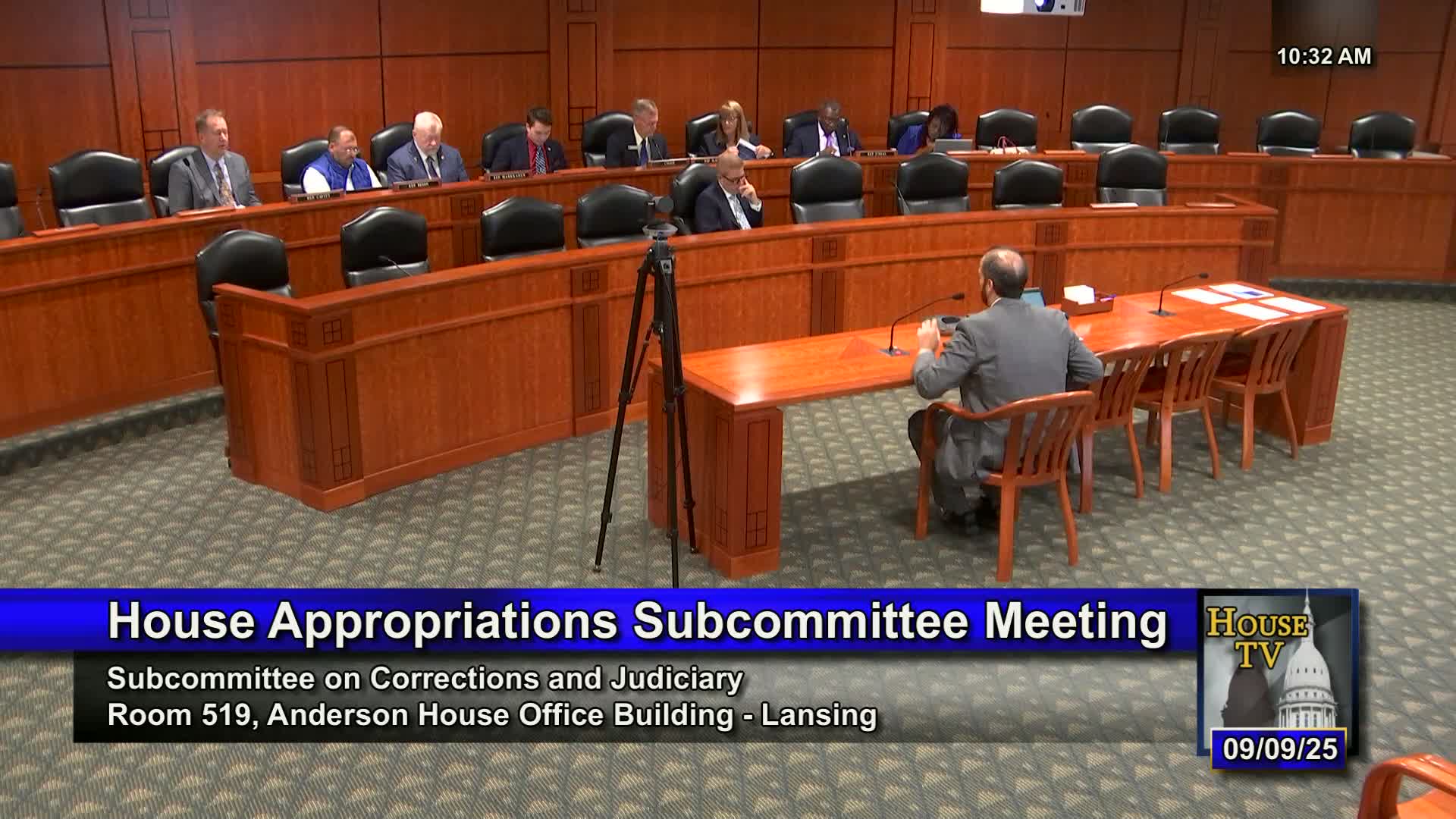
The Michigan Department of Corrections briefed the Appropriations Subcommittee on Corrections on recent critical incidents at the Saint Louis Correctional Facility and statewide measures to detect and prevent similar events. Kyle Kaminski, the department’s Offender Success Administrator and legislative liaison, described an uptick in negative prisoner behavior in June and July that included assaults on staff, resistance to restraints and a July 14 fight involving about a dozen prisoners.
Kaminski said staff responded to each event with heightened supervision, targeted use of chemical agents and tasers when necessary, and administrative actions including misconduct reports and transfers to higher custody facilities. "They were able to bring those prisoners under control," Kaminski said of the July 14 response, and the facility used a weeklong phase plan to restrict activities, conduct searches and review video and intelligence before gradually restoring operations.
The department told lawmakers it follows a publicly available critical-incident policy and uses two reporting tracks: an annual aggregated report and a 72-hour notice for incidents that meet the boilerplate’s severity threshold. "Last year there was about 4,400 critical incidents in the department," Kaminski said; he added that roughly 65 72-hour notices had been sent so far in 2025 and projected the year-end total to be between 75 and 80. Kaminski acknowledged that some increases over time reflect improved reporting—particularly for staff use-of-force incidents—rather than only changes in behavior.
Committee members pressed the department on classification, parole and contraband controls. Kaminski said the department is reviewing a decades-old classification worksheet and plans recommendations to better identify people who pose management risks; he estimated about two-thirds of the statewide population (roughly 22,000 people) receive few or no misconducts, while about 3,400–3,600 people (a little over 10 percent) are persistent management challenges. "We want people to make that behavior change so they could go down to level 2 and then level 1 and then release from there," Kaminski said, describing the department’s objective for custody reductions prior to parole.
On contraband, Kaminski described operational changes and new technology purchases funded with legislative help: photocopying personal mail (shredding originals) to block laced "dipped" paper, body scanners for people entering facilities and pilot package scanners. He also said the department has seen a shift toward fake legal mail used to attempt drug introduction; in response, MDOC contacts the purported sender and may destroy suspicious mail or refer intentional introductions for criminal prosecution. "We have had several attorneys in the state of Michigan now prosecuted for intentionally, in our opinion, sending drugs into our facilities using our legal mail process," Kaminski said.
The department highlighted accountability tools, including body-worn cameras with audio to support misconduct investigations and county prosecutors pursuing charges for assaults on staff. Kaminski also described operational changes such as reducing third-shift movement, closing day rooms on overnight shifts and installing interior yard fencing to limit large-group access and reduce opportunities for conflict.
Lawmakers raised reporting thresholds after a chair’s question about a news article that reported 15 staff assaults and 25 prisoner assaults; Kaminski said none of the Saint Louis incidents were classified at the highest severity (class 1) level that triggers the current 72-hour notice boilerplate and recommended the subcommittee review the boilerplate’s language to ensure it captures events the committee views as relevant. The subcommittee approved the meeting minutes by unanimous consent during the session.
Kaminski and staff offered to provide the committee additional data, including counts of level 4 prisoners moved or reclassified and more granular incident reporting, as the department and lawmakers consider possible changes to budget boilerplate and reporting practices. The subcommittee adjourned after members declined to call additional public questions.