Get Full Government Meeting Transcripts, Videos, & Alerts Forever!
Get email alerts on the Medicaid Costs topic
No spam. Unsubscribe anytime.
OSPB warns Medicaid growth is the largest structural budget pressure facing Colorado
Summary
OSPB told lawmakers that Medicaid spending growth far outpaces TABOR limits and other general-fund growth, and that federal changes will increase state exposure; the agency said Medicaid growth alone could absorb most allowed state revenue growth in coming years.
The Office of State Planning and Budgeting told the Joint Budget Committee that Medicaid'related spending growth represents the largest long-term structural pressure on Colorado's budget.
Director Mark Ferrandino said Medicaid medical spending has risen far faster than the state's allowable TABOR-based growth and that the mismatch is not sustainable. "Medicaid grew at just shy of 9% over the last decade," Ferrandino said, contrasted with TABOR growth of about 4.5%.
Ferrandino outlined how federal changes in HR1 increase state fiscal exposure by shifting some costs onto state budgets (for example, changes to premium tax credits and Medicaid matching mechanics) and said that a relatively small number of Medicaid program components (elderly and disabled services, waiver programs, autism/ABA services) are driving a disproportionate share of cost increases.
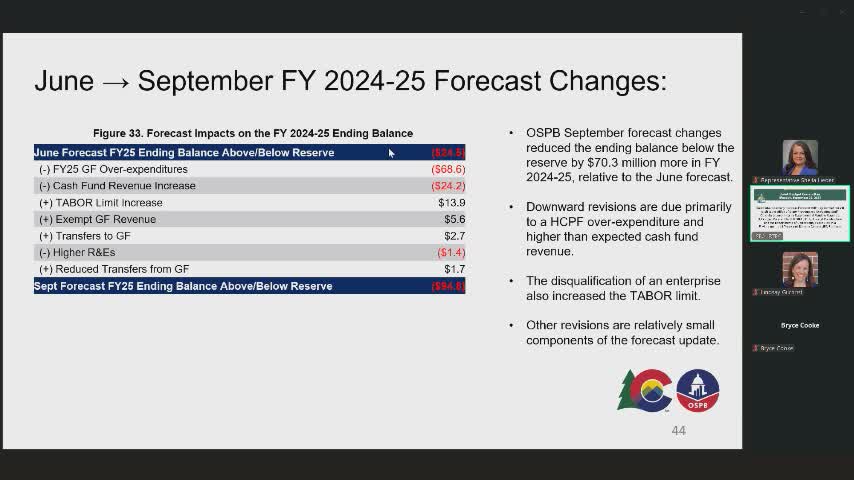
He noted a recent Medicaid over-expenditure (~$69 million) that worsened the current-year beginning balance and that even after executive actions and special-session measures the state's FY25-26 forecast remains sensitive to Medicaid caseload and cost pressures.
The director illustrated long-term consequences using modeled growth rates: if current trends persist, Medicaid general-fund costs could crowd out other services within two decades absent policy changes. He said the administration is preparing options and that the legislature will need to consider structural reforms, provider-rate policy and program changes to slow the growth rate.
Ferrandino also described how some HR1 effects (for example, on hospitals and federal matching) increase general-fund obligations for hospital payments and expansion populations; he recommended continued analytic work and legislative engagement to craft remedies.
"A growth rate of greater than the entire TABOR amount of growth in Medicaid is not something we can sustain," Ferrandino told the committee, adding that the administration will present options and partner with the legislature on next steps.