Get Full Government Meeting Transcripts, Videos, & Alerts Forever!
Get email alerts on the Medicaid Policy topic
No spam. Unsubscribe anytime.
State health officials warn HR 1 will add work requirements and other rules that could remove tens of thousands from Medicaid
Summary
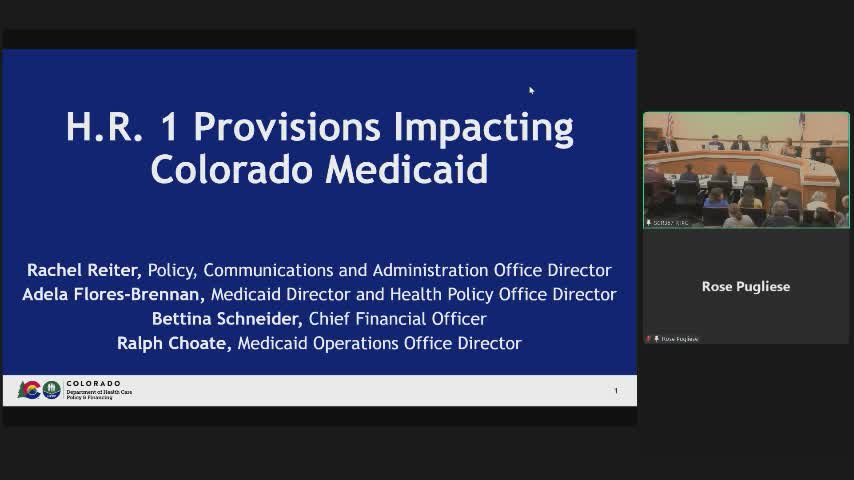
HCPF briefed leadership that HR 1 imposes new eligibility barriers, six‑month renewals and a federal work/community engagement requirement that will be implemented in stages (some rules effective Oct 2025, many in Jan 2027) and could meaningfully reduce coverage for parts of the Medicaid expansion population.
Health officials told the Executive Committee that HR 1 contains extensive Medicaid provisions that will shift financing and add administrative hurdles likely to reduce coverage and increase operating costs for the state.
"These changes will challenge all state budgets," Rachel Ryder of the Department of Health Care Policy and Financing said, adding that about 377,000 Coloradans in the Affordable Care Act expansion population are most exposed. HCPF staff said the bill includes new eligibility changes, tighter retroactive coverage, six‑month renewal cycles and a community engagement (work) requirement that will be effective January 1, 2027 for much of the expansion population.
Adela Flores Brennan, Medicaid director, summarized the operational lift: six‑month renewals will double the frequency of renewals for many expansion enrollees, reducing the share that can be automated and adding county workload; retroactive coverage for the expansion population will be cut from three months to one month; and the new work requirement will apply to many adults aged 19–64 with complex exemptions. "We don't have details on any of that yet," Flores Brennan said, noting federal guidance is expected in June 2026 and that the state faces a compressed timeline to build interfaces to verify work, school and volunteering claims.
HCPF also warned about provider‑fee and financing changes in HR 1 that will reduce the federal funding Colorado can draw through state‑directed payments and change net‑patient revenue tests. CFO Bettina Schneider said HR 1 reduces the allowable calculation of net patient revenue and caps new state‑directed payments; she described the rural health transformation program in HR 1 (a federal pool that could award roughly $100M annually to Colorado if the state application is approved) but said it will not offset the provider‑fee losses.
HCPF stressed uncertainty: final effects depend on federal rules, administrative interfaces, county capacity and appeals. The department committed to continuing updates and county planning materials. Members pressed HCPF about county workload, timelines and the need for outreach and resources ahead of implementation dates. The committee did not adopt policy but heard that implementation planning must begin immediately.