Get Full Government Meeting Transcripts, Videos, & Alerts Forever!
Get email alerts on the Economic Development topic
No spam. Unsubscribe anytime.
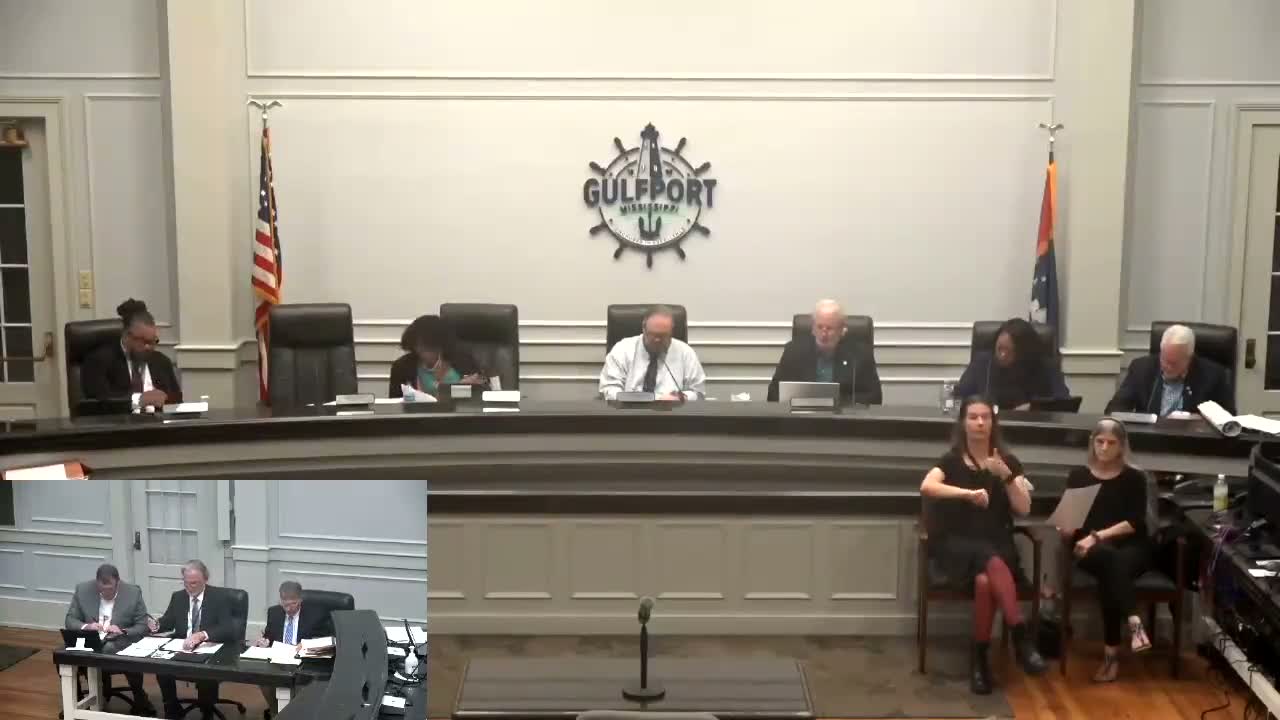
Gulfport council tables tax-abatement ordinance after heated debate over terms and city revenue
Summary
The Gulfport City Council debated a proposed citywide ad valorem tax abatement for capital projects of $10 million or more, heard competing amendment proposals (50–100% abatements for varying terms), and ultimately voted to table the ordinance for further study.
The Gulfport City Council on a unanimous voice vote tabled an ordinance that would allow the city to grant ad valorem tax abatements to capital projects valued at $10,000,000 or more, after an extended debate over how generous the exemption should be and how the city would protect its tax base.
Proponents, including Mayor Hugh D. Keating and administration staff, said the measure is a standard economic-development tool to attract large retail and commercial investments that otherwise would locate in neighboring jurisdictions. Mayor Keating told the council that developers have told city leaders they expect a predictable abatement policy and that a limited, temporary abatement helps the city compete: "If you don't give them the 100%, they're not going to come…That's why this ordinance is here."
Opponents and amendment sponsors pressed for guaranteed returns to the city. Councilor Ella Hines offered an amendment proposing a 50% abatement over five years (later discussed as a 75% option by Councilor Carissa Corbett), arguing the city needs "skin in the game" and revenue to sustain services after a difficult budget process. Councilor Buckner and others pressed for a requirement that projects demonstrate community benefits and suggested modest revenue-sharing into a local fund. Councilors cited numbers on likely foregone property tax revenue — roughly $51,000 per year on a $10 million true value at a 15% assessment and a 34-mill rate — to illustrate trade-offs.
City attorneys and administration said state law limits the abatement length to seven years for the abatement itself, while the ordinance authors proposed a ten-year sunset for the ordinance unless renewed. Administration urged a more generous temporary abatement to stay competitive with neighboring cities that offer similar incentives. At least one administration recommendation floated 100% abatement for a shorter fixed term or a minimum of 80% to avoid losing projects to nearby jurisdictions.
After back-and-forth amendments and procedural motions, Councilor Carissa Corbett moved to table the ordinance for further discussion; the motion carried by voice vote and was recorded as unanimous. The council did not adopt the abatement language at the meeting and left open follow-up work on specific percentage and term proposals, community benefit conditions, and competitiveness comparisons with neighboring jurisdictions.
Next steps: Council members asked staff to provide comparative incentive packages from nearby cities, a clearer projection of short-term revenue impacts and a recommended structure for community-benefit conditions before the ordinance returns to the council.