Get Full Government Meeting Transcripts, Videos, & Alerts Forever!
Get email alerts on the Airport Funding topic
No spam. Unsubscribe anytime.
Cut Bank airport authority outlines grant-funded projects and seeks local match dollar for voter ballot
Summary
Rick Geiger, speaking for the airport authority, described FAA and state grant opportunities for beacon replacement and runway/terminal planning, outlined a plan to set aside local matching funds, and said recent state law requires ballot requests to list dollar amounts rather than 'mills'. A Cut Bank resident sought follow-up and a mutual NDA to discuss opportunities.
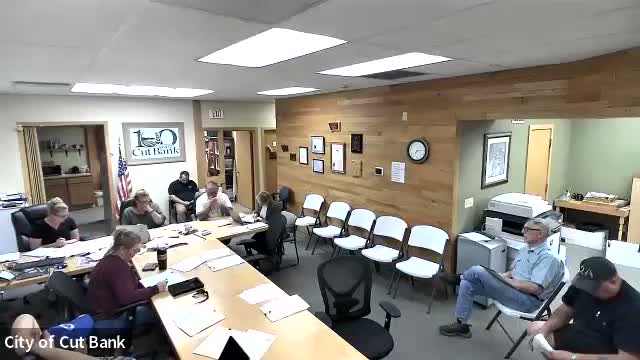
Rick Geiger, representing the airport authority, presented an update on airport finances, ongoing FAA and state grant projects and a proposed approach to a voter funding request during a Sept. 8 work session.
Geiger told the council the authority had applied for FAA funds and state aeronautics assistance to repair or replace a nonworking beacon on a main hangar; the FAA allotment for airports the authority described was about $150,000 annually for airports of this size, and state aeronautics funding would reduce the local match, leaving no local match out-of-pocket for that beacon project. Geiger said the beacon work is expected to proceed this fall and that engineering work is ready to begin once the required agreements are signed.
On larger projects, Geiger said a terminal remodel estimate could be roughly $1 million; with the FAA/state match rules the local match would be approximately 5% in the coming cycle (about $50,000) if the project is considered a public-space improvement and qualifies under grant assurances. He said if parts of a remodel are private space (for example private office build-outs), those elements might not be eligible for grant match and would fall to local payers.
Geiger explained a recent state law change affecting ballot language: rather than listing mills on a ballot, the municipality must now state the dollar amount requested. He and council members discussed how delinquency rates and sponsor allocations affect the final voter cost per household and how the county and city might share sponsor responsibilities for larger runway or terminal projects.
Geiger reviewed airport revenue streams (hangar leases, fuel sales — approximately 22,000 gallons combined per year — and other rents) and warned that operating revenue mostly covers a single staff member plus operations; he said fuel-system repairs, payroll and staffing remain pressure points. The authority also has a longer-term runway-replacement plan that would require multi-year savings to meet large-match thresholds for FAA runway grants.
Public comment included a Zoom presentation from Dr. Ricky S. Salazar (a Cut Bank resident) who said he has worked on FAA documentation and airport infrastructure planning, described the airport’s strategic value on tribal land and asked for a contact so he could share more detailed proposals under a mutual nondisclosure agreement.
What the authority asked of the council Geiger requested council support for certifying funding requests (using a dollar amount on the ballot per the new state requirement) and indicated the authority has located local entities willing to provide the ~ $50,000 match for a potential terminal engineering phase. The authority intends to set aside a portion of predictable annual allotments for future runway or taxiway match needs.
Next steps City and airport staff will coordinate on precise ballot language (dollar amount), county sponsorship if a countywide assessment is considered, and engineering scoping for either a terminal remodel or priority taxiway/maintenance projects.