
Fayette County schedules hearing on occupational license tax as $16M gap and contingency draw spark debate
Get AI-powered insights, summaries, and transcripts
Subscribe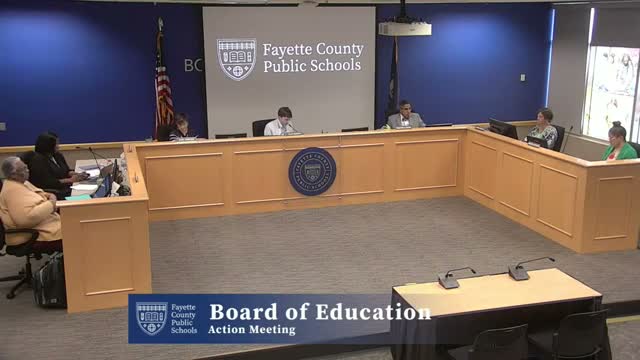
Summary
The Fayette County Board of Education agreed to prepare a public hearing on Sept. 5 to consider an occupational license tax increase after a budget solutions work group outlined recommendations to close a roughly $16 million shortfall and raised questions about the districtplanned contingency and recent carryforward numbers.
Chair Tyler Murphy called the Fayette County Board of Education to order on Aug. 18, and the meeting pivoted to a weeks-long budget review when Superintendent Manny Liggins presented the Board Solutions work group's findings on a projected $16,000,000 gap.
The work group offered ten recommendations to close the shortfall, including a temporary reduction of the districtplanned contingency from 6% to 4%, a freeze on non-contractual spending, further administrative attrition, liquidation of surplus assets, targeted maintenance savings, and, as a last resort, a 0.25 percentage-point increase to the countyoccupational license tax (OLT). The presenters said the additional 0.25 point could yield roughly $13.5 million to $16 million in the first partial year and $27 million to $32 million in a full year, but they emphasized those figures were estimates tied to collection timing and other variables.
Executive Director of Financial Accounting Rodney Jackson said the FY25 planned contingency was budgeted at roughly $42 million and that the FY24 audited fund balance was also $42 million; he acknowledged packet language showing $43,605,000 in contingency was due to a 6.5% calculation and said staff would reconcile and report updated carryforward figures next week. "There's no guessing," Jackson told the board; he said he had alerted the work group earlier in July when actuals indicated potential pressure on contingency.
Municipal advisor Michael George (Compass Municipal Advisors) warned that the funding environment for K-12 districts is tightening nationwide: "Moody's investor service recently issued a negative outlook for K through 12 schools nationwide," he said, citing slowing revenue growth and rising costs that can press fund balances and credit ratings.
Board members pressed for scenario modeling that lays out student-level impacts if new revenue is not secured. Several trustees emphasized protecting classrooms and student services while asking administration to identify cuts that would avoid classroom harm. Board member Monica Mundy said she had "no interest in setting a public hearing for a tax increase" based on community feedback, while others argued the public deserved an opportunity to weigh in.
Because of statutory timelines for OLT advertisement and the board's Sept. 8 vote deadline, members agreed to prepare a public hearing for Sept. 5 to present options and hear public input without taking a position on the tax. Superintendent Liggins said the district would return with clearer scenarios, revenue projections, and the administrative feasibility analysis needed for the board to act.
The board also directed staff to continue pursuing short- and long-term measures the work group recommended, including reviewing contracts, evaluating asset inventories for potential one-time proceeds, and assessing the tradeoffs of deferred maintenance or increased meal prices.
The board's decision to prepare a hearing does not constitute approval of a tax increase; it sets a public forum so the community can review the administration's financial scenarios and the tradeoffs for students and programs prior to any vote.