Get Full Government Meeting Transcripts, Videos, & Alerts Forever!
Get email alerts on the Public Health topic
No spam. Unsubscribe anytime.
Superintendent outlines 5% COVID threshold, family/employee survey, vaccine access and online-task-force plans
Summary
Superintendent presented COVID metrics and proposed a phased return tied to a 5% seven-day average infection rate, announced a district survey for families and staff to measure demand for in-person learning, described hubs and device/Internet supports, and said DPSCD is negotiating an MOU with the city health department to provide vaccine access for employees.
Superintendent Doctor Nikolai Vitti delivered a comprehensive update that tied decisions about reopening to a measured COVID-19 benchmark, described planned surveys of families and staff, and outlined early vaccine-access coordination with the city health department.
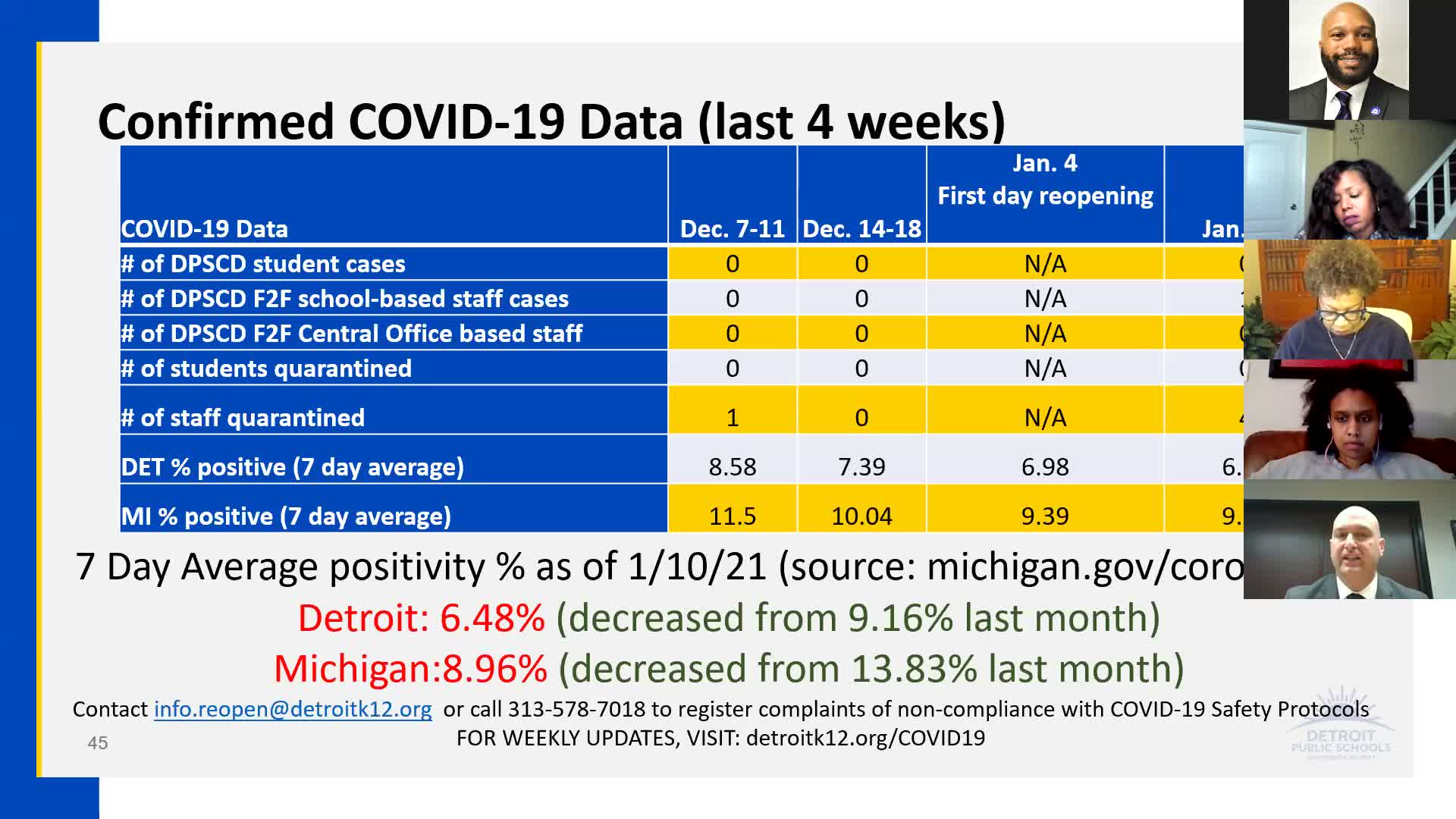
Vitti said the district is using a seven-day average infection rate and has set 5% as a working benchmark: "We have said if the infection rate is 5 percent or less, that that is safe for in-person learning," he told the board when explaining his recommendation framework. He said the district will remain data-driven and recommended opening learning centers when the rate is near and steady below that threshold, with full in-person learning deferred until the rate is consistently below 5%.
The superintendent said the district will release a brief survey to employees (including Detroit Federation of Teachers staff) and families to gauge preferences for in-person, hybrid or online learning and to ask about willingness to take the vaccine; the survey was slated to be released the day after the meeting. He said survey results will be used to match family demand with staff availability when building schedules and deciding which schools to open first.
On vaccines, Vitti said DPSCD is not running the city vaccine call center but is negotiating an MOU with the city health department to provide vaccine access for employees and contracted staff at a limited set of school sites, warning the district will be constrained by supply. He said the initial plan is to pilot in 4–5 schools and prioritize employees and certain contracted workers (custodians, maintenance workers, bus drivers). "We are not going to offer the vaccine to the general public," he said, and stressed scheduling will depend on vaccine supply.
Vitti also described district supports for families during virtual instruction: hubs offering device repairs and replacements (with some laptops including hotspots), continued free Internet access through June for students, hotlines for homework and mental-health supports, and plans for summer programs and expanded tutoring pending federal CARES/ESSER funding. He reported enrollment of about 49,333 students, average daily attendance of 72.4%, and that the district is serving roughly 20,000 meals per day during remote learning.
Vitti recommended establishing an online learning task force to consider concrete policy options — including setting a minimum active-participation threshold to prevent automatic failure, limiting daily screen time, and expanding grade-band definitions — and said learning centers could open sooner than full in-person instruction if safety indicators improve and staff are willing to return.
Board members asked for more data on pilot schedules and student outcomes; Vitti said the district is already reviewing attendance and early results from schools that implemented modified schedules and will provide more analysis after the quarter closes. He emphasized the district’s preference to follow the data and to avoid reopening and then reclosing schools.
The superintendent’s presentation anchored district planning around measurable public-health benchmarks, a forthcoming district survey, and negotiated city partnerships to improve employee vaccine access and community supports.