Get Full Government Meeting Transcripts, Videos, & Alerts Forever!
Get email alerts on the Land Use topic
No spam. Unsubscribe anytime.
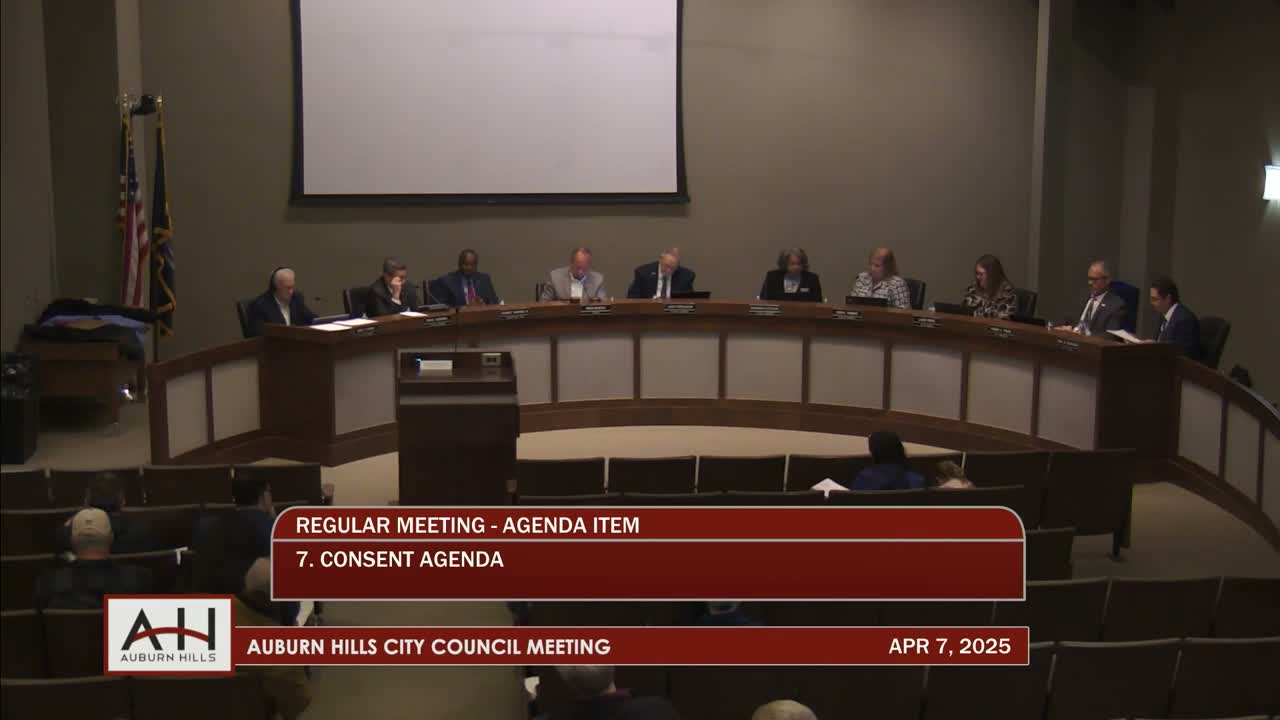
Auburn Hills council revokes PUD for Avant at 5 Points after years of delay
Summary
After lengthy public testimony and questions about financing, liens and construction progress, the Auburn Hills City Council voted 4–3 to revoke the planned-unit development approval for the Avant at 5 Points and ordered the developer to remove incomplete work within 90 days.
Auburn Hills — The City Council voted on April 7 to revoke the planned-unit development (PUD) approval for the Avant at 5 Points, a stalled multifamily project at 33555 Points Drive, citing repeated missed deadlines and neighborhood concerns.
Mayor Pro Tem Paul Hawkins moved to revoke the PUD under the project’s third amendment to the development agreement and to require the developer, OIK Construction, to remove incomplete foundations and structures and restore the site at its own cost within 90 days (deadline stated as July 7, 2025). The motion, seconded by Councilmember Ferguson, carried 4–3. Councilmembers Hawkins, Ferguson, Dr. Fletcher and Mayor Marzoff voted in favor; Mr. Knight, Ms. Rebecchi and Mr. McDaniel voted no.
The revocation followed a staff presentation from Community Development Director Steve Cohen summarizing the project’s approval history: an original approval in November 2019 for a 61‑unit, three‑story apartment building, a 2023 amendment increasing units to 68, and multiple deadline extensions granted by the council when vertical construction did not begin. Cohen told council the project had not begun vertical construction as required by the third amendment and that OIK had submitted a fourth extension request proposing a new start date in October 2025 and completion in October 2026.
OIK’s counsel, Ben Aloya, and contractor Fred Hadid asked the council for more time, saying the contractor had invested “several millions of dollars” in on‑site work and that winter conditions and site dewatering created unforeseen delays. Project manager Jim Tagg and an on‑site tradesman described a prolonged, exceptionally cold winter, frost‑limits on hauling and limited laydown space that slowed foundation and structural work. The petitioner said portions of steel and mechanical equipment had been contracted and deposits paid; they acknowledged two liens on the property — one connected to rented forming panels and a small concrete supplier invoice they estimated at roughly $7,000–$8,000 — which they said they intend to resolve.
Neighbors urged the council to deny additional extensions. Resident Patty Hassett raised concerns about a replaced retaining wall, high piles of dirt against trees that she said will kill them, and standing materials on site. Resident Mario DeBartolomeo told council, “They’re not gonna finish it in 5 years,” and urged members to consider the neighborhood’s daily impact. Project representatives disputed some complaints, saying some visible containers held construction materials and that certain joints and landscape removals were part of the approved civil drawings.
City Attorney Dirk Beckerleg advised council on contract enforcement and litigation risk, saying the city has a signed development agreement with dates the applicant provided and that any lawsuit would be difficult for the applicant to win on a breach‑of‑contract claim. Council discussed options including conditional extensions, requests for proof of financing, and whether a completed residential project was preferable to removing site work and returning the lot to a marketable condition.
The council’s revocation order requires OIK, at its own cost, to remove incomplete structures and foundations and restore the site in accordance with city ordinances within 90 days; if the developer fails to comply, the city manager or designee may authorize the city to take reasonable enforcement actions and charge those costs back to the applicant.
Council members who voted against revocation said they were sympathetic to the construction challenges and to the money already spent on the site; those in favor cited repeated missed deadlines and the neighborhood burden of prolonged, low‑activity construction. The public hearing was closed after the vote.
Next steps: The council’s order sets a 90‑day removal timeline; staff said they would monitor compliance and the city may pursue enforcement actions if the developer does not restore the site.