Get Full Government Meeting Transcripts, Videos, & Alerts Forever!
Get email alerts on the Public Works Budget And Actions topic
No spam. Unsubscribe anytime.
Muskegon County Board of Public Works reviews 2026 enterprise budgets, approves landfill rates and force‑main contract
Summary
The Muskegon County Board of Public Works on Sept. 4 reviewed 2026 enterprise fund budgets for solid waste, regional water and the Resource Recovery Center; it approved 2026 landfill disposal rates, awarded a $3.00099779 million low bid for a sanitary force main and authorized a RIC building change order and MOA termination with the DNR.
The Muskegon County Board of Public Works on Sept. 4 reviewed recommended 2026 enterprise fund budgets and approved several operational and capital actions, including new landfill disposal rates and a contract award for a sanitary sewer/force main.
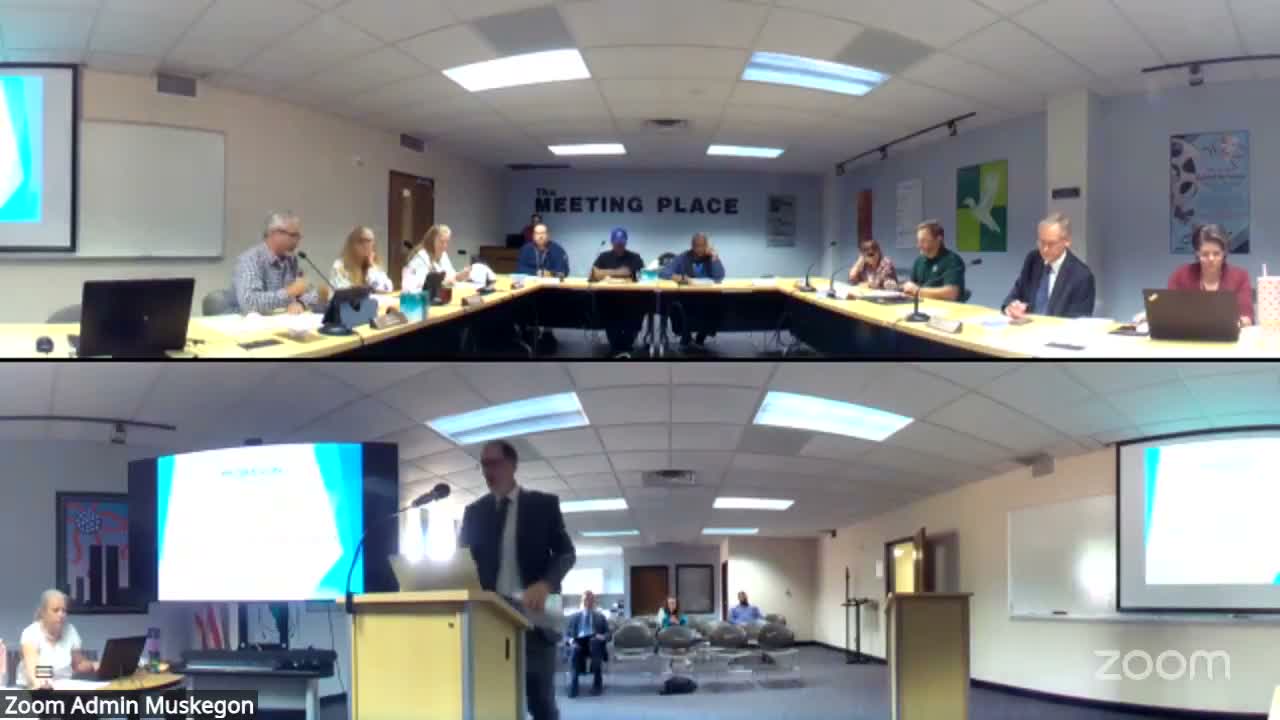
Public Works Director Wade Van Bosch opened the meeting with a presentation on the solid waste management and regional water budgets. Van Bosch said the solid-waste fund is projected to end fiscal 2025 with about $6.4 million in revenues and roughly $5.8 million in expenses, and that the recommended fiscal‑2026 figures change modestly. He identified tipping fees as the largest revenue source and cited upcoming capital work on Cell 7 — including liner installation, gas-collection and leachate systems — as drivers of higher contractual and engineering costs.
Van Bosch also reviewed the regional water system, saying fiscal‑2026 recommended revenues are about $8.7 million with expenses near $8.2 million. He told the board the county purchases bulk water from the City of Muskegon and that the city’s wholesale price is increasing about 10 percent; Van Bosch said the board’s recommended budget includes a corresponding 10 percent increase in user fees to offset that rise.
“In the water system, our major revenue is user fees,” Van Bosch said. “Their prices are actually going up 10 percent this year, so we are recommending a 10 percent increase in our user fees.”
Dave Johnson, Resource Recovery Center manager, presented the center’s budget and capital program. Johnson said the Resource Recovery Center’s 2026 budget contains roughly $34.5 million in projected revenues and about $24.7 million in appropriations; he listed a capital program of about $14.7 million, not including a grant-funded Southeast Regional force main and several projects the county intends to bond.
Johnson described planned equipment purchases and small‑farm projects: a replacement gas chromatograph–mass spectrometer (GC‑MS) budgeted at $200,000 for volatile organic compound testing; a gas‑diffusion sample unit to replace manual distillation for ammonia and cyanide; a John Deere no‑till corn planter acquired under the state purchasing contract (estimated at about $254,000); and variable‑rate‑tillage discs estimated at roughly $400,000.
“These tools will allow us to take advantage of some new technology,” Johnson said, summarizing the laboratory and farm investments.
After presentations and questions, the board took several formal actions. An unidentified board member moved to approve the 2026 landfill disposal rates (BPW25/09/057) effective Jan. 1, 2026; the motion was supported by Chair Paige and Vice Chair Kerwin and carried on voice vote.
The board also voted to accept the low bid of $3,000,997.79 for the Q‑to‑C force main, sanitary sewer and emergency storage work (BPW25/09/0458) and authorized the board chair to sign the contract and the county administrator to execute it; the motion included authorization for change orders up to 5 percent of original contract costs. A roll‑call vote was recorded with the commissioners voting in favor and the motion carrying.
Members authorized the Resource Recovery Center to invoke early termination of a memorandum of agreement with the Michigan Department of Natural Resources that had required leaving strips of corn unharvested to benefit waterfowl hunting. Johnson told the board the practice was producing volunteer corn that contaminated subsequent crops and prompted complaints from a local alfalfa buyer; he said the center will leave strips only until the last day of corn harvest and will forgo some DNR compensation rather than continue the full‑season arrangement.
The board also approved change order #1 for the RIC administration building contract with Edgard Construction, increasing contract costs by $19,879 and authorizing the chair to sign the change order and amend the budget. The motion carried on a recorded roll call.
The meeting closed after staff noted informational materials — the Public Works monthly report for August 2025 and the Resource Recovery Center monthly report — and discussed a pending administrative transition to seat Sam Jensen on a users committee at next month’s meeting.
What happens next: the budget recommendations and contract approvals proceed to implementation steps identified in the meeting materials; several projects (Cell 7 construction, the force main contract and planned lab purchases) are scheduled to proceed under the approved authorizations and available funding.