Get Full Government Meeting Transcripts, Videos, & Alerts Forever!
Get email alerts on the Road Swap Hicks Chambers topic
No spam. Unsubscribe anytime.
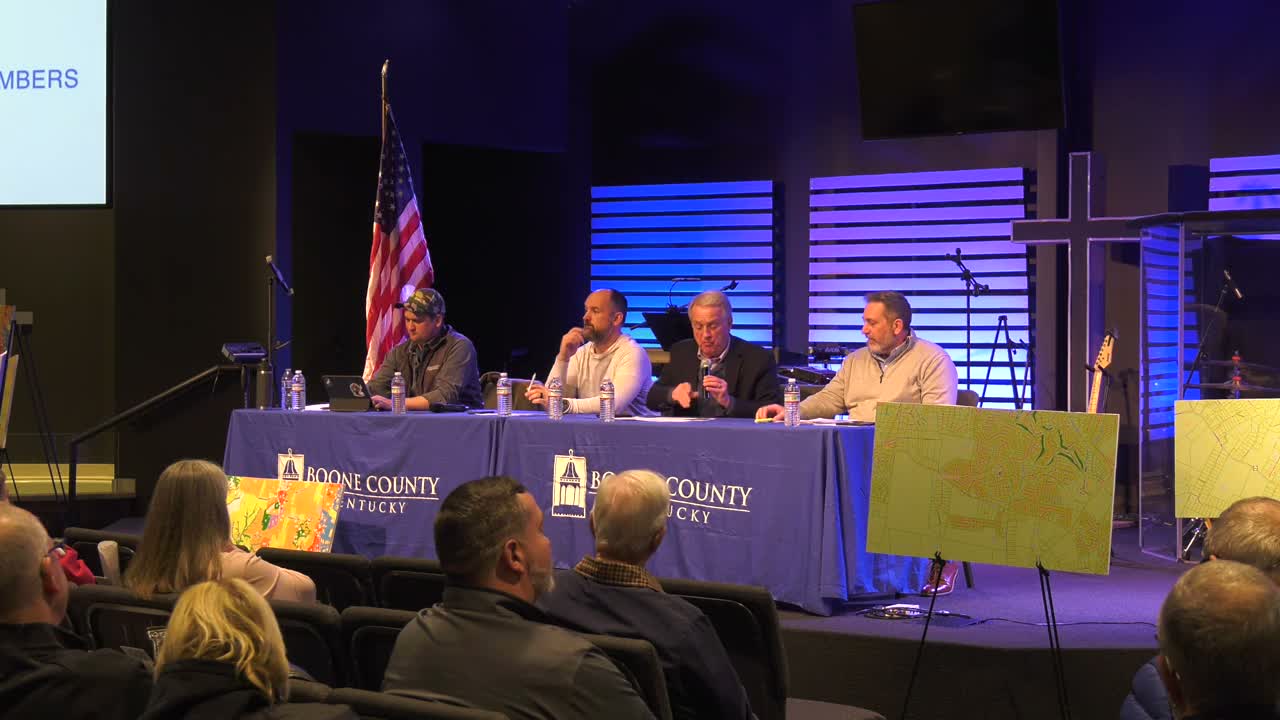
Boone County holds town hall on proposed Hicks Pike–Chambers Road swap; residents raise safety, truck and flooding concerns
Summary
Boone County officials and KYTC staff outlined a proposed swap to bring Hicks Pike into the state system and transfer Chambers Road to county control to unlock federal/state funding for a $61.1 million modernization. Residents pressed officials on interim truck routing, property impacts, drainage and emergency response; a 30‑day public comment period is open.
Boone County Judge opened a caucus‑style public meeting to discuss a proposed road ownership swap that would transfer Hicks Pike to the Kentucky Transportation Cabinet (KYTC) and return Chambers Road to county control. County engineer Rob Franksman told the audience the swap is designed to unlock federal and state funding to modernize Hicks Pike and address longstanding safety concerns.
Franksman said Hicks Pike is currently county‑owned, roughly 2.5 miles long, about 18 feet wide and carries just over 3,100 vehicles per day. Using the most recent five‑year crash data (2019–2023), he reported 53 crashes with six injuries and no fatalities on Hicks. The KYTC six‑year highway plan includes roughly $4.9 million in federal design funds for FY2025 and project funding identified in out years that total about $61.1 million to complete the modernization, which could include roundabouts, multi‑use paths, shoulders and dedicated turn lanes. “There’s just over 3,100 vehicles a day that travel Hicks Pike,” Franksman said during the presentation.
KYTC staff described the cabinet’s planning process for swaps as two official orders from the transportation secretary: first accepting a county route into the state primary system and then ordering the transfer of ownership/maintenance for the state route to the county. KYTC District Engineer Bob Yeager (introducing Jamie Wood as his assistant) said federally funded projects typically present multiple alternatives in early design and noted that federal standards require designing routes to accommodate freight movements. Yeager emphasized that early design usually yields several alternatives and public input shapes final choices.
At the meeting residents pressed officials on multiple concerns. Several longtime Hicks Pike homeowners opposed a full four‑lane widening and urged a “boulevard” or traffic‑calming design with roundabouts and turn lanes to preserve the area’s residential character. Others worried that once Hicks becomes a state route trucks would be legally allowed to run heavier loads there; Franksman and KYTC staff said design would account for required truck weights but they did not expect a large, immediate surge in truck traffic unless routing incentives or industrial development created a reason for trucks to shift onto Hicks.
Multiple speakers raised short‑term risks if the swap occurs before improvements are built: GPS routing and advisory changes could divert trucks to Hicks and damage shoulders or private property. Residents shared incidents of semis getting stuck on local streets, trucks damaging yards, and safety risks at local intersections. County and KYTC officials said they plan to pursue advisory signage and enforcement and will discuss interim mitigations with the state. “We will have to allow the trucks…we will deal with that as best we can,” Franksman said when asked about interim truck access.
Community members also asked about right‑of‑way and property impacts, drainage on Chambers Road, and emergency‑response times if the tunnel under I‑71 is modified or closed during construction. Franksman said design (if funded) typically takes 18–24 months and that right‑of‑way and utility phases can follow; he repeatedly noted that specific impacts — driveway or mailbox loss, property takings — are determined in final design and cannot be known at this stage. On drainage, Franksman said detention will be required for new development and that county public works would evaluate cross culverts and local drainage needs if the county assumes control of Chambers.
KYTC staff summarized the interchange‑study alternatives for the I‑71/71‑75 area near Chambers Road: keeping the tunnel, closing and cul‑desac‑ing it, or building a bridge (the planning recommendation was a Chambers‑over‑71‑75 bridge). KYTC noted that bridge options and interchange geometry carry differing costs and impacts, and that final engineering could alter the current planning preference.
Officials opened a 30‑day public comment period immediately after the meeting and posted the presentation materials online (a QR code was provided). Franksman said fiscal court could consider a resolution asking KYTC to proceed with the secretary’s official orders after the comment period; he suggested March–April as a possible timeframe for fiscal court action but said it could take longer.
The meeting closed after a motion by Commissioner Chet Hahn, seconded by Commissioner Brewer, to adjourn was approved by voice vote.
The county is accepting written comments for 30 days; the presentation and project materials are available on the county’s project page (QR code provided at the meeting).