Get Full Government Meeting Transcripts, Videos, & Alerts Forever!
Get email alerts on the Agriculture topic
No spam. Unsubscribe anytime.
House Agriculture Committee passes bill adding black bears to Livestock Loss Board
Summary
The House Agriculture Committee passed House Bill 356 by voice vote to add black bears to Montana's Livestock Loss Board, making ranchers eligible for compensation and mitigation grants; proponents said black-bear predation is rising as grizzly expansion shifts bear ranges, and the Department of Livestock outlined existing funding and verification processes.
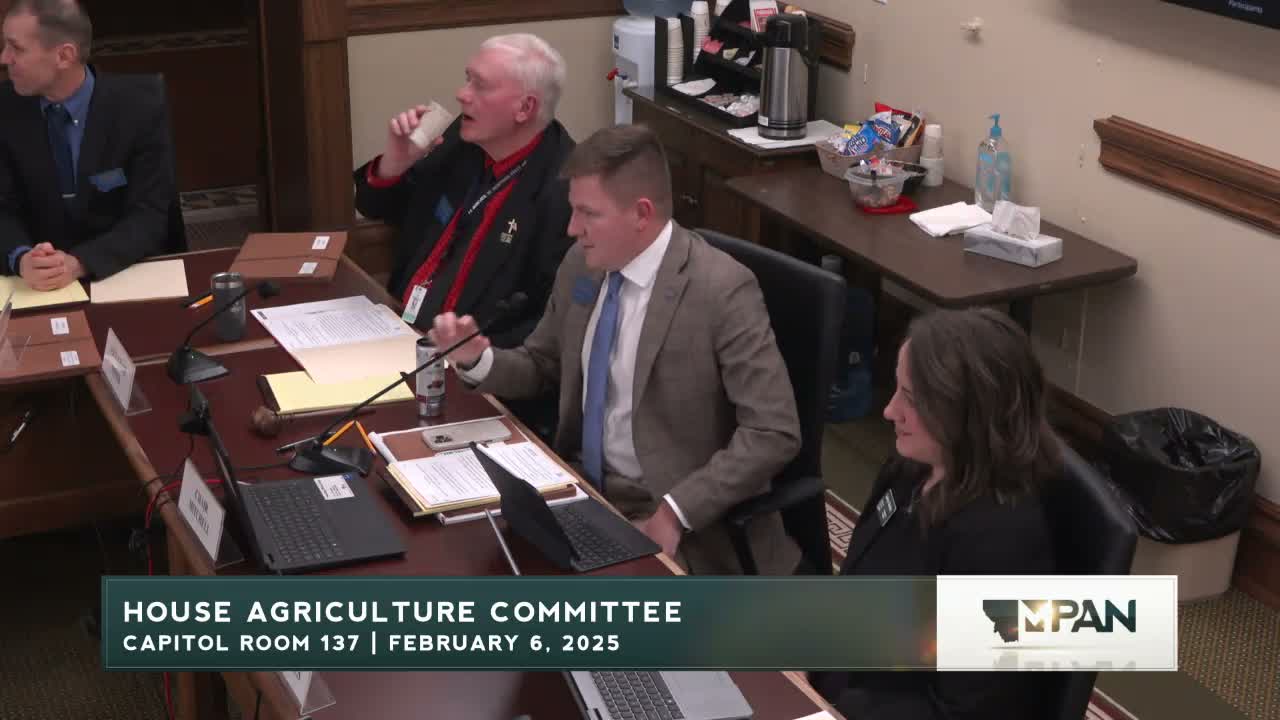
Representative Eric Tillman of House District 23 opened and closed the public hearing on House Bill 356, telling the House Agriculture Committee that the bill would add black bears to Montana’s Livestock Loss Board so ranchers could be compensated for depredation and apply for mitigation grants.
Tillman said the Livestock Loss Board — established by the Legislature in 2006 to compensate losses from state-managed predators — already covers grizzly bears and mountain lions and that adding black bears would “give ranchers eligibility for compensation” and extend grant funding for prevention such as electric fencing. He told the committee that "last year there was $450,000 that is annually set aside" for the program and that he expected roughly "$18,000 in claims" if black bears were added.
Testimony in favor came from ranchers and agriculture organizations. Merrill McKamey, a fourth-generation ranch manager from Cascade County, said black-bear predation on his operation "accounts for no less than 10 ewes and lambs a year, and in some years, in excess of 20," and argued that losses from a state‑managed predator should be treated the same as losses from wolves or mountain lions. Carly Johnson, state affairs coordinator for the Montana Farm Bureau Federation, and representatives of the Montana Stock Growers Association, Montana Cattle Women and the Montana Wool Growers Association also urged the committee to give the bill a due pass, arguing the Livestock Loss Board’s combination of producer and wildlife representation produces practical, landscape-level solutions.
Brian Simonson, deputy executive officer for the Department of Livestock, appeared as an informational witness and described the board’s funding and claims process. He told the committee the board is supported by two primary revenue streams: a House Bill 2 general‑fund allocation used for operations and some claims and a separate statutory appropriation intended to fund claims and prevention grants. Simonson said USDA Wildlife Services investigates suspected depredations in the field, documents the kill, and that ranchers then submit an application listing the animal type, date and size; the board refers to Montana weekly market reports and statutory guidelines to approximate market value at the time of depredation.
Committee members pressed for details. Representative Kametz asked how the board values animals; Simonson said market reports and statutory guidelines guide valuation and the board retains some discretion for nonstandard animals (for example, guard dogs or llamas). Representative Vauvlander asked whether the department requires a fixed response time for verification; witnesses and proponent ranchers said USDA Wildlife Services generally responds promptly (often within a day), but no statutory deadline was cited in testimony. On tribal lands, Simonson said the department has no tribal agreements in place now but stated that tribal members are exempt from the bill’s per‑capita fee and that losses on tribal land would be eligible for Livestock Loss Board payments.
Members also raised related scope questions: Representative Tillman said constituents had asked for domestic bison to be included, but the sponsor and committee noted adding bison would change the bill title and should be handled as a separate measure.
After closing the hearing, the committee entered executive action. A motion that House Bill 356 "do pass" was made on the record, and members conducted a voice vote. The clerk reported proxies for Representatives Romano and Baum and a final tally of 17 in favor and 0 opposed; the chair declared the bill passed by the House Agriculture Committee.
Next steps noted on the record: the chair discussed scheduling for other committee business and adjourned the meeting.