Get Full Government Meeting Transcripts, Videos, & Alerts Forever!
Get email alerts on the Property Tax topic
No spam. Unsubscribe anytime.
Belgrade staff recommends converting voted mill levies to dollar amounts after state tax changes
Summary
City staff told the Belgrade City Council that recent state legislation (Senate Bill 542 and House Bill 231) will lower residential taxable percentages and shift tax burden to second homes and commercial property; staff recommended converting voted mill levies to fixed dollar amounts (Option 1) and estimated the police levy lost about $459,080 this year.
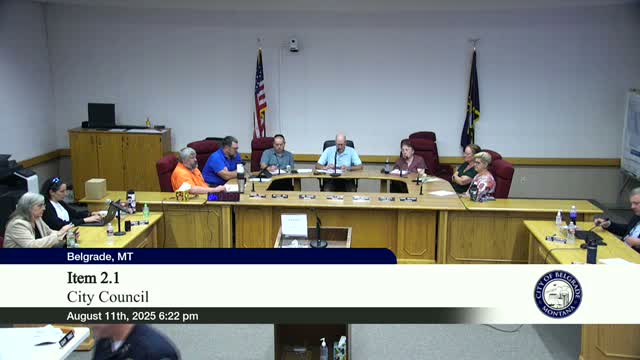
Belgrade city staff presented a detailed analysis of two state laws that change how property taxes are calculated and offered a staff recommendation to convert the city’s voted mill levies to fixed dollar amounts.
The presentation, given during the council workshop, explained that Senate Bill 542 establishes value‑based tiering that lowers the residential taxable percentage for many homeowners and that House Bill 231 offers two options for local governments: (1) convert voted mill levies to dollar amounts and then apply the state’s inflation rule, or (2) recalculate current mills to raise last year’s revenue and freeze that mill count. City staff recommended Option 1.
Why it matters: staff said the changes reduce how much taxable value is attributed to many owner‑occupied residential properties and move more of the tax burden onto second homes, rental properties and commercial property. Using county valuation data, staff estimated that Belgrade’s police voted levy will collect roughly $459,080 less in this tax year and the library levy about $54,009 less because of the new calculations.
"The police department has lost $459,080 in this tax year because of the changes made," the presenter said, summarizing staff’s back‑of‑the‑napkin revenue impact. Staff also noted county valuation figures differ from Department of Revenue certified values and that final rules and protest outcomes could change the totals.
Under Option 1, staff said the city would convert the voted levies to dollar amounts based on last year’s revenue and then be eligible for the state’s inflation allowance (the 15/10/4/20 rolling average), which provides a modest CPI adjustment this year (about 2.11%) and full inflation up to a 4% cap in later years. Staff argued this option provides stability during the reset period but severs the automatic growth that previously came from newly taxable property; if growth does not return the city would likely need to ask voters for additional dollars in future elections to maintain current service levels.
Under Option 2, freezing the mill count to match last year’s revenue would initially produce a different mill rate but, staff warned, would expose the city to larger revenue declines in future years as the residential taxable percentage continues to drop.
Staff also presented comparisons with nearby cities and noted Belgrade has a higher share of taxable value concentrated in the residential brackets most affected by the new law. The presentation did not ask the council to adopt a final policy tonight; staff said they will prepare a resolution for the council to consider at a future meeting.
The council discussed mechanics (how brackets are applied, treatment of newly taxable value—100% this year, 75% thereafter—and how commercial growth spreads burden) and asked about alternative revenue tools such as a local option sales tax; staff provided revenue examples but did not recommend pursuing a sales tax at this meeting.
Next steps: staff will bring a formal resolution for council consideration at an upcoming meeting and continue to refine numbers as Department of Revenue values and protests are finalized.