Get Full Government Meeting Transcripts, Videos, & Alerts Forever!
Get email alerts on the Municipal Finance topic
No spam. Unsubscribe anytime.
New Berlin leaders review "wheel tax" and levy-referendum options to pay for firefighters; no action taken
Summary
At a July 29 special committee meeting, New Berlin leaders reviewed municipal funding options — including a vehicle-registration "wheel tax" and a levy-limit referendum — to finance 12 proposed firefighter positions and other public-safety needs; council requested detailed cost estimates and will revisit the figures at future meetings.
New Berlin’s special committee of the whole met July 29 to examine funding options for the city, including a municipal vehicle-registration fee (commonly called a "wheel tax") and a potential levy-limit referendum aimed at shoring up public-safety staffing. Mayor (name not specified) emphasized the session was informational only and that "no action will be taken tonight." The council asked staff for specific cost estimates and directed that the information be published before the Aug. 26 common council meeting.
The presentation, delivered by the finance director (name not specified), framed the discussion within constraints imposed by Wisconsin’s levy limits and the city’s budget structure. The finance director said the city’s 2025 budget was presented in the meeting as roughly $54.5 million and noted that public safety consumes a substantial share of that budget. The director also cited DMV counts indicating "about 35,000 vehicles that will be subject to this tax," describing wheel taxes in other Wisconsin municipalities and counties as precedents.
Supporters and critics on the dais framed the proposal differently. The mayor warned of limits attached to some local fees and highlighted a key characteristic of a wheel tax: "The wheel tax is flat," meaning the fee would not automatically grow with inflation, a point that several council members said should factor into any long-term plan. Council members repeatedly requested clear, line-item estimates to distinguish between what is strictly needed to maintain service levels and what might be optional or a "wish list." "I can't make a decision without data," the mayor said.
Officials described a proposed public-safety use for new revenue: adding 12 firefighter positions to improve coverage and staff additional EMS units. Presenters referenced national or professional response standards that call for an effective response force of 17 people within eight minutes; speakers said the city rarely meets that threshold under current staffing and that minimum daily staffing levels can drop to 12–13 during leaves, vacations and training. The presentation tied those staffing shortfalls to operational gaps on the city’s west side and to potential impacts on homeowners’ insurance.
Council members also raised equity and business concerns. Members asked how a wheel tax would affect residents who rely on personal vehicles in a largely car-dependent, roughly 36-square-mile municipality; they asked about exemptions or special treatment for small fleets and industrial businesses. Staff noted some jurisdictions use both municipal and county vehicle fees, creating overlapping charges for some taxpayers, and pointed to the Wisconsin Department of Transportation as a source for jurisdiction lists of current wheel fees.
On timing and procedure, officials said state statute constrains when a referendum can occur and that scheduling choices interact with tax-bill deadlines and pre-scheduled election dates. The finance director and mayor confirmed the next step is to return with detailed cost estimates and a transparent report: staff will publish the materials on a dedicated webpage and present preliminary numbers at the Aug. 26 common council meeting ahead of the mayor’s September budget submission.
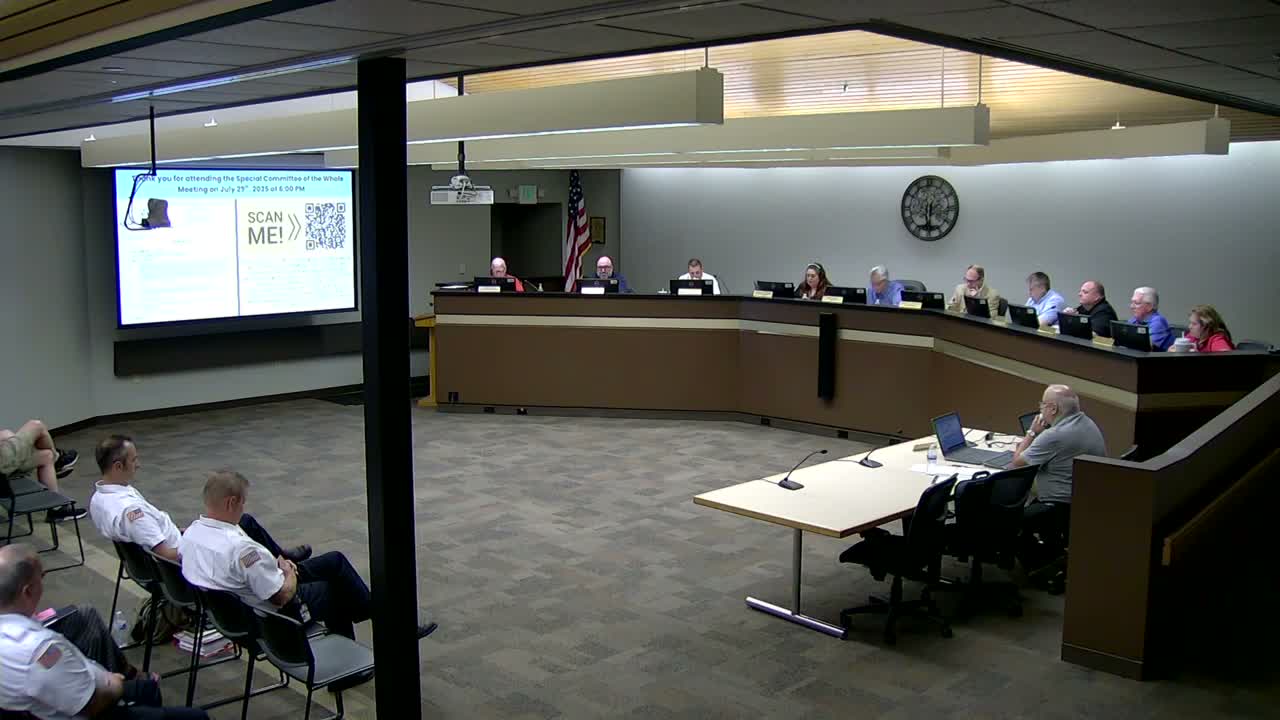
Because the meeting was convened as a special committee informational session, no motion, vote or ordinance was introduced or decided. Attendees were told how to follow up: sign in with Megan, the deputy city clerk, scan the QR code displayed in the meeting room, or email citizencomments@newberlin.org to receive materials and provide feedback.