
Clark County staff warn improper timber harvest permits can trigger development moratoria; urge early planning
Get AI-powered insights, summaries, and transcripts
Subscribe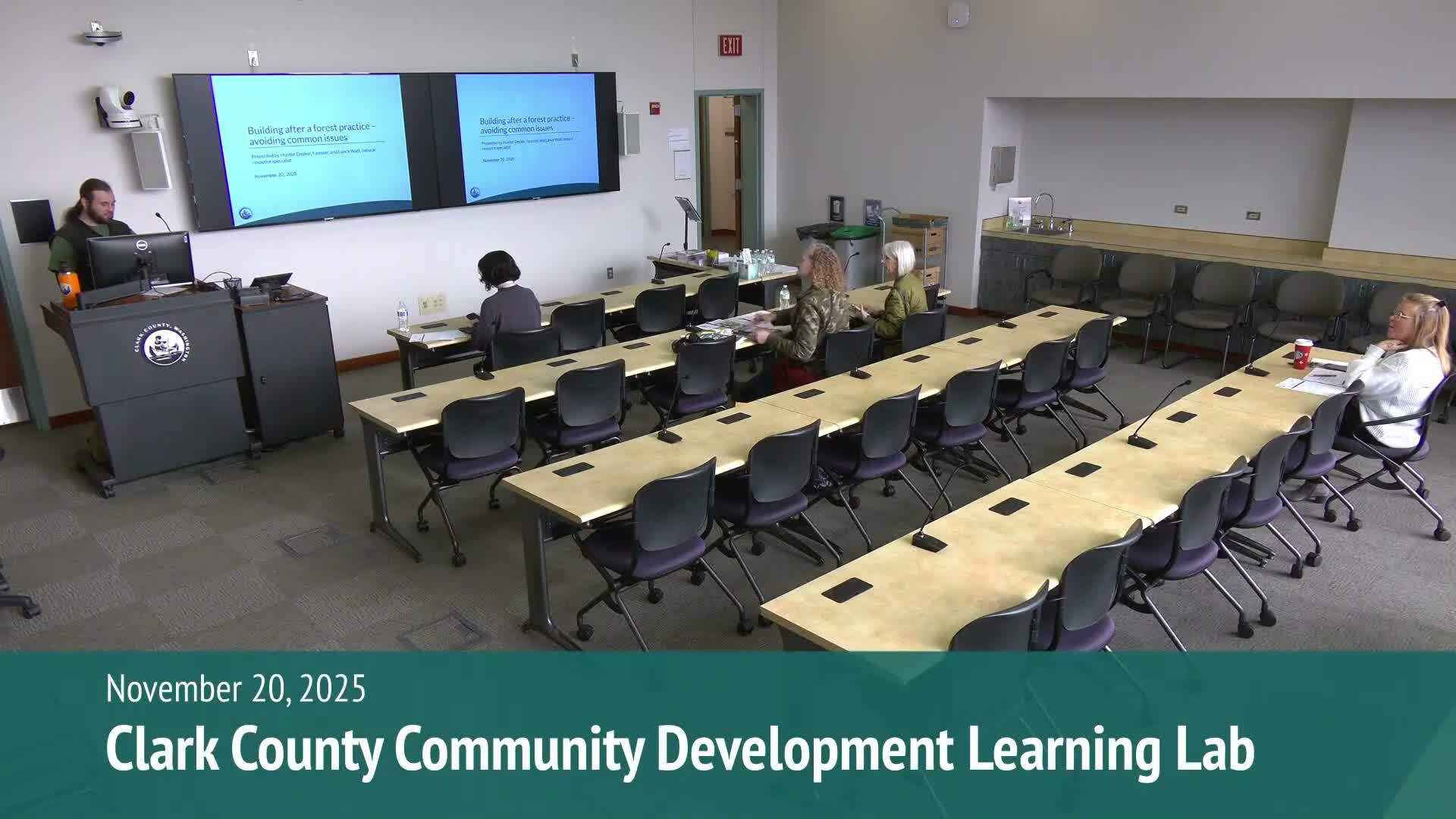
Summary
At a November learning lab, Clark County foresters urged landowners to decide early whether land is meant for long-term forestry or conversion, use the correct forest-practice permit (class 4 general or COHP for development), and check county/DNR records to avoid six-year moratoria and other delays.
Clark County County Forester Hunter Decker told attendees at the November learning lab that landowners who harvest timber before clarifying development intent risk long, costly delays. "Nobody wakes up in the morning hoping to earn a 6 year moratorium on their property," Decker said, adding that choosing the correct permit up front can avoid legal delays and financial penalties.
Decker outlined owner responsibilities tied to harvests: pay forest excise tax, notify the Department of Natural Resources (DNR) if operators change, and file continuing forest land obligation forms to document whether the parcel remains forest land after harvest. He said that when DNR approves a forest-practice application (FPA) and indicates replanting on a harvest area, the county receives notification and a development moratorium can be placed on that area — preventing building, septic and right-of-way permits until the moratorium is removed.
Decker explained county and state roles. The state’s Forest Practice Act (Revised Code of Washington 76.09) and related Washington Administrative Code rules (WAC 222) govern many harvest classes, while Clark County applies its local forest and critical-areas codes to conversions and some exemptions. He said landowners inside urban growth areas generally come to the county for conversion reviews; the county assumes jurisdiction for conversions unless a landowner has a 10-year recorded nonconversion agreement.
On permit classes, Decker described the basic thresholds: class 1 is minor cutting (about 5,000 board feet and handled by the county), class 2 covers small harvests up to 40 acres and is administered by DNR, class 3 is larger harvests over 40 acres (DNR), and class 4 general is the county pathway for converting forest land to another use. He said the Conversion Option Harvest Plan (COHP) is a paired county/state pathway that allows landowners to harvest now and keep the option to develop later without triggering an automatic moratorium if the COHP and county type 2 review are completed first.
Decker also described a single-family-dwelling waiver the county can grant: it allows up to 2 acres of the state’s replanting requirement to be waived to build a house and accessory building, while the remainder of the harvested area remains subject to continuing forest land obligations and replanting requirements. He cautioned that critical-area locations and county mitigation requirements may still apply to the remainder.
During the Q&A, Decker reiterated thresholds for hazard-tree removals and permits: the 5,000-board-feet threshold is a practical guide (about one-and-a-half fully loaded log trucks); inside urban growth areas, harvesting under 5,000 board feet and outside mapped critical areas may not require a permit, while rural Clark County typically requires a permit for harvests over 5,000 board feet. He also pointed attendees to the county’s Property Information Center and the DNR application review system to check parcel histories, FPA numbers and moratorium flags before buying or developing.
Decker closed by urging landowners to decide intent early, use the correct permit class, include clear maps of harvest and building sites, and keep both county and state agencies in the loop. He offered county forestry and wetland/habitat contacts and links to forms and submittal checklists for those seeking assistance.