Get Full Government Meeting Transcripts, Videos, & Alerts Forever!
Get email alerts on the Transit And Local Infrastructure topic
No spam. Unsubscribe anytime.
RTC Washoe outlines North Valleys transit, road and safety projects and recent federal grants
Summary
Paul Nelson of RTC Washoe told the Neighborhood Advisory Board the agency has seen sustained ridership growth, won a $21.5 million FTA grant to buy 19 diesel‑hybrid buses, and plans a slate of North Valleys projects including Buck Drive, Military Road widening, Lehi Drive resiliency work partially funded by a $25 million grant, and neighborhood bike‑and‑ped improvements.
Paul Nelson, government affairs officer for RTC Washoe, presented transit, planning and engineering updates to the Neighborhood Advisory Board on Thursday, saying the agency has recorded more than three years of consecutive ridership gains and secured federal funding to modernize its fleet.
Nelson said RTC is on a “winning streak” with about 37–38 straight months of ridership growth and roughly 6,000,000 trips in the last 12 months. He told the board that the Federal Transit Administration had awarded a $21.5 million discretionary grant to purchase 19 diesel‑hybrid buses, which RTC plans to use to retire shorter‑range electric buses whose manufacturer has gone bankrupt and caused parts‑supply problems.
Why it matters: Nelson said the new buses and planned road projects aim to improve reliability and capacity for 60% work trips and for routes with heavy weekday demand. The agency emphasized projects meant to expand travel choices, reduce congestion and improve pedestrian and cyclist safety in the growing North Valleys area.
Major projects and programs described
- Fleet and service: Nelson said nearly all 40‑foot buses will be diesel‑hybrid, with eight hydrogen fuel‑cell buses acquired through two grants to test longer range vehicles (roughly 300 miles). Paratransit and smaller cutaway vehicles use compressed natural gas, while university and college programs allow students free access on RTC routes.
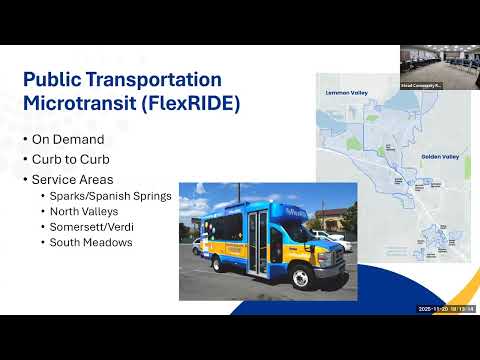
- Bus rapid transit and microtransit: The Virginia and Lincoln lines are the system’s busiest corridors, accounting for about 22–23% of bus ridership on 20 routes. The FlexRide microtransit bubbles (North Valley, South Meadows, Spanish Springs/Sparks, Somerset/Verdi) operate like on‑demand rides within a zone at $2 per ride or $3 for a day pass.
- Neighborhood network and quick builds: RTC is breaking the region into 12 neighborhood plans, advancing two per year. Nelson highlighted quick, lower‑cost safety measures such as bulb‑outs, refuge islands, painted and protected bike lanes and bike parking.
- Local capital projects: Nelson outlined North Valleys projects including a Buck Drive signal and widening (anticipated in spring), Military Road capacity and safety work to widen from two to four lanes with a center turn lane and 10‑foot multiuse paths, a Lehi Drive resiliency project (about 90% design) supported by a $25,000,000 grant covering roughly half the cost, and later phases of North Virginia Street improvements aligned with NDOT’s US‑395 widening.
- Studies and long‑range options: RTC is studying a USA Parkway–Spanish Springs connection (contingent on BLM easements and funding) and a commuter‑rail feasibility study that preliminarily estimates roughly 5,000 daily riders if implemented.
Board concerns and responses
Board members pressed RTC on right‑of‑way and coordination with Union Pacific on a Silver Lake crossing and asked whether FlexRide intermingling would reduce ADA paratransit capacity. Nelson said access trips are scheduled 24 hours in advance and scheduled trips keep priority; intermingling would use vehicles already in place only when it does not displace scheduled customers. On fleet choices, Nelson said the agency is shifting away from short‑range battery buses because parts are unavailable for those models and replacing them with diesel‑hybrid buses funded mostly by the FTA grant.
Quotes from the record
“We are receiving 21 and a half million dollars to purchase 19 new, diesel hybrids,” Paul Nelson said, describing the FTA award and the agency’s plan to retire failing short‑range electric buses.
“We subsidize it. Enterprise will provide the vehicle, and it makes it very affordable for the driver to lease one of these vehicles,” Nelson said describing RTC’s vanpool program.
A community member, Marissa Hayes, asked about pedestrian safety in the Bonanza area: “When are you going to work on those pedestrian sidewalks in the Bonanza area? It’s very dangerous right now.” Nelson replied that the North Virginia and Bonanza work is tied to NDOT’s phase timetable and tentatively targeted for 2027–2028 depending on external schedules.
Budget and funding context
Nelson said RTC’s FY26 revenues are roughly $290,000,000, with the largest share from fuel tax, then federal funding and local sales tax contributions for transit. Road impact fees paid by developers were discussed in dollar terms (examples given of roughly $5,200–$5,300 per residential unit north of I‑80), and Nelson warned that changes to impact fees must pass through newly required state business‑impact processes, which lengthen approval timelines.
What’s next
Nelson said more detailed design information on Buck Drive should be available at the next RTC appearance to the board and that NDOT will present to the board on Dec. 4. RTC staff said they will return with more detailed project plans as designs and funding are finalized.