Get Full Government Meeting Transcripts, Videos, & Alerts Forever!
Get email alerts on the Millage Rate topic
No spam. Unsubscribe anytime.
Rockdale County sets 2025 millage at 18.284, returns host collections to taxpayers
Summary
The Rockdale County Board of Commissioners voted to set the 2025 millage rate at 18.284 (a rollback) and to set the host percentage at 50.29%, returning host collections to taxpayers. Staff presented revenue and budget details; the motion passed unanimously at a called meeting.
The Rockdale County Board of Commissioners voted to set the 2025 millage rate at 18.284 and adopt a 2025 host percentage of 50.29%, a measure commissioners said will return local sales-tax (host) collections to taxpayers and hold the county’s rate below last year’s 18.69.
Interim finance director Sue Sanders presented the figures before the vote, saying, “The proposed millage for 2025 is 18.284, which is a millage reduction.” Sanders told commissioners the rollback rate would generate about $91,030,520 in property-tax revenue for the county in 2025; non‑property revenues were listed at $38,147,777 for a combined total of $129,178,297 in projected revenues for 2025.
Why it matters: the presentation showed how the general fund is allocated and how the tax burden is distributed. Sanders said the general fund budget allocations for 2025 include roughly 42% for public safety, 37% for general government functions, 10% for court services, 7% for recreation and 4% for transportation. For homesteaded properties that receive the host exemption, Sanders said about 78% of the tax bill goes to the school system and approximately 22% goes to county maintenance and operations.
Sanders provided sample calculations to illustrate household impacts: a $100,000 home with homestead and host exemptions was shown with a 2025 tax of about $227 (slide); without exemptions the presentation listed about $731.36. For a $350,000 home, the presentation listed roughly $1,136 after exemptions and $2,559.76 without them. (Some slide numbers in the transcript were partially unintelligible when read aloud during the presentation.)
Board discussion and public input focused on clarity and process. Resident Nick Duva, who identified himself as a longtime county resident, said he views taxes as “an investment in our community” and asked that county and school millage items be presented together in future years so residents can see the total tax impact. Commissioners thanked staff for the presentation and emphasized efforts to find cost savings and revenue-recovery measures, including user fees and grant funding.
Before the motion, commissioners sought clarification about the host percentage and how the 1% local option sales tax (host) is handled. Staff confirmed the resolution lists a host percentage of 50.29% and that the county is recommending returning 100% of host collections back to taxpayers; the board said this is the third year using that approach. Board members noted host collections amount to roughly $24 million annually and credited the return to taxpayer relief.
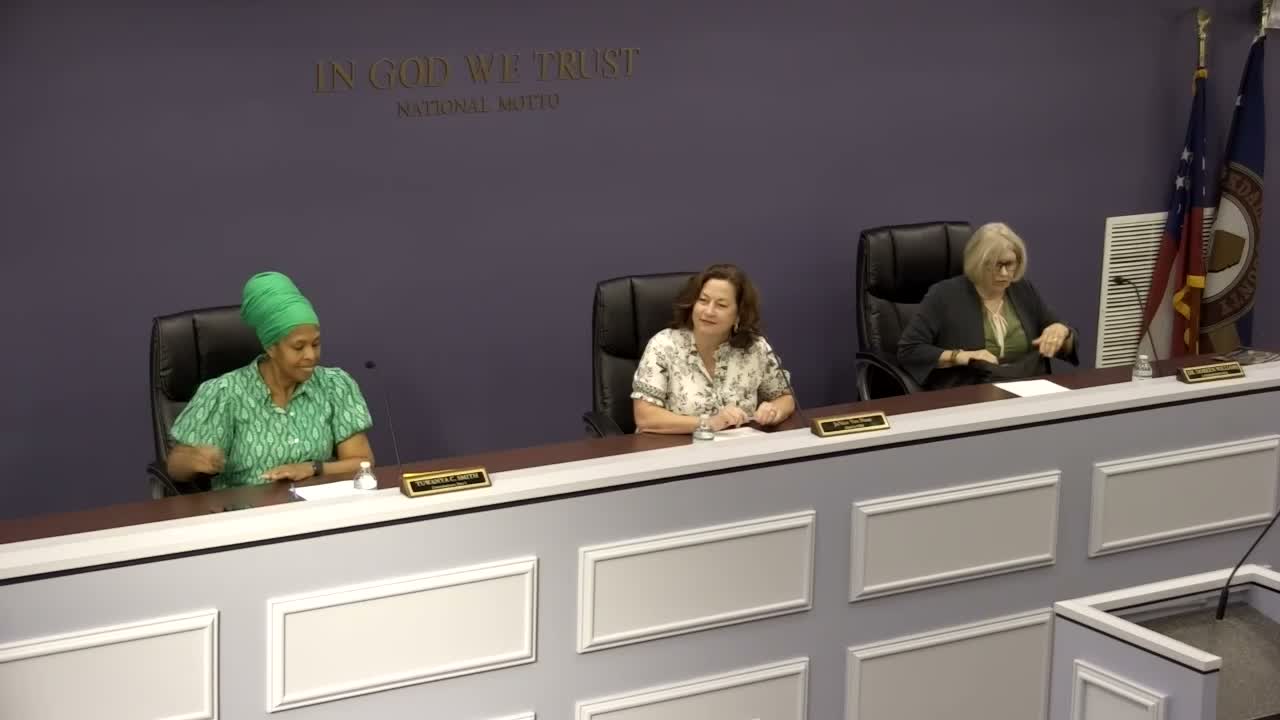
Commissioner Williams moved “to set the millage rate at 18.284 and to set the 2025 host percentage at 50.29% and to adopt the resolution as presented.” Another commissioner seconded. After brief remarks supporting the rollback rate as a way to save taxpayers money while recognizing upcoming budget pressures, the chair called the vote. Commissioners responded “aye,” and the motion carried.
Because the board adopted the rollback rate, Sanders said no additional public hearings were required; the tax commissioner’s office will file the adopted millage with the state, concluding the county’s millage-setting process for the year. The board adjourned after encouraging residents to "Shop The Rock" to support local businesses and revenue.
The presentation and vote also referenced budget pressures for 2026, including inflation, personnel requests (about $3.1 million in new requests cited by staff), a 2.5% cost‑of‑living increase that was covered from contingency this year but must be funded fully next year, and House Bill 85 costs related to judges. The county’s next procedural step is submission of the adopted millage to the state via the tax commissioner’s office.