Get Full Government Meeting Transcripts, Videos, & Alerts Forever!
Get email alerts on the Millage topic
No spam. Unsubscribe anytime.
Rockdale County sets 2025 millage at rollback 18.284, adopts 50.29% host percentage
Summary
At a called meeting, the Rockdale County Board of Commissioners voted to set the 2025 millage rate at the rollback rate of 18.284 and adopt a 50.29% host percentage; county staff said the rate yields about $91.0 million in property tax revenue and requires no further public hearings.
The Rockdale County Board of Commissioners voted at a called meeting to set the county’s 2025 millage rate at the rollback level of 18.284 and to set the county’s 2025 host percentage at 50.29%, adopting the resolution as presented.
Interim finance director Sue Sanders told commissioners the proposed millage of 18.284 is a reduction from the 2024 rate of 18.69 and described the rollback as the rate that would generate the same amount of property tax revenue as the prior year. Sanders said the proposed county property tax revenue under that rate would be $91,030,520; non‑property tax revenues were listed at $38,147,777 for total projected revenues of $129,178,297 for 2025.
Why it matters: Sanders said that for homesteaded properties with the host exemption, roughly 78% of the total property tax bill goes to the school system and about 22% goes to the county for maintenance and operations. She gave sample calculations showing a $100,000 home (with homestead and host exemptions) would owe an estimated $227.17 in county property taxes under the proposed millage; without exemptions the example figure shown was $731.36. For a $350,000 home, Sanders’s slides showed an estimated $1,136.12 with exemptions and $2,559.76 without.
During discussion, commissioners and staff flagged 2026 budget pressures including pay‑plan updates, a 2.5% cost‑of‑living increase the county absorbed this year (which will require full funding in 2026), and implementation of House Bill 85 for judges, which Sanders said will affect next year’s budget. Sanders also said the county has limited contingency and that some director requests total about $13 million above current baselines.
Host percentage and credits: Commissioners sought clarity about the ‘‘host’’ sales tax credit used to reduce property tax bills. Sanders and other staff clarified that while state law would allow keeping a portion of host collections for capital (she referenced the option to keep up to 20%), the recommendation in the resolution is to return 100% of the host collections used in the calculation back to taxpayers; the 50.29% figure in the resolution reflects how the credit is applied in the calculation.
Public comment: Resident Nick Duva spoke at public comment, calling property taxes an "investment in our community," praising county communications and long‑serving officials, and asking the county to consider holding a combined meeting with the school system so residents can see the county and school millage rates together.
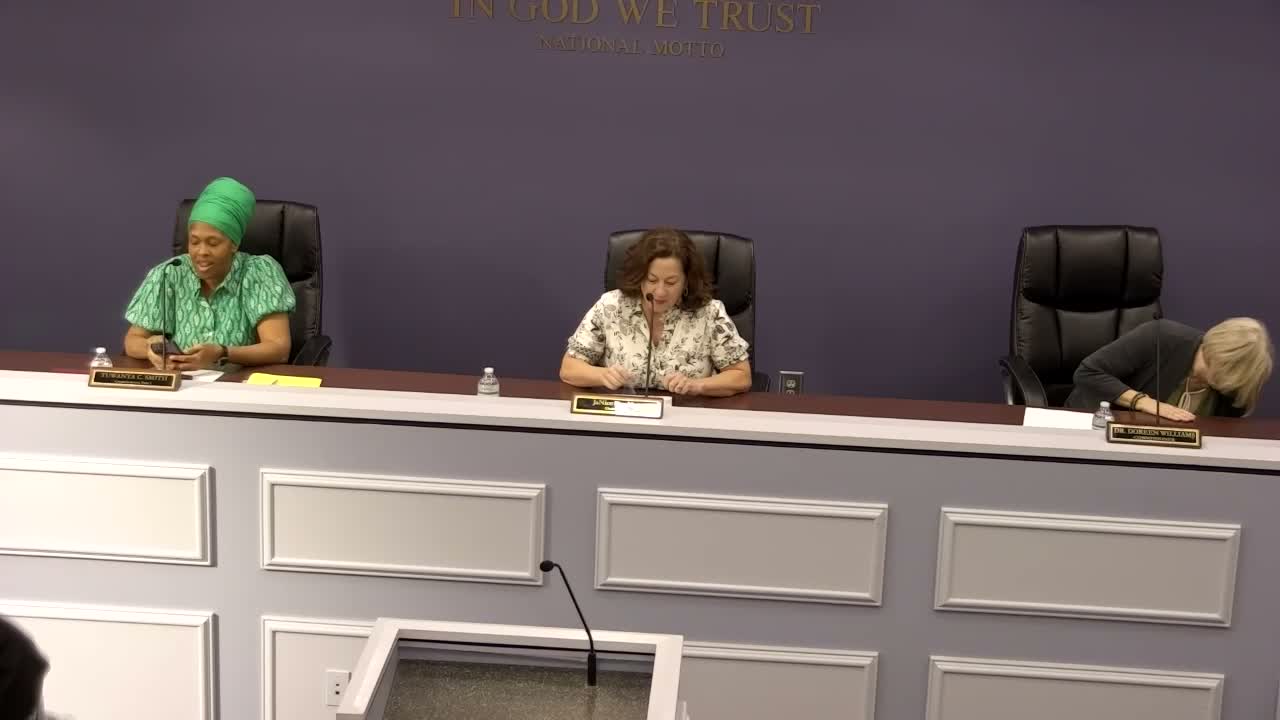
The motion: An unidentified board member moved to set the millage at 18.284, set the 2025 host percentage at 50.29% and adopt the presented resolution; a second was recorded. After brief comments from commissioners supporting the rollback as a taxpayer savings measure, the chair called a voice vote. The chair declared the motion carried on the board’s voice vote.
Next steps: Because the board adopted the rollback rate, staff said no additional public hearings were required under state rules. The tax commissioner’s office will receive the adopted millage and submit it to the state to complete the county’s required process. The meeting then was adjourned.
Quotes: "The proposed millage for 2025 is 18.284, which is a millage reduction," Sanders said during the presentation. Resident Nick Duva said, "I look at it as an investment in our community." Commissioner Williams said he supported the rollback rate, noting that "anytime we can save tax dollars for our citizens, that's a really good thing."
What the board did not decide: The board did not adopt or increase any new taxes beyond the adopted millage, did not set separate school millage (the school board sets that separately), and did not record a roll‑call vote tally in the transcript; the action was recorded as a voice vote and declared carried.