Get Full Government Meeting Transcripts, Videos, & Alerts Forever!
Get email alerts on the Civic Campus topic
No spam. Unsubscribe anytime.
Greeley council weighs $80–120M Civic Campus plan, asks staff for deeper financing models
Summary
City staff presented two Civic Campus cost options (a full $120M plan and a value‑engineered alternative) and financing choices including COPs, GO bonds, and leasing; council asked for revenue modeling, phasing options, and clarity about a county parking garage before moving forward.
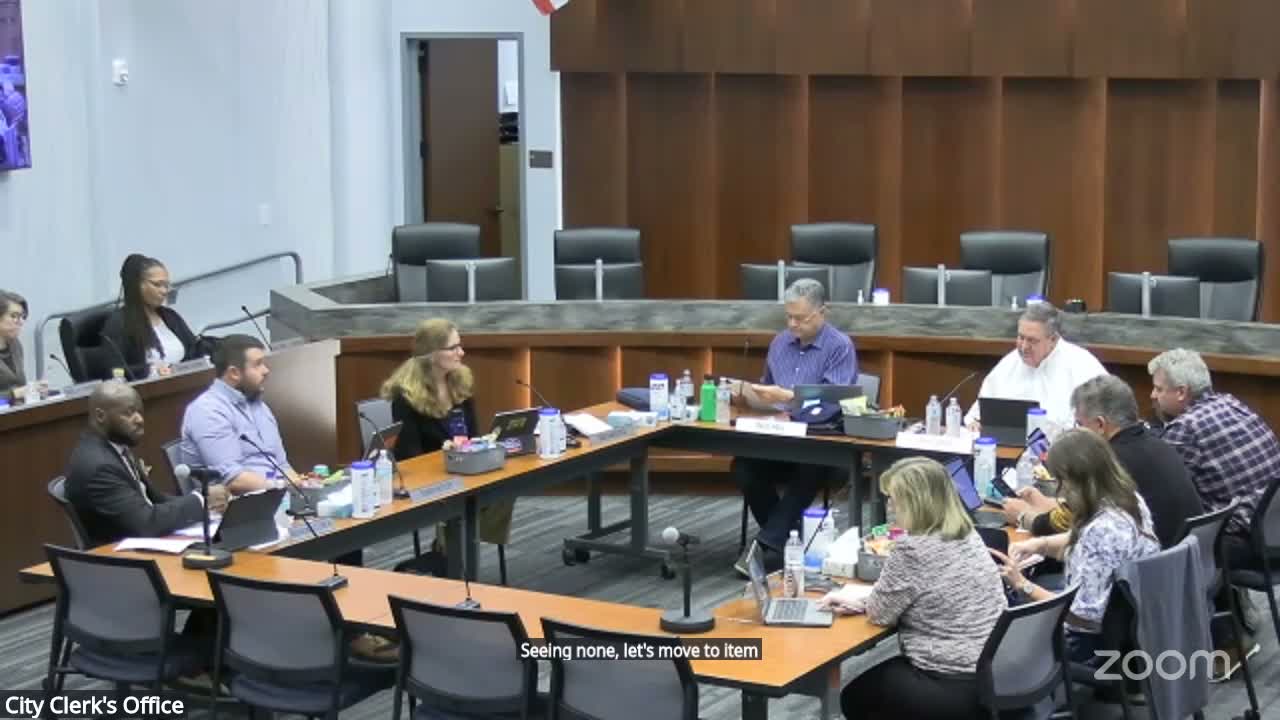
GREELEY — City staff on Tuesday outlined two financing options for a proposed downtown Civic Campus and asked the Greeley City Council for direction on what financing scenarios to explore further.
Kelly, the city’s finance lead, told the council the city is aiming to fund a new Civic Campus without a new revenue source such as a property tax and presented two estimates prepared by Richmark: a full-scope package estimated at $120,000,000 that includes Lincoln Park and a $10,000,000 contribution for a county parking garage, and a value‑engineered alternative that trims finishes and parking to reduce costs. "This initiative basically was asking how could we fund a new civic campus without a new revenue source, such as a property tax," Kelly said.
The presentation included acquisition and demolition needs (Methodist Church, Wheeler properties, the Public Works building and a juror parking lot), a proposed new city hall program of roughly 96,000 square feet, and a parking garage sized in one model at 352 spaces. Staff compared debt options: certificates of participation (COPs), which do not require a voter measure but are limited by the city charter to 20 years, and general obligation bonds (GO) that require voter approval and could extend to 30 years. Staff used a 5.5% interest assumption and estimated COP annual payments in the range of $6.7M–$7.7M (depending on option) and GO payments that would be lower on an annual basis but higher over the life of the loan.
Why it matters: councilors said the magnitude of the annual debt service would force tradeoffs in the city’s existing budgets and programmed projects. Staff warned that using the food tax or quality-of-life tax to repay this debt would require deferring capital maintenance and replacement projects currently funded by those revenues.
Councilors pressed staff for more detailed performance and revenue modeling tied to private development planned downtown. Councilor Debuti asked whether anticipated private investment (hotel, apartments, retail) had been modeled to show tax revenues large enough to help service COP payments; staff said Richmark has run economic-impact models and offered to provide the lodging, sales and property tax projections to council staff. "We're taking about 6 acres of nontaxable land and turning into taxable revenue," a councilor said, noting the potential for increased tax receipts but asking for concrete figures.
Council debate focused on several recurring choices: lease versus purchase, phasing the project so the city would delay the parking garage or Lincoln Park work, and whether the program square-footage (96,000) is larger than current needs. Councilor Olson and others urged consideration of a P3 lease option to reduce near-term cash outlays until additional revenue from West Greeley or private development materializes. Councilor McDonald and developer partners emphasized that surface parking reduces future redevelopment potential and encouraged parking structures if long‑term downtown density is a priority.
Staff also presented potential revenue sources to cover annual debt service, including the food tax (projected annual revenue roughly $13.6M for 2026–2030), the quality of life tax (projected ~$11.8M annually and $30M already committed to another project through 2042), general fund allocations, federal/state grants, land sales and a possible future public facilities impact fee tied to a pending fee study.
Votes at a glance: Council moved by Councilor Olsen and seconded by Councilor McDonald to adjourn to executive session to discuss purchase, acquisition or lease of real property and negotiation instructions and legal advice (CRS citations given); the roll-call vote was 7–0 and the council adjourned at 7:27 p.m.
What’s next: staff will return with more detailed revenue and performance models from Richmark, a justification for the 96,000-square-foot program based on a pending space study, and options for phasing and parking that clarify county involvement and ownership of the county garage. Councilors asked staff to include modeled tax receipts tied to the private development concepts and to present the financial tradeoffs of using dedicated taxes versus other funding approaches.