Get Full Government Meeting Transcripts, Videos, & Alerts Forever!
Get email alerts on the Zoning Industrial Park topic
No spam. Unsubscribe anytime.
Fiscal court declines extra public hearing on large industrial-park zone change after split discussion
Summary
After extended debate, Franklin County fiscal court rejected a motion to add a public hearing on the proposed 127 Industrial Park zoning change. Members split over whether the planning commission record and prior public meetings suffice; the motion to add a hearing failed on a roll-call-style vote during the voting session.
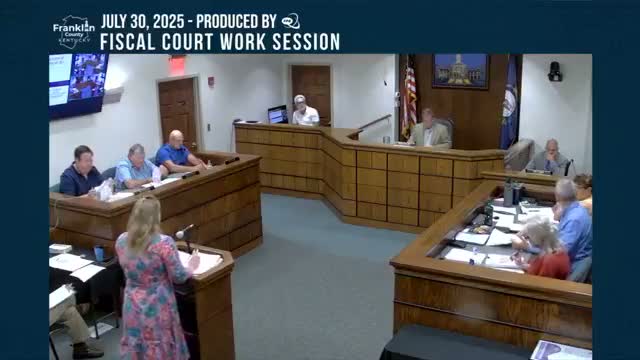
Franklin County fiscal court held a lengthy work-session debate on whether to hold an additional public hearing on a large zoning amendment for a planned commercial/industrial area known locally as the 127 Industrial Park.
Several magistrates said the projectfs scale, the number of documents (hundreds of pages) and community concern justified a separate public hearing before the court acted. They noted a split 5-3 planning commission vote, a large packet of plans and public comments, and the special status of the authority that the county helped create for the park.
Other members argued the planning commission record and prior public forums (including a Kentucky State University session that the county hosted) already gave the public opportunity to be heard and that additional hearings would likely repeat testimony already on the record. The judge and county attorney clarified procedural limits: adding the hearing as an agenda item required action in the voting session, not in the work session.
During the voting session a motion to add a public hearing on the 127 Industrial Park zoning change was made and seconded; the court then conducted a roll-call-style vote. Multiple members voted "no" and the motion failed. The court subsequently proceeded with other agenda items; the first reading of the larger zoning ordinance was retained without a county-level public hearing being added at that time. Several magistrates said they will press for safeguards and explicit expectations in the zone-change and any future development agreements.
The work-session discussion also included comments about how the county should track and enforce any promises made by the industrial authority (for example, job minimums and environmental protections) and whether certain expectations should be formalized in the ordinance or in accompanying agreements.
Outcome: motion to add public hearing failed; the zone-change packet will move forward under the normal process with second-reading opportunities on the stated future date.