Get Full Government Meeting Transcripts, Videos, & Alerts Forever!
Get email alerts on the Public Comment Policy topic
No spam. Unsubscribe anytime.
County attorney tells court public comment on zoning approvals is off the record; resident calls move unconstitutional
Summary
Franklin County's attorney advised the fiscal court that comments about whether the court should grant or deny zoning amendments must be kept off the record and limited to the planning commission record, prompting a public commenter and at least one magistrate to say the policy risks suppressing First Amendment and due-process rights.
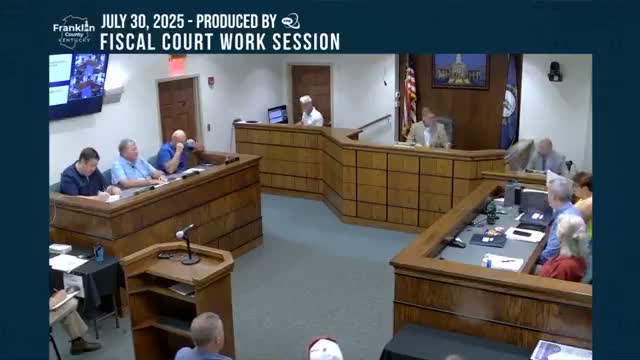
Franklin County's county attorney told the fiscal court during its July 30 work session that members must decide zoning amendments based on the record from the planning commission or a separate evidentiary hearing and therefore cannot accept public comments on whether the court should grant or deny those zoning changes. The attorney said comments about whether to hold a hearing remain permissible but that testimony bearing on the merits could be treated as evidence not in the record.
The guidance prompted an immediate objection from a court member who said the advice jeopardizes the constitutional right to free speech and risks discriminating against viewpoints. That member argued the judge sets the agenda under Kentucky Revised Statutes and that the court should be able to hear constituents before acting.
During the public comment period, resident John Carlton urged the court to restore unrestricted public comment on zoning matters. "This restriction . . . silences the public on some of the most impactful government decisions," Carlton said, arguing the limitation is "arbitrary, selective, and discriminatory" and risks violating federal and state due-process and equal-protection guarantees. He told the court that KRS Chapter 100 does not override the First and Fourteenth Amendments or analogous provisions of the Kentucky Constitution.
The court discussed the line between its judicial/quasi-judicial role when acting on planning commission records and a legislative role when considering policy or initiating hearings. The county attorney said the court sits in a quasi-judicial role for planning and zoning matters and offered to review case law or statutes that differ from his advice. Several members said they want clarity and outside review; one member said he had previously asked the court to seek an attorney general opinion but the court declined.
No change to the public comment policy was made at the session; the discussion was part of the work-session record and members signaled the question could be revisited in future meetings.
The court's statements and the public remarks focused on procedure and legal risk; no formal zoning decision was made during the public-comment portion of the meeting.