Get Full Government Meeting Transcripts, Videos, & Alerts Forever!
Get email alerts on the Workplace Health topic
No spam. Unsubscribe anytime.
Sheriff and employees say county-owned building made staff sick; residents demand accountability
Summary
During public comment at the Jan. 9 Flagler County commission meeting, Sheriff Rick Staley and multiple sheriff's office employees said a county-owned building caused illnesses; speakers urged the commission to address employee care, FDEP enforcement and possible permit violations.
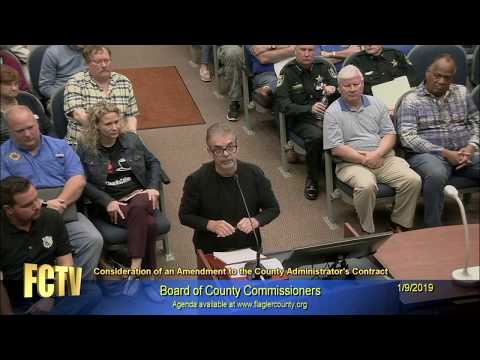
Dozens of sheriff's office employees have experienced health problems they and their union say were caused by a county-owned building, Flagler County Sheriff Rick Staley told commissioners at a Jan. 9 special meeting.
"It was completely 100% preventable," Staley said, urging the board to act and to ensure affected employees receive care and support. His remarks came during public comment on a separate agenda item — an amendment to County Administrator Craig Coffey—s employment agreement — but several speakers linked the personnel decision to broader questions about accountability for the building and employee welfare.
Franklin Gomaro, a sergeant who identified himself as a sheriff's office employee, described colleagues who had major life changes because of illness he tied to the building. "Before Mr. Coffey exits his position here at the county, I believe he owes those people an apology," Gomaro said.
Other public commenters made procedural and regulatory claims. Dennis McDonald alleged the county removed 21,000 square feet of material without an FDEP permit and said he had the Department of Environmental Protection fine in hand; McDonald also cited what he called a relevant Florida building-code provision.
A resident critical of Coffey—s tenure alleged higher water bills and closed-bid contracting, telling the commission she had personally paid "over $2,700 in unnecessary increase in our water bills alone." Those claims were made in public comment and were not adjudicated at the meeting.
County Attorney Al Hadid described the nondisparagement clause in Coffey—s amendment but did not address regulatory enforcement or remediation steps at the meeting. Commissioners acknowledged the public-health claims and scheduled a Monday workshop focused on transition planning; they did not, during this meeting, adopt a remediation plan or refer the building issues to a specific agency for investigation.
The testimony raises procedural and factual questions that will require records and external verification: claims about permit omissions and fines, the scope of demolition, medical causation for employee illnesses and any costs for remediation or workers' compensation. The commission's decision to accept the employment amendment did not resolve those claims and left open next steps for addressing the building and affected employees.