Get Full Government Meeting Transcripts, Videos, & Alerts Forever!
Get email alerts on the Fire Assessment Fee topic
No spam. Unsubscribe anytime.
City administrator defends fire assessment fee use, says prior representations about staffing/trucks did not align with adopted budget
Summary
City Administrator Faye Johnson reviewed the history and legal uses of the fire assessment fee, said the city has not misused the funds, and identified gaps between August 2019 public presentations (which stakeholders characterized as promising 9 firefighters and two trucks) and the FY20 adopted budget, which did not include those FTEs.
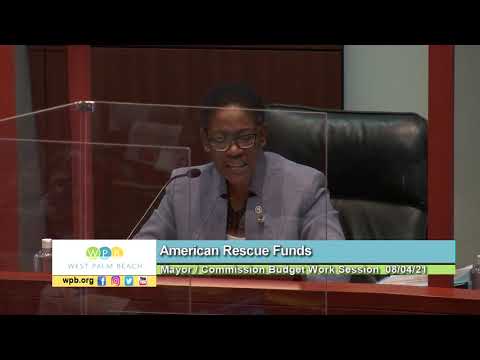
West Palm Beach officials spent the second half of an Aug. 4 budget work session reviewing the city's fire assessment fee: its legal basis, how revenues were used, and lingering questions about promises made during a 2019 rate increase discussion.
City Administrator Faye Johnson told commissioners she opened the review to confirm legal compliance with ordinance 41-41-08, to "clear up the discrepancy" about what was represented in 2019 about how revenue increases would be used, and to explain quarterly reporting practices. "I want to start out by emphatically stating that there has been no misuse of the city's fire fees," she said.
Johnson traced the fee's origin to a 2008 program developed by Government Services Group (GSG), described the ordinance's permitted uses (a lettered list of categories including personnel services, materials and services, capital outlay and debt service), and noted the fee is deposited in a separate capital-type fund (Fund 131) for eligible fire-related uses. She summarized revenue growth following multi-step rate changes (residential rates moved from $25 to $50 in 2018 and to $100 in 2019) and said total adopted revenue for FY19-FY21 rose from roughly $4.5M to $9M in the most recent adopted budget year.
Johnson and staff addressed an apparent mismatch between a 2019 public presentation that stakeholders and some commissioners recalled as pledging two trucks and nine firefighters, and the actual FY20 adopted budget. The administration argued the presentation's arithmetic and commitments did not match the budget documents that were adopted: "The math doesn't work," Johnson said, noting that the FY20 adopted budget did not include the nine firefighter FTEs. Budget manager Linda McDermott confirmed the record: at both September 2019 budget hearings there were no additional FTEs added to the fire-fee fund.
Former city administrator Jeff Green and the budget office staff said the budget process and the general fund had been largely set and that, while presentations may have described needs or intentions, the adopted budget did not contain the positions. Staff described later financing and procurement changes that allowed more vehicles to be acquired than the initial presentation had specified (four trucks financed rather than three), but underscored that staffing lines were not included in the FY20 adoption.
Johnson acknowledged the administration did not meet the commission's earlier request for scheduled quarterly work sessions on the fire fee during a leadership transition, but said that omission was not evidence of misuse and pledged to resume regular reporting. She noted that the city's external auditor had reviewed the fire-fee fund and that the annual financial statements contained no findings of misapplication of the fee.
Fire Chief Diana Maddie described remaining operational needs: some promises were fulfilled (engine 1 was returned to service), but Station 9 still operates from a temporary trailer, Station 1 downtown is beyond its capacity and life expectancy, and other stations remain undersized. Chief Maddie supported developing a multi-year strategic plan to align anticipated revenues with staffing and capital requirements.
Next steps: Johnson said administration will present a line-item proposed FY22 use of the fire fee and a third-quarter expenditures report at a budget work session on Aug. 10, with the preliminary general-fund balanced budget presented Aug. 23 and subsequent public hearings in September. Commissioners urged a strategic 5- to 10-year plan for the fee so the public and elected officials can track promises and long-term commitments.
No votes were taken; commissioners agreed to the Aug. 10 follow-up and to resume regular reporting on the fire-fee fund.