Get Full Government Meeting Transcripts, Videos, & Alerts Forever!
Get email alerts on the Arpa Allocation topic
No spam. Unsubscribe anytime.
West Palm Beach weighs ARPA spending: replace lost revenue, premium pay and vehicle replacements recommended
Summary
City staff outlined a three-part ARPA spending plan — replacing lost revenue, targeted premium pay, and public-health/economic-impact programs — but deferred setting dollar amounts pending a union impasse and a public hearing. Administration flagged $8 million in critical vehicle replacements and an estimated 1,275 eligible employees for premium pay.
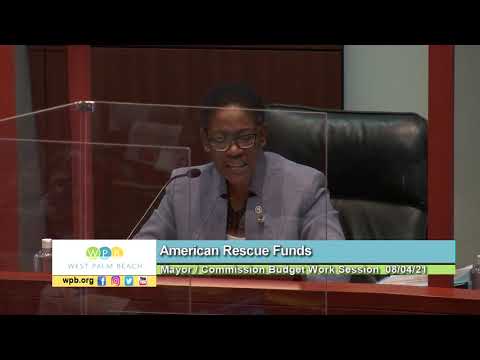
West Palm Beach city administration told commissioners on Aug. 4 that the city's American Rescue Plan Act allocation of $24,530,820 should be targeted at replacing lost revenue, providing premium pay to essential workers and addressing public-health and economic harms from the pandemic. Officials said they are postponing specific dollar recommendations until a pending public hearing on a union impasse is resolved.
The city attorney, Miss Rothenberg, opened by summarizing the federal rules: metropolitan cities received roughly $45.6 billion total under ARPA; West Palm Beach's allocation arrives in two tranches and must be obligated by Dec. 31, 2024 and spent by 2026. Eligible uses include public-health responses and mitigation, premium pay for eligible workers, replacement of lost government revenue, and certain infrastructure such as water, sewer and broadband. "The city's allocation was $24,530,820," she said, describing the categories in the interim rules and the emphasis on serving communities hardest hit by COVID-19.
Faye Johnson, city administrator, said administration's recommendation is to exclude the water/sewer/broadband category from ARPA spending because recommended utility projects carry large price tags and other funding may be forthcoming. Instead, Johnson proposed three priorities for these federal dollars: replace lost revenue, provide premium pay to essential workers and fund public-health and economic-impact programs. Johnson emphasized that no dollar amounts are being recommended at this stage because of a pending public hearing tied to a union negotiation.
Support services director Mario Guzman told commissioners the city has identified about $12 million in vehicle replacements across departments and highlighted $8 million of "critical" replacements needed immediately to maintain operations. Guzman gave specific cost examples: a garbage truck costs about $350,000; a pumper/rescue apparatus roughly $800,000. "We identified $8,000,000 as critical replacements, that provide services," he said.
On premium pay, HR and administration presented a draft list of essential-worker classifications and a preliminary headcount of roughly 1,275 employees who might qualify, after removing employees who worked regularly via telework. Administration said the federal guidance allows premium pay up to $13 per hour and a maximum of $25,000 per worker, and directs jurisdictions to prioritize lower-income employees and workers with regular in-person duties.
Commissioners asked for scenarios showing the budget impact of different premium-pay structures (for example, tiered payments for frontline workers versus a flat lump sum) and for a crosswalk showing which job classifications received cost-of-living adjustments last year to avoid double-counting or unfair overlap. Administration agreed to return with more detailed options during upcoming budget sessions and said the Aug. 10 budget work session will include follow-up analysis.
No formal action was taken. The administration asked the commission to direct staff on categories and priorities and to await the scheduled public hearing before adopting specific dollar allocations. The board set the next step as an Aug. 10 work session where administration will present third-quarter ARPA/FY22 budget proposals and premium-pay scenarios.
What comes next: commissioners will review the administration's budget scenarios at the Aug. 10 work session; a preliminary balanced budget will be presented Aug. 23 followed by public hearings in September.