Get Full Government Meeting Transcripts, Videos, & Alerts Forever!
Get email alerts on the Land Use Special Events topic
No spam. Unsubscribe anytime.
Larimer County commissioners begin overhaul of special-events land use code, question 40-person threshold
Summary
County staff proposed a comprehensive update to the special-events section of the Larimer County Land Use Code, seeking public input on permit thresholds, zoning differences, camping, enforcement and caps; commissioners expressed support for clearer rules and raised concerns about the current 40-person permit threshold.
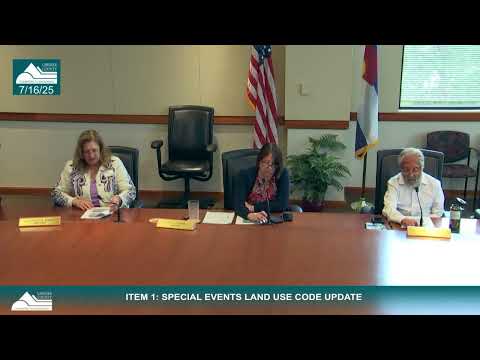
Larimer County commissioners on July 16 held a work session to begin a comprehensive update of the countys Land Use Code sections governing special events, with staff seeking early direction on when permits should apply, how rules should vary by event type and zoning, and how enforcement and outreach should work.
Rebecca Everett, director of Community Development, told commissioners the county has spent 2023'2024 improving administrative processes and permitting software and now wants to zoom out to make the regulatory framework match the evolving types and sizes of events. Everett said staff had planned to finish the project in 2025 for the 2026 season but delayed that timeline; staff now aims to complete drafting in 2026, hold hearings by about August 2026 and have code changes take effect for the 2027 special-event season.
Michael Whitley, senior planner, read the central applicability threshold in the current code: a special-event permit is required when attendance is anticipated to exceed 40 persons. "A special event permit is required for any special event where it is anticipated that the overall attendance will exceed 40 persons," Whitley said. He presented a list of issues for commissioner input: whether to keep or change the attendance threshold, whether to distinguish private events that are open to the public, whether rules should vary by zoning or land use, caps on the number of permits or event days per property, how outstanding code violations should affect permit eligibility, whether overnight camping should be allowed and what penalties should apply for unpermitted or noncompliant events.
Whitley also described existing numeric limits in the code: up to three special-event permits per private parcel per calendar year, no more than one permit per month, and a cumulative limit of 30 event days in any 12-month period. Staff said camping is currently allowed under the code but that the rules only reference compliance with unspecified local and state requirements, prompting staff to consider whether clearer camping standards are needed.
Senior planner Samantha Mott outlined an outreach plan that includes an online public input tool, direct email to past organizers, press releases, partnerships with the countys Natural Resources division, hybrid in-person meetings, reviewer consultations and a survey that would collect respondent role and basic demographics.
Commissioners offered early reactions focused on balancing community events with neighborhood impacts. Commissioner Jody Shattuck McNally urged a tiered approach to applicability and fees and said the 40-person threshold "is a bad idea anymore because people have found ways to go around that," arguing that criteria tied to likely impacts (wildfire risk, proximity to neighbors, traffic, lighting and noise) would better identify events that require oversight. McNally recommended stronger consequences for repeat noncompliance and suggested prioritizing input from neighbors most affected by events near Horsetooth Reservoir, Carter Lake, Pinewood Springs and other unincorporated areas.
Commissioner Cavallos asked staff to list the current criteria in Article 7 and supported streamlining the process for nonprofit organizers and agritourism businesses that rely on occasional events, while also endorsing graduated enforcement that distinguishes first-time, inadvertent organizers from deliberate violators. Commissioner John Kefalas emphasized agricultural uses and noted the need for clearer referral-agency criteria on public-safety issues; he also called attention to unauthorized gatherings that occur off county land but generate county impacts on roads and emergency services.
Staff said they will return with peer comparisons to neighboring counties, outreach findings and recommended options. No formal vote or ordinance action occurred at the session; commissioners directed staff to continue public engagement and bring draft code language and analysis back in 2026.
Next procedural step: staff will begin public outreach through late 2025, draft code revisions in 2026, vet changes with the Planning Commission and aim for a public hearing with the Board by about August 2026, with any adopted code changes planned to take effect for the 2027 season.