Get Full Government Meeting Transcripts, Videos, & Alerts Forever!
Get email alerts on the Minimum Wage topic
No spam. Unsubscribe anytime.
Public commenters clash over Boulder County minimum wage as commissioners pledge further review
Summary
At the July 1 Boulder County commissioners meeting, business and farm advocates urged pausing planned county minimum wage increases, while labor leaders defended the policy as necessary for workers; commissioners said changes to state law or regional coordination would be needed and noted legal timing constraints on ordinances.
Boulder County — Business owners, farmers and labor advocates offered sharply different views on the county minimum wage during public comment at the Board of County Commissioners’ July 1 meeting.
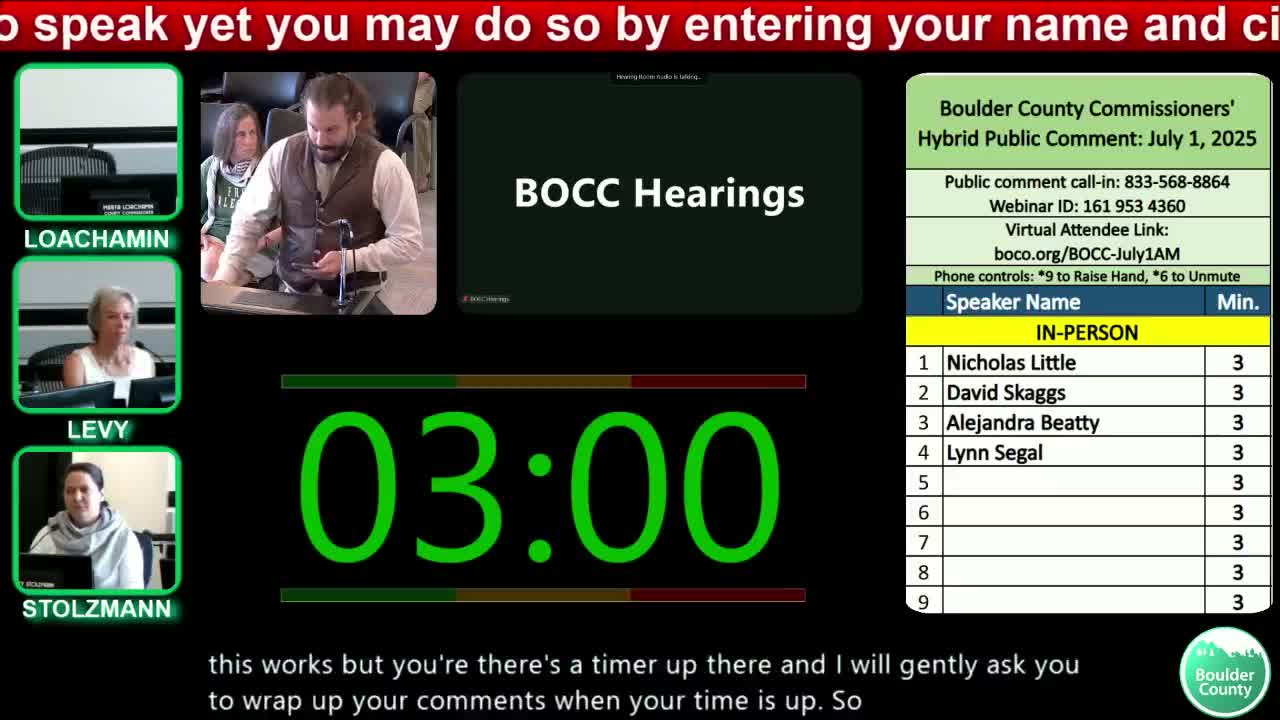
Nick Little, representing the Keep Boulder County Farms and Jobs Alliance, told commissioners the county’s increase will “erase entry-level job opportunities” and predicted that “at $25 an hour, who’s gonna hire a teenager?” He said the wage change, combined with zoning and climate policies, is driving families out of the county.
David Skaggs, also speaking for a farming coalition, said the ordinance puts unincorporated-area farmers and small businesses at a competitive disadvantage and singled out a bookkeeping burden created by a county rule requiring that a worker employed four hours or more in unincorporated Boulder County be paid the higher county minimum regardless of where the employer is based. Skaggs urged the county to pause further increases while jurisdictions discuss uniformity.
By contrast, Alejandro Beatty, president of the Boulder Area Labor Council, argued higher wages increase local spending and strengthen the economy, saying, “If I make more money, I can go out to eat.” He asked the commission to lead coalition-building with regional partners to balance worker and small-business needs.
Several other speakers echoed both sides of the debate. Allison Steele, a small grocery owner, asked commissioners to “pause” increases if neighboring municipalities do not align, saying the policy strains very small businesses. Commissioners also heard concerns about enforcement and administrative burdens for businesses that cross jurisdictional lines.
In responses after public comment, the commissioners said they heard the concerns and noted structural limits on what the county can do. They explained that local ordinances take effect under a schedule set by county code — typically an ordinance effective date of Jan. 1 — and that some aspects of the county rule (including the four-hour provision) derive from state law. Commissioners urged regional coordination and suggested changes would require action by the state or a regional consortium of jurisdictions.
The meeting did not include any change to the ordinance; public comment closed and the board adjourned after routine administrative business and the scheduled public-comment period.