Get Full Government Meeting Transcripts, Videos, & Alerts Forever!
Get email alerts on the Road Safety topic
No spam. Unsubscribe anytime.
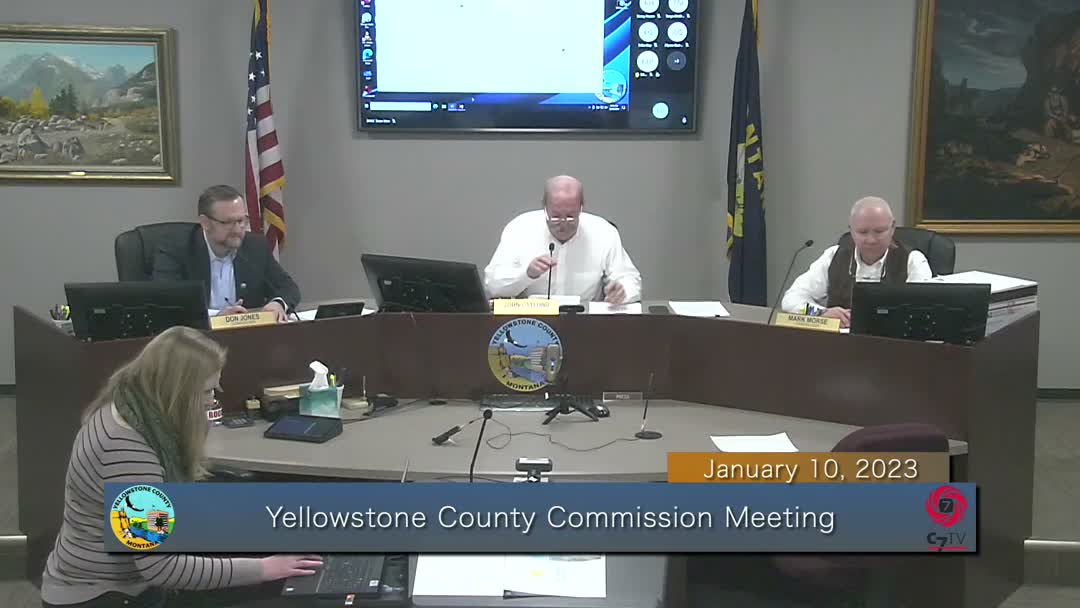
Commissioners approve updated Billings Community Transportation Safety Plan emphasizing Vision Zero and behavioral strategies
Summary
The board approved an update to the Billings Community Transportation Safety Plan that reaffirms a Vision Zero goal, preserves a 20% five-year rolling reduction target, and highlights enforcement, education, EMS and engineering strategies to reduce fatalities, impaired and distracted driving.
The Board of County Commissioners approved the updated Billings Community Transportation Safety Plan (CTSP), a five-year framework focused on behavioral and partnership strategies to reduce traffic fatalities and serious injuries.
A CTSP presenter described the update as rooted in crash-data analysis across a 10-year window and built by an advisory committee that included law enforcement, emergency services, engineers and other safety stakeholders. The advisory committee retained a Vision Zero framing (the federal and state objective of zero fatalities and serious injuries) and preserved the five-year rolling goal to reduce fatalities and serious injuries by 20 percent; consultant analysis showed a 15 percent reduction on the original baseline and an 18 percent reduction when including 2020 data.
The plan centers on the four 'E's' of traffic safety: engineering, emergency services/EMS, enforcement and education. Recommended tactics included establishing a standing transportation safety oversight committee, enhancing enforcement of seat-belt and child-seat laws, expanding youth and adult education about seat-belt use, expanding awareness and access to safe transportation alternatives to reduce impaired driving, and increasing proactive speed and distracted-driving enforcement. The plan also recommends partners, resources and concrete action items in the full document.
Commissioners asked whether unlicensed and uninsured motorists were tracked in the crash dataset; consultants said such fields were tracked by some agencies but were not provided for this review and offered to supply that information as a next step. Commissioner Jones moved to approve the CTSP and forward it to PCC; the motion carried by voice vote.
The approval moves the draft plan forward for finalization and implementation planning; staff and the advisory group will continue coordination on data gaps, enforcement partnerships and public education efforts.
What happens next: The plan will move forward for final adoption steps and the consultants recommended establishing a standing oversight committee to sustain cross-agency collaboration and implementation.