Get Full Government Meeting Transcripts, Videos, & Alerts Forever!
Get email alerts on the Signage topic
No spam. Unsubscribe anytime.
Board approves limited on-premise tenant ads on two existing billboards at 111 S. Green River Road
Summary
The Board of Zoning Appeals voted 4–2 to allow two existing electronic billboards at the Brinker’s shopping center to carry on‑premise tenant advertising under a recorded use-and-development commitment limiting aggregate tenant time to 50%, requiring static images, and tying the dual use to property ownership.
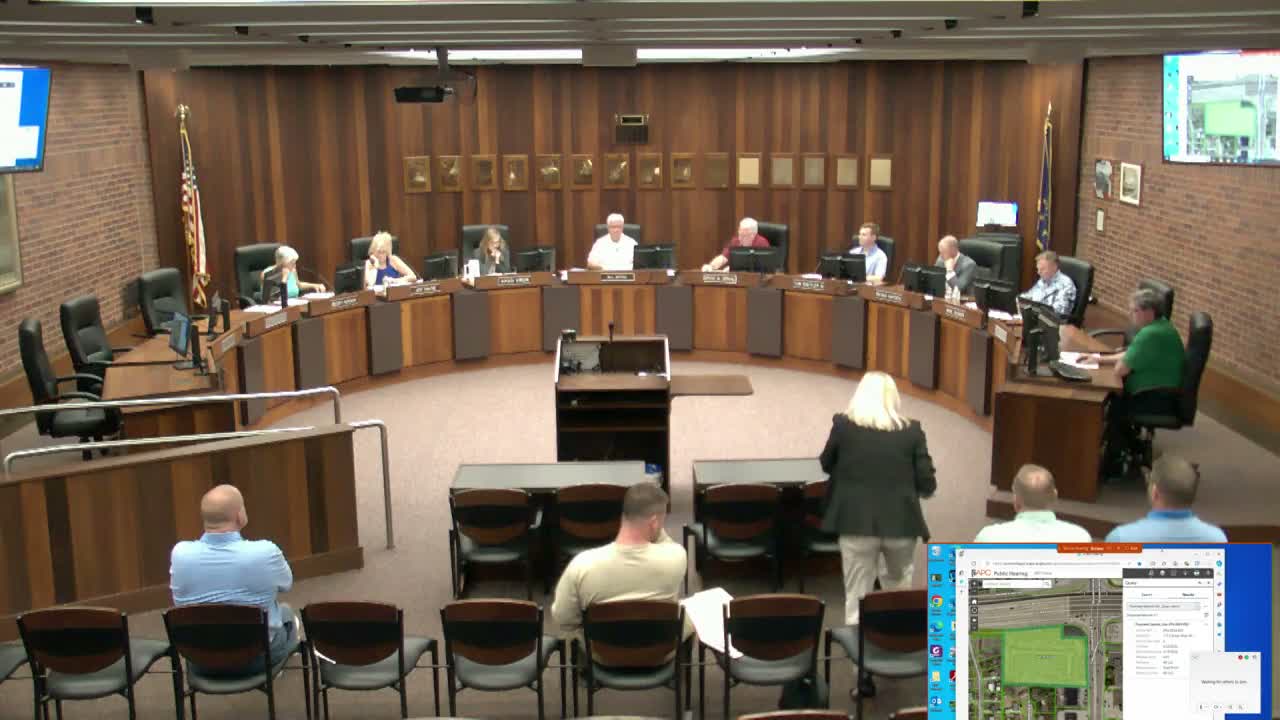
The Evansville Board of Zoning Appeals voted 4–2 on Aug. 15 to approve a special‑use permit and companion variances to let two existing electronic message signs at 111 South Green River Road carry on‑premise tenant advertising under a recorded use‑and‑development commitment. The approval was conditioned on the petitioners executing and recording the commitment and keeping the signs subject to the city’s sign ordinance.
Krista Lockyer, attorney and representative for 4 D LLC, told the board the petition seeks to allow tenants in the eight‑tenant Brinker’s shopping center to advertise on two electronic signs already on the property. Lockyer said the applicants negotiated restrictions with Keep Evansville Beautiful and incorporated them into the commitment, “So we have a limitation of 50% of available advertising for on premise,” she said, adding that tenant ads will be static only and transitions must follow the city’s off‑premise sign rules.
Owner Kyle Brinker said the property owner purchased and installed the two large electronic signs and that digital faces were installed about two years ago. “They have been there for over 15 years,” Brinker said, describing efforts to work with remonstrators and to keep the advertising tasteful.
Board members debated whether the request satisfied the variance criteria required under state law and the local code, with particular focus on the “practical difficulties” criterion (criterion 3) and whether the applicant created the need for relief (criterion 6). Legal counsel and petitioners argued that the ordinance language and the facts support the requested relief and that the use‑and‑development commitment provides enforceable limits. Counsel and staff also noted that Indiana Department of Transportation (INDOT) guidance discourages mixing on‑ and off‑premise messages on control‑route signs and that a city approval would not override INDOT’s decisions.
The motion to grant the special use was approved by roll call with four yes votes and two no votes (Yes: Shetler, Zaner, Hayden, Petke; No: Payne, Kasha). A second motion approving the variances (to increase allowable on‑premise signage time and aggregate square footage as described in the application) carried on the same 4–2 vote. The board’s approval explicitly ties the relief to the two existing off‑premise signs and requires recording the use‑and‑development commitment that (1) caps aggregate tenant advertising time at 50%, (2) restricts tenant ads to businesses with a minimum footprint (as described in the commitment) and (3) forbids animation or video.
The recorded commitment also contains language intended to prevent a future owner from separating the signage from the shopping center to reconfigure the signs for full off‑premise advertising; the BZA required the ownership tie as a condition of approval. Staff told the board they have contacted INDOT for clarification on mixing on‑ and off‑premise messages on control routes and have not yet received a definitive written position; INDOT’s guidance remains a potential external constraint.
The approval allows qualified tenants to buy advertising time under the normal rate sheet; petitioners said tenants would not receive special discounts. The board’s action leaves in place both city sign‑ordinance standards and the added recorded limits the BZA required. The petitioners said they will record the commitment and will operate the two signs under the conditions approved by the BZA.
The special use and variance filings are listed in the record as SPU-2024-002 and VAR-2024-043. The board’s next regular meeting is scheduled for Sept. 19, 2024.