Get Full Government Meeting Transcripts, Videos, & Alerts Forever!
Get email alerts on the Micromobility topic
No spam. Unsubscribe anytime.
Veo outlines forced-parking, photo verification and new enforcement as council trims mobility permit fee
Summary
Veo told the West Lafayette City Council it recorded about 86,000 trips this year and has activated forced-parking geofences in a primary zone; the council amended mobility-permit fees and approved the ordinance as amended after public safety concerns about sidewalk and trail blockages.
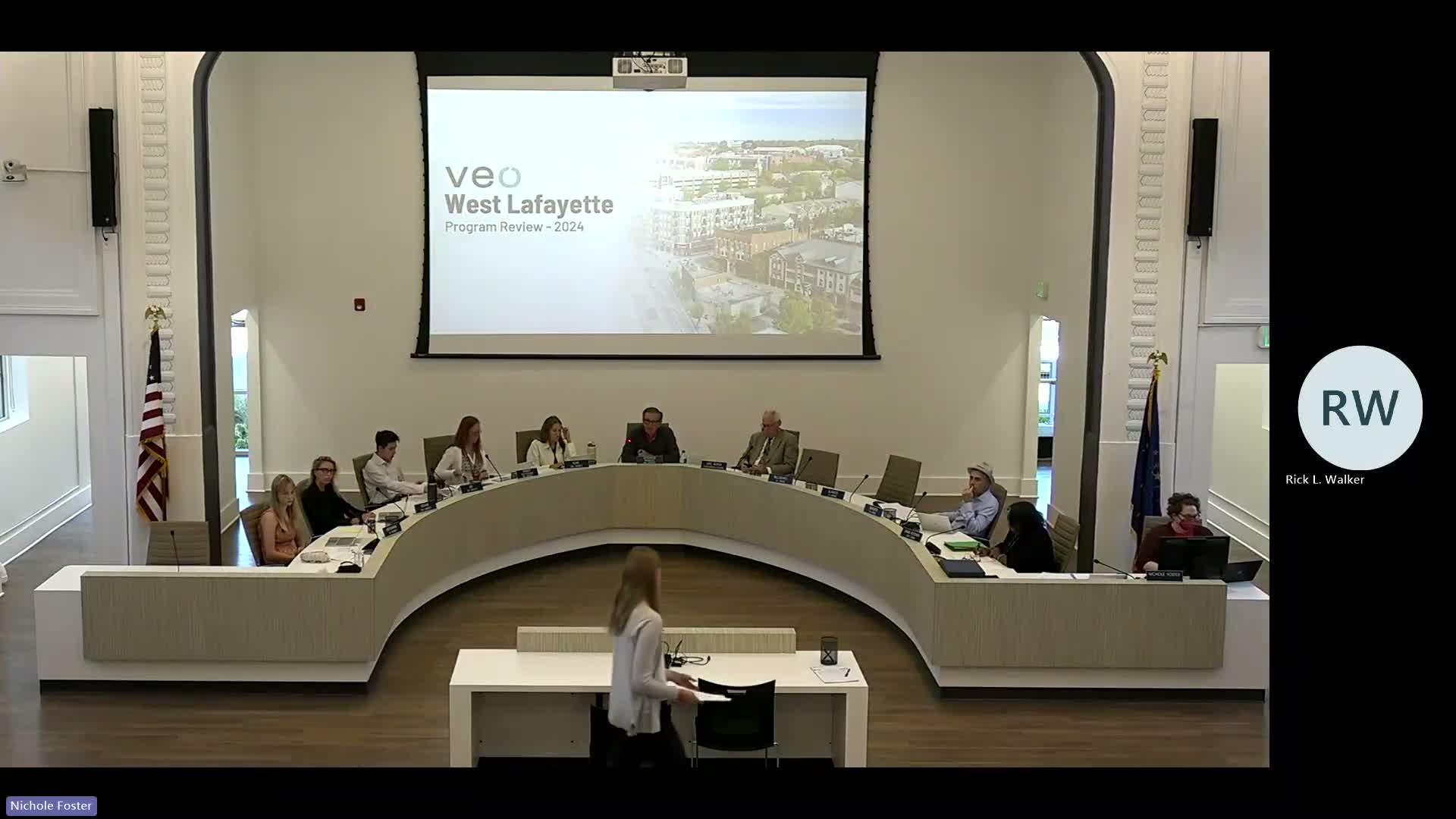
West Lafayette — The city council on Aug. 19 heard a progress report from Veo, the company operating scooters and bikes in the Purdue/West Lafayette market, and approved an amended mobility permit fee ordinance after residents and councilors pressed for stronger parking enforcement.
Natalia Bartos of the engineering department introduced Aaron Madrid, Veo’s policy and partnerships manager, who said the company has recorded roughly 86,000 trips year-to-date and that about 60,000 originated on campus and about 20,000 off campus. Madrid said the operator expanded geofenced “no parking” zones across multi-use paths, cycle tracks and selected sidewalks, and activated a forced-parking configuration in a primary Zone 1.
“There's a total of 86,000 trips so far this year,” Madrid said, adding that Zone 1 is “completely activated” and that the firm has expanded private-property geofences where requested by business owners.
Madrid explained the current photo-based end-of-ride process: users take a photo to confirm compliant parking, and operations staff review photos on reports or when staff observe an issue. He said Veo will deploy new technology before winter that will instantly validate whether a rider has parked correctly and immediately notify the user and assess fines when needed.
Council members pressed for details on signage, user maps and fines. Madrid said signs are not yet installed everywhere and that the Veo app already displays nearby permitted parking locations; when a rider attempts to end a trip away from an approved spot the app will “draw a line and literally show them where the closest one is.” On sanctions he described an escalating system of warnings, $10–$20 fines and temporary bans requiring an educational quiz to restore account access.
Residents told the council enforcement remains uneven. Trinda Steckler, who said she walks the Celery Bog every morning, described scooters left on trails and sidewalks as “a debris field,” and said she had reported devices that were not promptly removed. “They’re blocked at the crossing parkway … it’s just a debris field,” Steckler said.
Council debate overlapped with consideration of Ordinance 10-20-24, which updates mobility system enterprise permit fees. Councilor Sanders proposed reducing an earlier proposed fee increase from $10,000 to $5,000 (amending a $25,000 fee to $20,000 annually); that amendment was seconded, approved by voice vote, and the ordinance passed as amended by roll call.
Councilors and Veo agreed to continue coordination with CityBus and apartment complexes on designated parking locations and to report back with enforcement metrics at the traffic committee. Madrid said Veo plans continued testing and private-property outreach and offered to bring before-and-after metrics to the next traffic committee meeting.
What’s next: the council approved the amended mobility-permit ordinance at the meeting’s vote; staff and Veo will continue geofence tuning, private-property outreach and data reporting to city committees.