Get Full Government Meeting Transcripts, Videos, & Alerts Forever!
Get email alerts on the Housing Development topic
No spam. Unsubscribe anytime.
Los Alamitos planning commission continues hearing on 246‑unit Lampson Park Place after hours of public comment
Summary
Planning commissioners continued the public hearing on the Lampson Park Place project at 4665 Lampson Avenue after residents and neighboring Seal Beach officials raised concerns about traffic safety, sewer and stormwater capacity, park access and rushed review of the draft EIR. Staff and applicants said most technical issues are conditions of approval and will be addressed before permits are issued.
Los Alamitos planning commissioners on [date not specified] voted to continue the public hearing on the Lampson Park Place development — a proposed 246‑unit project at 4665 Lampson Avenue — after more than two hours of staff presentation, applicant remarks and public testimony that ranged from strong support for new housing to detailed objections from neighboring Seal Beach residents.
Staff told the commission the project would include 246 residential units on about 12.3 acres north of Lampson Avenue and adjacent to Arbor Park, with a mix of product types: 55 single‑family courtyard homes, 114 townhomes and 77 affordable rental units. The staff presentation said the project proposes 577 on‑site parking spaces, on‑site recreation and open space, a one‑on‑site management unit for the affordable component and a range of infrastructure improvements. "This housing community will generate over $4,000,000 in fees to the city of Los Alamitos," the applicant's representative, George Voigt, said during his remarks; he added the project would produce roughly $2,000,000 in school fees to the Los Alamitos School District.
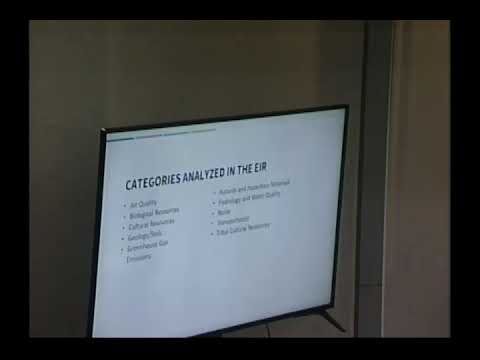
Staff and the city's EIR consultant, Bill Halligan, summarized the environmental review. Halligan said the draft and final EIR analyzed air quality, biology, cultural resources, geology, greenhouse gas emissions, hazards, hydrology and water quality, noise, transportation and tribal cultural resources. Most topics were found to be less than significant or less‑than‑significant with mitigation, he said. "The EIR did identify one significant unavoidable adverse impact, and that was related to transportation and traffic," Halligan told the commission, citing changes under state law (SB 743) that require vehicle miles traveled (VMT) as the traffic metric rather than level of service.
Applicant and affordable‑housing partner CNC Development described the affordable component as workforce housing designed to prioritize local households, workers and veterans. Todd Caudill of CNC said the 77 affordable units would include a 25% preference for veteran households and on‑site resident services including after‑school programming.
Public comment was extensive and sharply divided. Seal Beach officials and multiple College Park East residents objected to the pace of the environmental review and urged more interjurisdictional coordination. "In my opinion, this EIR is not complete," the mayor of Seal Beach said, urging that Seal Beach staff be given time to review the approximately 2,500 pages released shortly before the hearing. Several speakers documented repeated reports of manholes bubbling during storms and described ongoing stormwater and sewer capacity concerns in neighborhoods that abut the project site.
Other speakers supported the development as one of the few realistic opportunities to add housing in Los Alamitos. "We need opportunities for housing for our families and for those financially less fortunate or just starting out who are the key to the fabric of our community," one resident said. Several veterans and veterans' advocates praised the proposed veteran preference for the affordable units.
Commissioners' questions to staff and the applicant focused on a set of technical and interjurisdictional issues raised repeatedly during public comment: whether the project has a "will‑serve" agreement with Seal Beach for sewer, how stormwater would be handled if the preferred drainage path across federal or base property is unavailable, how access and easements between the market‑rate and affordable parcels will be protected from future gating, the number and placement of trash enclosures for multifamily residents, and specific parking stall dimensions that the commission noted appear on plan sheets as 17 feet deep where code requires 19 feet.
Staff and the applicant indicated many of those topics are addressed in conditions of approval or in the tentative tract map; the applicant's civil engineer showed a tentatively dedicated city easement along the northern boundary to provide access and limit gating. Halligan and staff confirmed some final utility coordination — including any necessary concurrence from Seal Beach and the Joint Forces Training Base on off‑site connections and easement use — remains to be completed before building permits could be issued.
After deliberation, a majority of commissioners voted to continue the public hearing to the commission's next regular meeting and asked staff to return with a focused progress report on the outstanding items (trash enclosure siting and sizing, parking depth clarifications and plan corrections, the status of sewer/will‑serve coordination with Seal Beach, and the nature of any agreements or memoranda with the Joint Forces Training Base concerning Arbor Park access). The public hearing remains open and the commission's continuance is a recommendation step to City Council; any final approvals (including certification of the Final EIR or recordation of maps) would be acted on later in the entitlement process.
What is next: staff will contact Seal Beach and other agencies referenced in the EIR to report on outstanding service and access issues and will return to the Planning Commission with a progress update and corrected plan details. Any building permits remain contingent on required utility agreements and the standard conditions for approval described in the EIR and staff report.
Key quotes
"The EIR did identify one significant unavoidable adverse impact, and that was related to transportation and traffic," Bill Halligan, city EIR consultant.
"This housing community will generate over $4,000,000 in fees to the city of Los Alamitos," George Voigt, applicant representative.
"In my opinion, this EIR is not complete," the mayor of Seal Beach (public commenter).
"These 77 new units are designed to serve lower income Los Alamitos residents, our local workforce, and veterans within the community," Todd Caudill, CNC Development.
Ending
The Planning Commission left the public hearing open and continued the item to its next regularly scheduled meeting, requesting targeted updates from staff and the applicant on the narrow list of outstanding technical and interjurisdictional items before forwarding recommendations to City Council.