Get Full Government Meeting Transcripts, Videos, & Alerts Forever!
Get email alerts on the Internet Safety topic
No spam. Unsubscribe anytime.
VDOE seeks practitioner feedback on Internet‑safety model policy while rolling out AI and computer science supports
Summary
VDOE staff told the advisory committee the State Board adopted a model Internet safety policy in June and asked for practical feedback; staff also described AI literacy initiatives, teacher training, new computer science instructional guides and a $1.35 million grant to support CS implementation.
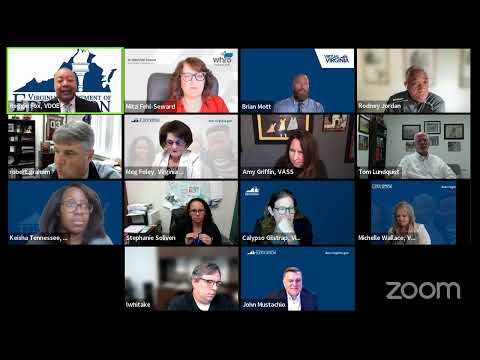
VDOE staff told the Virtual Learning Advisory Committee that the State Board of Education adopted a model policy concerning Internet safety in June and the Department is seeking practitioner feedback to refine the policy for classroom use.
Calypso Gilstrap said the model policy was developed in response to statute and that the State Board asked VDOE to revisit the policy with stakeholders; the policy’s goals include protecting students, supporting Internet safety instruction and aligning with the recently released cell‑phone policy and forthcoming AI guidance. The VDOE has posted model instructional practices and an Internet Safety Hub on GoOpen VA and encouraged divisions to share resources they would like included.
Committee breakout groups recommended a multi‑tiered approach that pairs technical measures (filters, broadband and network hardening) with instruction (digital wellness and trusted adult guidance), professional learning for educators, and law‑enforcement partnerships. WHRO and VDOE described a funded partnership to produce interactive middle‑school lessons and situational‑awareness content to meet legislative requirements for seventh‑ and eighth‑grade instruction.
Keisha Tennessee summarized the Generative AI Year of Learning initiative (75 participating divisions) and training for educators with Germanna Community College; she also noted that the 2024 Computer Science Standards were fully adopted in June with full implementation targeted for fall 2025 and described the Advancing Computer Science Education grant appropriation of about $1,350,000 to support implementation and resource development.
Committee members raised concerns about measuring the impact of recommendations, potential teacher workload from concurrent initiatives, and the need to be explicit about accountability and responsibilities for integrating computer science into non‑CS courses. VDOE staff said they will collect the committee’s input and provide further guidance and exemplars for professional learning.