Get Full Government Meeting Transcripts, Videos, & Alerts Forever!
Get email alerts on the Meeting Summary topic
No spam. Unsubscribe anytime.
VDOE advisory panel reviews virtual learning programs, seeks feedback on internet‑safety policy and AI guidance
Summary
The Virginia Department of Education’s Virtual Learning Advisory Committee reviewed Virtual Virginia and the Multi‑division Online Provider program, discussed integration of computer science and AI literacy, and solicited stakeholder input on a new model Internet safety policy and implementation supports.
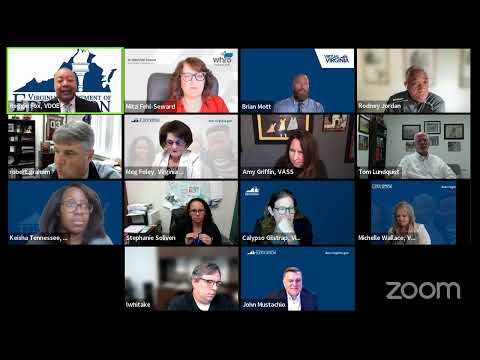
The Virginia Department of Education convened its Virtual Learning Advisory Committee in a virtual meeting to review statewide virtual learning programs, outline next steps on computer science and AI literacy, and solicit stakeholder feedback on a recently adopted model Internet safety policy.
Assistant Superintendent Michelle Wallace told committee members the VDOE is aligning instructional technology work with recently implemented standards of learning and a new school performance and support framework, and asked the group to advise on supports divisions will need as those systems are implemented.
Presenters described how virtual programs expand course access: Meg Foley summarized the multi‑division online provider (MOP) program and said the MOP tab is now included in School Quality Profiles, and Brian Mott described Virtual Virginia’s portfolio of AP, dual‑enrollment and CTE pathways, noting the program’s role as a complement to local offerings.
Calypso Gilstrap reviewed the model policy concerning Internet safety adopted by the State Board of Education and said the VDOE and partners have published resources on an Internet Safety Hub on GoOpen VA; she asked the committee to provide feedback to balance student safety, privacy and instructional benefit. Keisha Tennessee detailed AI and computer science work, including a Generative AI Year of Learning initiative (75 divisions participating) and state guidance tied to the 2024 Computer Science Standards, which are to be fully implemented in fall 2025.
Committee breakout groups reported common themes: flexibility in scheduling (summer and school‑year options), equity for small divisions, varied implementation use cases, the need to define integration versus standalone computer science instruction, and concern about competing priorities for teachers. Members also urged clearer measures of progress so the group can assess whether recommendations change classroom practice.
The committee set a tentative in‑person follow‑up for late April or early May and asked staff to synthesize feedback for the VDOE and the State Board; no formal votes or regulatory changes were taken at the meeting.