Get Full Government Meeting Transcripts, Videos, & Alerts Forever!
Get email alerts on the Wildfire Mitigation topic
No spam. Unsubscribe anytime.
SFPUC presents wildfire mitigation plan update and de-energization experience from October events
Summary
Hetch Hetchy division manager described required wildfire planning under SB 901 and Public Utilities Code citation in the transcript, mapped SFPUC lines against CPUC high-fire zones, explained de-energization thresholds tied to NOAA wind forecasts, and described localized de-energizations and restorations during October events.
San Francisco ' The San Francisco Public Utilities Commission received a detailed briefing on Nov. 12 about wildfire mitigation obligations and how the utility managed recent red-flag wind events.
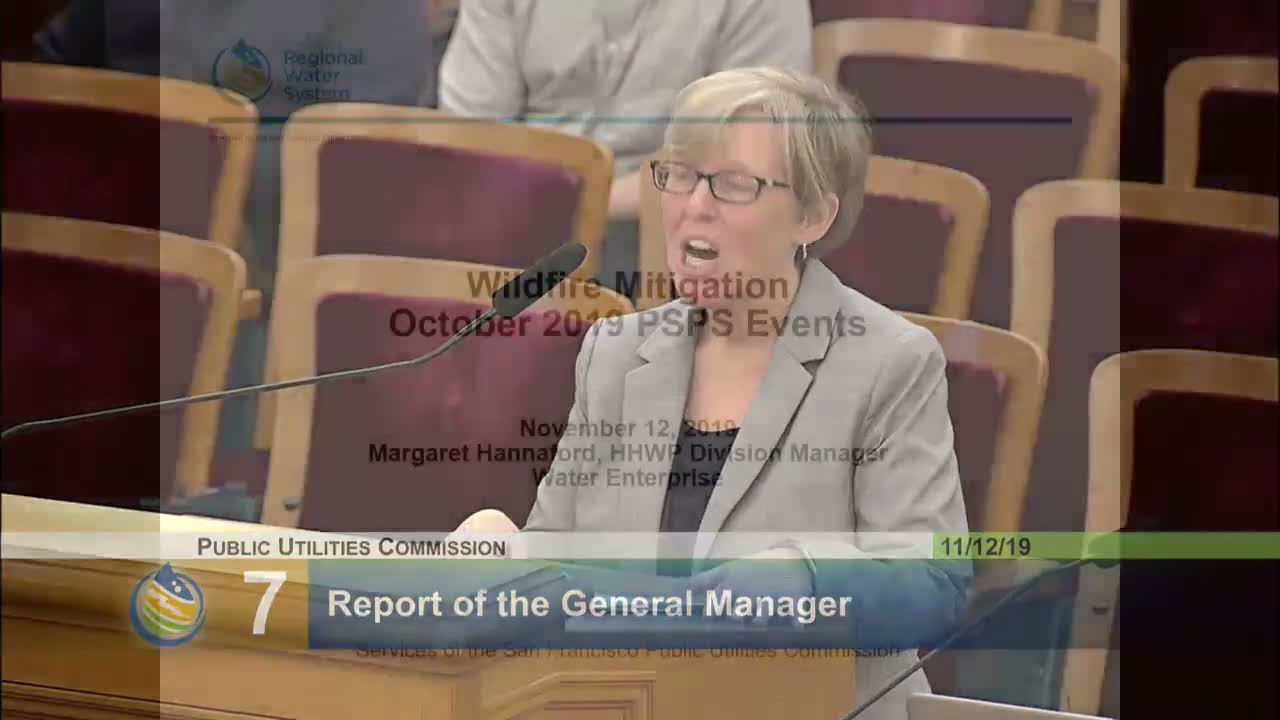
Margaret Hannaford, division manager for Hetch Hetchy Water and Power, told commissioners the utility has prepared a required wildfire mitigation plan under the state statutory framework cited in the presentation (speaker cited "Senate Bill 901" and "Public Utilities Code 8,387" in the transcript) and that the plan must be updated annually. The plan maps SFPUC transmission and distribution assets against the California Public Utilities Commission's high-fire-threat maps and requires defined roles and an independent evaluator.
Hannaford described the de-energization strategy the department uses when forecast and observed winds exceed thresholds. The staff uses NOAA forecasts and the same wind thresholds used by PG&E: sustained wind speeds at 25 miles per hour or gusts exceeding 45 mph. Hannaford said staff both forecasts and monitors conditions in real time to determine whether lines should be isolated or de-energized.
The division described its response in October. Staff isolated and de-energized some lines feeding watershed keeper houses on the peninsula and de-energized selected lines upcountry during the events; on Oct. 28 some lines were restored when observed winds did not meet the de-energization thresholds. Hannaford said about 100 miles of SFPUC lines lie in tier 2-3 high-fire areas and that the utility is evaluating additional mitigation, including vegetation management, system hardening and selective undergrounding where cost-effective. She said staff will return with an updated plan and possible budget modifications on Dec. 10.
Board members asked for more detail on peninsula vegetation management, coordination with PG&E and Cal Fire, and cost comparisons for undergrounding versus other mitigation. Commissioners also asked for more data about the frequency of events and the consequences of pre-emptive de-energization.
Hannaford said the utility will continue to coordinate with county, federal and state partners—naming Cal Fire, U.S. Forest Service and Tuolumne and Mariposa counties among SWIFT partners—and is planning independent evaluation and budgeting steps as the plan is finalized.