Get Full Government Meeting Transcripts, Videos, & Alerts Forever!
Get email alerts on the Urban Forestry topic
No spam. Unsubscribe anytime.
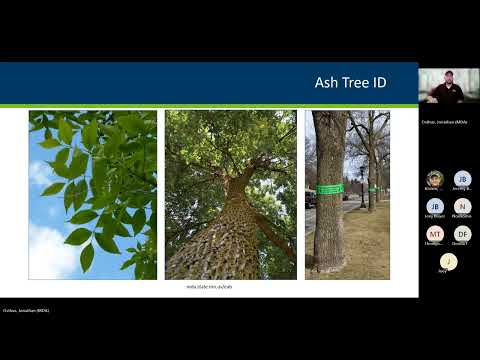
How to spot and manage emerald ash borer: identification, treatment and resources
Summary
MDA technical coordinator Jonathan Ostes outlined how to identify emerald ash borer (S‑shaped galleries, larval tail spines, woodpecker damage), options for treatment or removal, expected costs, and reporting and grant resources for communities and homeowners.
The Minnesota Department of Agriculture provided practical guidance on identifying emerald ash borer and on management options for homeowners and communities.
Jonathan Ostes explained the most reliable field signs: serpentine S-shaped feeding galleries under the bark, larval bodies with two tail spines (uragomphi), and woodpecker 'blonding' with shallow, dime-sized holes. "If you find that S-shaped feeding gallery in an ash tree, it is emerald ash borer," Ostes said. He cautioned that D-shaped exit holes and adult sightings can be harder to use for identification because they are small or can be confused with other insects.
Ostes reviewed the insect’s life cycle and detection window: adults typically emerge in mid‑May to June in southern Minnesota (timing varies by growing degree days) and larvae can overwinter in the tree, producing one- or two-year life cycles depending on latitude and density. He noted it can take about five years on average from initial infestation to tree death, although heavy pest pressure can shorten that interval.
For management, Ostes said options are broadly removals or insecticide treatments. He advised communities to build an ash inventory and to schedule removals during the dormant period (Oct. 1–Apr. 30) when possible to avoid moving material during the beetle’s active season (May 1–Sept. 30). "The only guaranteed way to protect an ash tree from emerald ash borer is treating individual trees with insecticide," he said, describing homeowner soil drenches (products such as imidacloprid or dinotefuran) and professional trunk injections using emamectin benzoate (a restricted-use pesticide that typically provides two years of control). Ostes recommended professional treatment for large trees (12–15 inches diameter at breast height and larger).
He gave cost context: some backyard removals can range from $7,000 to $10,000 for large trees; professional treatment costs often average about $10 per diameter inch but community programs can reduce that to under $5 per inch in some cases. MDA also cited treatment efficacy guidance: trees with less than 30% canopy decline remain reasonable candidates for treatment; once canopy decline exceeds roughly 30%, treatment is unlikely to restore the tree.
Ostes described compliant options for moving regulated materials (chipping/grinding to ≤1 inch in two dimensions, debarking with at least ½-inch sapwood removed, composting to 140°F for four days, and certified heat treatment) and reiterated that MDA‑certified, heat‑treated firewood may move freely. He urged residents to minimize long‑distance movement of firewood and to buy firewood where it will be burned.
Resources: Ostes pointed to MDA’s EAB homeowner insecticide guide, the EAB status map, DNR Forestry cost‑share and Urban & Community Forestry grants, and the Centering Communities and Canopy Solutions grant round (about $1 million total, up to $100,000 per community) with an application deadline referenced in the meeting. He also reviewed reporting methods (MDA report‑a‑pest email/form/voicemail and the EDDMaps app) and asked attendees to include photos and precise locations when reporting.
The presentation closed with a Q&A period; Ostes said the recording and links will be posted to MDA’s EAB web pages and YouTube channel and encouraged further contact for follow-up questions.