Sandy staff propose sweeping code-enforcement overhaul, higher fines and new irreversible-violation class
Summary
City staff presented a plan to centralize fines, remove obsolete code, and add tougher penalties for irreversible violations (trees, wetland/hillside disturbances). Council asked for clearer remediation timelines, equity for homeowners, and staff maintenance commitments.
City staff presented a package of code-enforcement changes intended to modernize Sandy’s municipal code and strengthen compliance tools, including higher fines, a standardized fine schedule and a new class for irreversible violations.
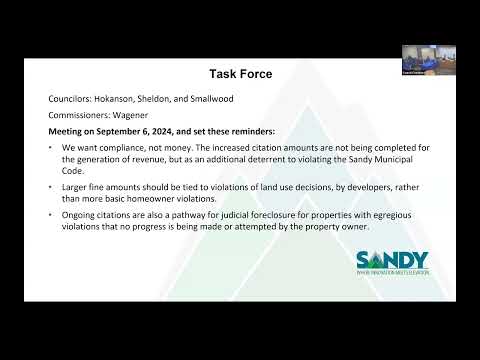
Kelly (Development Services staff) told the council the impetus for the overhaul was a recent case in which trees were cut despite a final order. She said many code chapters date to the 1970s and contain inconsistent fine amounts, which undermines deterrence. “The majority of what we’re changing here will have increased fine amounts, but the reason…is for compliance. It’s not for money or increasing revenue,” Kelly said.
Staff proposed removing Chapter 1.16 (an obsolete provision that can require trial by jury), consolidating fine schedules under Chapter 1.18, revising the business-license chapter, and updating the sign code and outdoor-burning rules. For certain irreversible violations tied to development approvals — including unauthorized removal of protected trees, hillside disturbance or wetland impacts — staff proposed a separate, higher penalty class and is exploring an escrow/deposit requirement on some projects so funds are available to remedy violations.
Councilors pressed staff to clarify remediation timelines and to avoid penalizing homeowners unfairly compared with developers. One councilor asked whether fines are per violation or escalate only on repeat offenses; staff said the draft will specify first-notice and cure periods and that repeat violations on the same property typically would escalate to the next class. Staff also acknowledged a gap in enforcement authority for outdoor burning and said the plan would bring the Fire Marshal and state DEQ into consultation.
Several council members raised concerns that raising penalties while the city does not adequately maintain its own properties could invite public backlash. Staff and council agreed to address internal maintenance funding in the next budget so city properties meet the same standards expected of residents.
Next steps: staff will bring code amendments back to council in stages, with the sign code slated for a November work session and more legally complex elements (irreversible-violation text) likely in 2025 after attorney review.
AI generated
The text on this page is AI generated. Summaries, highlights, analysis, and video transcripts are all produced from the original source material.
AI can make mistakes, so if you spot one, and we will fix it for everyone.
Note: the source content is unaltered by us. Any content source we link to, be it a video, an audio recording, or a document, is presented exactly as its publisher released it. That publisher is usually a government body, sometimes an individual official or another organisation.